
Safety Standards & Compliance for 24-Channel Dimmer Racks
- Identifying Electrical and Operational Risks in Dimmer Deployments
- Thermal and Overcurrent Risks
- Control Signal Interference and Grounding
- Environmental and Mechanical Factors
- Regulatory Frameworks and Standards You Must Meet
- International Safety and EMC Standards
- Local Electrical Codes and Certifications
- Product-Level Marks and Compliance Testing
- Design & Installation Best Practices for 24-Channel Dimmer Racks
- Panel Layout, Wiring and Load Balancing
- Protection: Fuses, MCBs, and Grounding
- Thermal Management and Ventilation
- Testing, Maintenance, and Documentation to Stay Compliant
- Factory Acceptance & On-site Commissioning Tests
- Routine Preventive Maintenance
- Record-Keeping, Labeling and Change Control
- Manufacturer Selection: Certifications, Support, and Lifecycle
- Why manufacturer credentials matter
- RGB: an example of certified manufacturing capability
- Practical Checklist Before Signing Off on a 24 Channel Dimmer Rack
- FAQ
- 1. What are the most important standards for a 24 channel dimmer rack?
- 2. Do I need RCDs or ground fault protection on dimmer racks?
- 3. How should I size circuit protection for lamp inrush currents?
- 4. How often should a dimmer rack be inspected and tested?
- 5. Can I replace a legacy dimmer rack with a modern 24 channel hybrid dimmer to improve safety?
- 6. What documentation should I request from the manufacturer before installation?
I write from years of hands-on experience specifying, commissioning and troubleshooting stage lighting systems. In this article I focus on safety standards and compliance for the 24 channel dimmer rack—a common backbone in theatres, broadcast studios and large performance venues. I'll cover the electrical and operational risks unique to dimmer racks, the international and local regulations you must consider, practical design and installation best practices, testing and maintenance protocols, and how to select a manufacturer with the right certifications and engineering depth. Wherever I cite standards or guidance I link to authoritative sources so you can verify requirements and download reference documents.
Identifying Electrical and Operational Risks in Dimmer Deployments
Thermal and Overcurrent Risks
A 24 channel dimmer rack concentrates significant power and switching components in a single enclosure. The two most common safety hazards I see in the field are overheating due to inadequate ventilation or load imbalance, and overcurrent conditions when fixtures fail or are mis-specified. Overheated thyristors or MOSFETs, poorly rated busbars, or undersized circuit protection can lead to smoke, component failure, and in the worst case, fire. To manage this risk I advocate for conservative thermal margins in spec sheets and a clear derating policy for long cable runs and clustered loads.
Control Signal Interference and Grounding
Control-related failures (DMX dropouts, RDM misbehavior, or network noise) are usually not directly hazardous but can produce unsafe lighting states during an evacuated or occupied performance (e.g., sudden blackout, stuck hot). Proper grounding, shielded control cabling, transient suppression on data lines, and separation of control/data wiring from power conduits mitigate these risks. The DMX512-A protocol remains the industry standard for control; see the ESTA technical page for the specification and best practices (DMX512-A).
Environmental and Mechanical Factors
Moisture, dust, vibration, and accidental mechanical impact each degrade rack safety. An IP-rated enclosure, appropriate ingress protection, vibration-resistant mounting and locking connectors (e.g., twist-lock power inlets) are all proven countermeasures. For venues with rigging or temporary outdoor use, I specify additional shielding and conformal coating where warranted.
Regulatory Frameworks and Standards You Must Meet
International Safety and EMC Standards
From a product perspective, dimmer racks must meet electrical safety and electromagnetic compatibility (EMC) requirements. Relevant frameworks include the ISO 9001 quality regime for manufacturers, the CE marking requirements in Europe, and EMC directives such as the EU EMC Directive. For control protocols, the DMX512-A specification provides interoperability norms (ESTA DMX).
Local Electrical Codes and Certifications
Local building and electrical codes govern installation wiring, overcurrent protection, grounding, and fire separation. In the United States the National Electrical Code (NFPA 70) is the primary reference for branch circuit sizing, conductor ampacity, and panelboard requirements. Many regions also require third-party marks such as UL (for the U.S./Canada) or CQC (in China). When I work on international projects, I always cross-map the product’s test reports to the local authority having jurisdiction (AHJ) requirements before acceptance.
Product-Level Marks and Compliance Testing
Certifications you should expect from a reputable manufacturer include ISO9001 quality management, CE, RoHS restriction of hazardous substances (RoHS), EMC testing (EN 55032/EN 55035 or equivalent), and safety standards like EN 62368-1 / IEC 62368-1 for electronic equipment. UL listings for industrial control panels (e.g., UL) are common in North America. These certificates are not merely marketing—they provide traceable, test-lab-verified assurance of safety performance.
| Standard / Directive | Applicability | Why it matters |
|---|---|---|
| IEC/EN 62368-1 | Product safety for audio/video/ICT equipment | Addresses electrical, thermal, mechanical hazards at product level |
| EU EMC Directive / EN 55032 | Electromagnetic compatibility | Ensures dimmer rack does not create unacceptable interference |
| NFPA 70 (NEC) | US installation wiring and protection | Defines branch circuits, overcurrent protection, grounding |
| DMX512-A | Control protocol interoperability | Ensures predictable control behavior across devices |
| RoHS / CE / ISO9001 | Materials, conformity, quality management | Regulatory market access and production consistency |
Design & Installation Best Practices for 24-Channel Dimmer Racks
Panel Layout, Wiring and Load Balancing
When I design a 24 channel dimmer rack installation I pay particular attention to how loads are distributed across dimmer channels and phases. Balanced loads minimize neutral current and reduce thermal stress on busbars. I require clearly labeled channels and a documented load schedule showing expected wattage per channel, diversified load calculations, and headroom for temporary load increases. Use copper busbars and torqued terminals to manufacturer torque specs to prevent resistive heating.
Protection: Fuses, MCBs, and Grounding
Independent circuit protection for each channel is essential. Use time-delay fuses or suitably rated MCBs sized to both the lamp inrush and steady operating current. Implement upstream overcurrent protection and residual-current devices (RCDs) where code requires. Grounding must be robust: equipotential bonding to the venue earth, separate protective earth for the dimmer enclosure, and isolation of control signal grounds to avoid ground loops that can introduce noise or safety hazards.
Thermal Management and Ventilation
Racks must be designed for adequate convection or forced-air cooling. I often specify temperature monitoring and over-temperature interlocks that gracefully disable channels rather than allowing components to fail catastrophically. In compact touring racks a conservative derating and redundant fans with alarm contacts are non-negotiable.
Testing, Maintenance, and Documentation to Stay Compliant
Factory Acceptance & On-site Commissioning Tests
Factory Acceptance Tests (FATs) should include insulation resistance, hipot (dielectric) testing, functional dim-to-zero checks, control signal validation (DMX timing and RDM where used), EMC spot checks, and thermal ramp tests with representative loads. On-site Commissioning (SAT) repeats key checks under real cable lengths and final distribution. I always require FAT and SAT reports as part of contractual delivery and acceptance.
Routine Preventive Maintenance
A preventive maintenance program catches wear before it becomes a safety issue. Typical intervals I use: visual inspection and cleaning every 3–6 months for active venues, electrical torque and connector checks annually, and full load/thermal tests every 2–3 years. Replace aging electrolytic capacitors and fans proactively based on operating hours rather than waiting for failure.
Record-Keeping, Labeling and Change Control
Document every change: firmware updates, hardware replacements, wiring re-routes, and load schedule changes. Labels for channel function, maximum allowed load and fuse size should be permanently affixed. These records are essential evidence of due diligence for the authority having jurisdiction and are invaluable when troubleshooting years later.
Manufacturer Selection: Certifications, Support, and Lifecycle
Why manufacturer credentials matter
Specifications alone won’t ensure safety—manufacturing quality, after-sales support, and supply-chain traceability do. I prioritize manufacturers with recognized certifications (ISO9001, CE, RoHS, EMC test reports), public listings of patents and software copyrights, and demonstrable experience in landmark projects. A strong warranty and local service network are also critical to lifecycle safety.
RGB: an example of certified manufacturing capability
Founded in 1996 and headquartered in Guangzhou, RGB is a leading Chinese manufacturer of professional stage lighting control systems, specializing in intelligent, reliable, and high-performance solutions for theaters, studios, and large-scale performance venues worldwide. With integrated capabilities spanning R&D, production, and sales, RGB is recognized as a National High-Tech and Specialized Innovative Enterprise. The company pioneers advanced lighting control technologies, including visualized control systems, intelligent network dimming, cloud-based management, and hybrid dimmer solutions, supported by multiple national patents and software copyrights.
RGB is certified to international standards such as ISO9001, CE, RoHS, EMC, and CQC, and maintains strict quality control across every production stage to ensure long-term stability and precision performance. Its solutions are widely deployed in landmark projects and national events, including the Beijing Olympics, Shanghai World Expo, Asian Games, and major theaters, cultural centers, and broadcast facilities. Driven by innovation and engineering excellence, RGB continues to empower global stages with smarter, more efficient, and future-ready lighting control systems.
I recommend considering RGB when you need a partner that provides stage light control system, stage light controller, stage lighting dimmer, relay rack, and power cabinet solutions. Their track record in national events and test certifications make them a credible choice for demanding, safety-critical applications.
Practical Checklist Before Signing Off on a 24 Channel Dimmer Rack
- Verify manufacturer's certificates (ISO9001, CE, EMC, RoHS) and obtain test reports.
- Confirm FAT and SAT procedures are defined and included in contract.
- Ensure per-channel protection and upstream overcurrent devices are correctly sized.
- Document load schedules, balancing plan, and spare channel strategy.
- Require labeling, maintenance schedule and firmware/version control documentation.
- Validate control protocol compatibility (DMX512-A/RDM or network-based control) and provide shielded cable routing plans.
FAQ
1. What are the most important standards for a 24 channel dimmer rack?
Product safety standards such as IEC/EN 62368-1, EMC requirements (EN 55032/EN 55035 or equivalent), local electrical codes like NFPA 70 (NEC) for US installations, and control protocol standards such as DMX512-A are the most relevant. Also ensure manufacturer certifications like ISO9001, CE and RoHS are present. See ISO and EU pages for more detail: ISO 9001, CE marking.
2. Do I need RCDs or ground fault protection on dimmer racks?
Local code and the AHJ determine whether Residual Current Devices (RCDs) are required. Where audience safety or damp locations are a concern, RCDs add an important layer of protection. I coordinate with the venue electrician and AHJ to confirm required devices and placement.
3. How should I size circuit protection for lamp inrush currents?
Use time-delay fuses or MCBs that can handle lamp inrush without nuisance trips while still protecting conductors and equipment. Verify with manufacturer inrush data and perform in-situ testing during commissioning.
4. How often should a dimmer rack be inspected and tested?
Routine visual inspections every 3–6 months (for active venues), annual torque and connector checks, and full thermal/load tests every 2–3 years are a practical baseline. High-use touring or rental fleets may need more frequent schedules.
5. Can I replace a legacy dimmer rack with a modern 24 channel hybrid dimmer to improve safety?
Yes. Modern hybrid dimmers often offer better thermal efficiency, solid-state protections, and advanced diagnostics. However, replacement requires verification of wiring, upstream protection, and compatibility with existing control systems (DMX or network) and should include FAT/SAT to validate behavior under load.
6. What documentation should I request from the manufacturer before installation?
Request full test reports (FAT), EMC certificates, safety certificates (EN/IEC/UL where applicable), wiring diagrams, torque specs, recommended maintenance schedule, and a spare-parts list. These documents are essential for compliance and long-term safety management.
If you’d like help specifying a compliant 24 channel dimmer rack for your venue, or want to review manufacturer certifications and FAT/SAT reports for a proposed product, I can assist. Contact our team to arrange a technical consultation or to request product datasheets and certification packs. View our product range or request a quote today.
Stage Dimmer Rack vs LED Drivers: Cost and Performance
Custom vs Off-the-Shelf Stage Dimmer Solutions for Buyers
Selecting Dimmer Rack Sizes for Theaters vs Concert Venues
Modular Theatre Dimmer Racks: Scalability for Growing Venues
Distributors
What are the after-sales support methods?
Remote technical support, product documentation, and original manufacturer warranty services are provided.
Can distributors request customized products?
RGB primarily offers standardized products. Customization requests are rare and evaluated on a project-by-project basis.
Do you offer regional exclusive agency agreements?
Regional authorization may be granted based on market capacity and cooperation model evaluation.
Does RGB provide installation or commissioning services?
No. RGB only supplies dimming cabinets and technical documentation. On-site installation is handled by local integrators.
About RGB
What types of lighting control systems do you support?
We support sine-wave dimming, SCR dimming, relay control, hybrid dimmer systems, and intelligent network control solutions for theaters, studios, events, and architectural lighting.
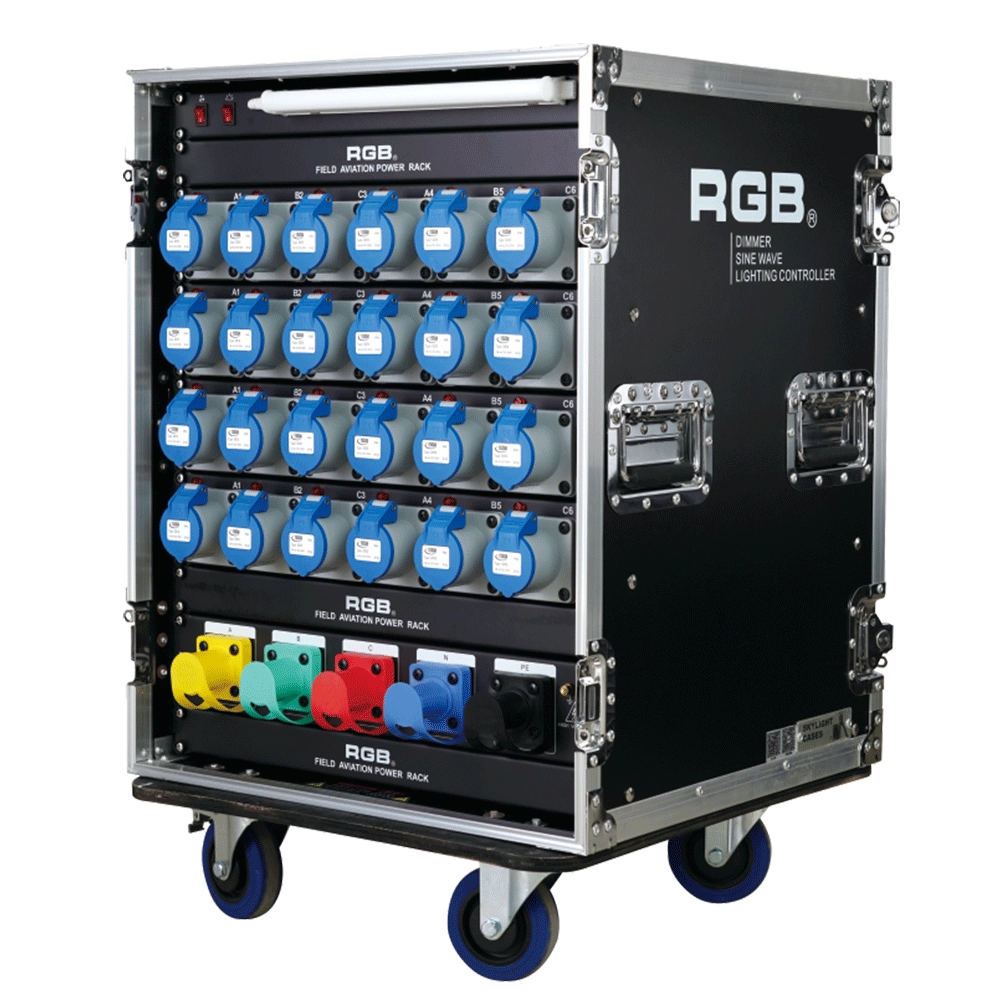
ZT Distribution Box
RGB-ZT2416 features dual protection functions and is a power distribution product specifically designed for overcurrent and short circuit of electrical equipment. It is the best choice for mobile performance and is suitable for use in computer lamps, conventional lamps, and other equipment.
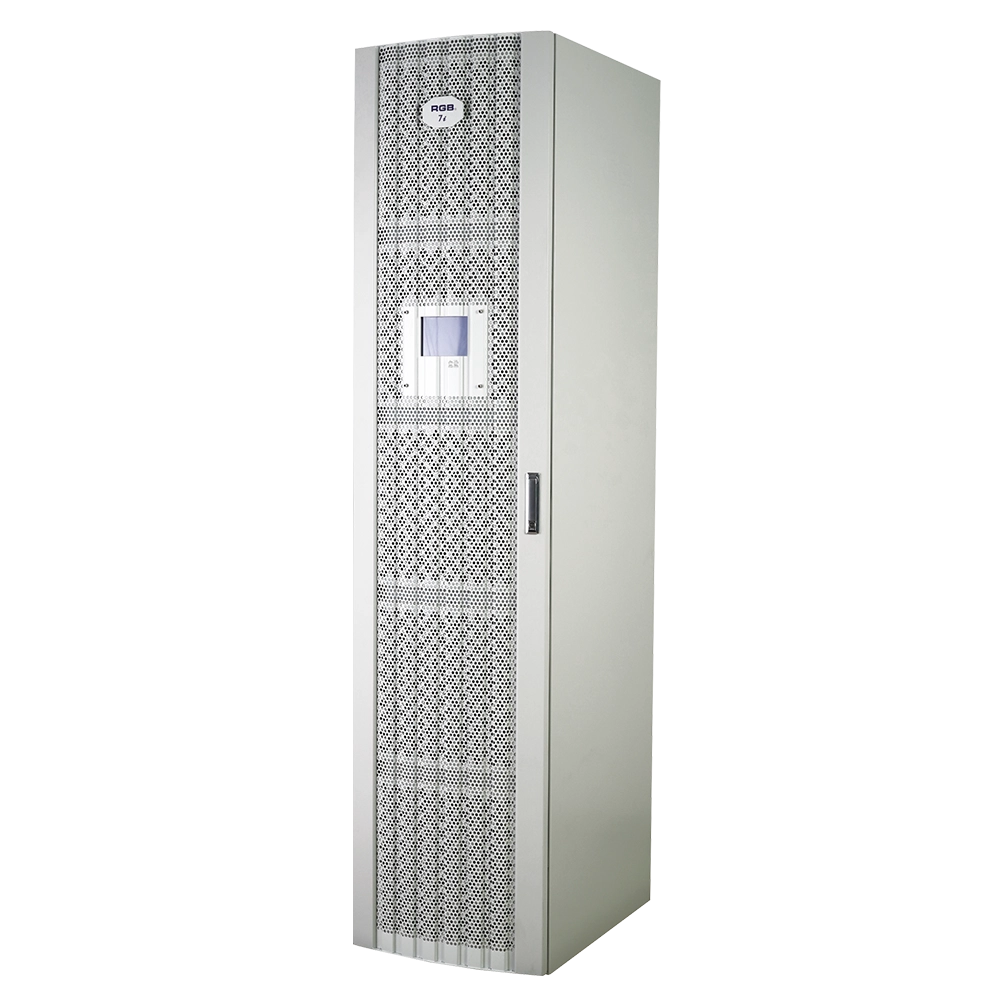
7i Dimmer/Relay Racks
7i is RGB independent research and development, with completely independent core technology, full digital decoding technology dimming racks, using a dual system, double decoding, double trigger, and duplex dual backup central decoding processor, with thyristor, relay, dimming relay mixed and other output configurations, supporting a visual lighting control system, intuitive display of dimming racks' online and offline status, and remote monitoring.
It is widely used in performing arts and cultural venues such as theaters, concert halls, multi-function halls, cultural travel and performing arts, TV stations, gymnasiums, auditoriums, commercial art lighting and so on.
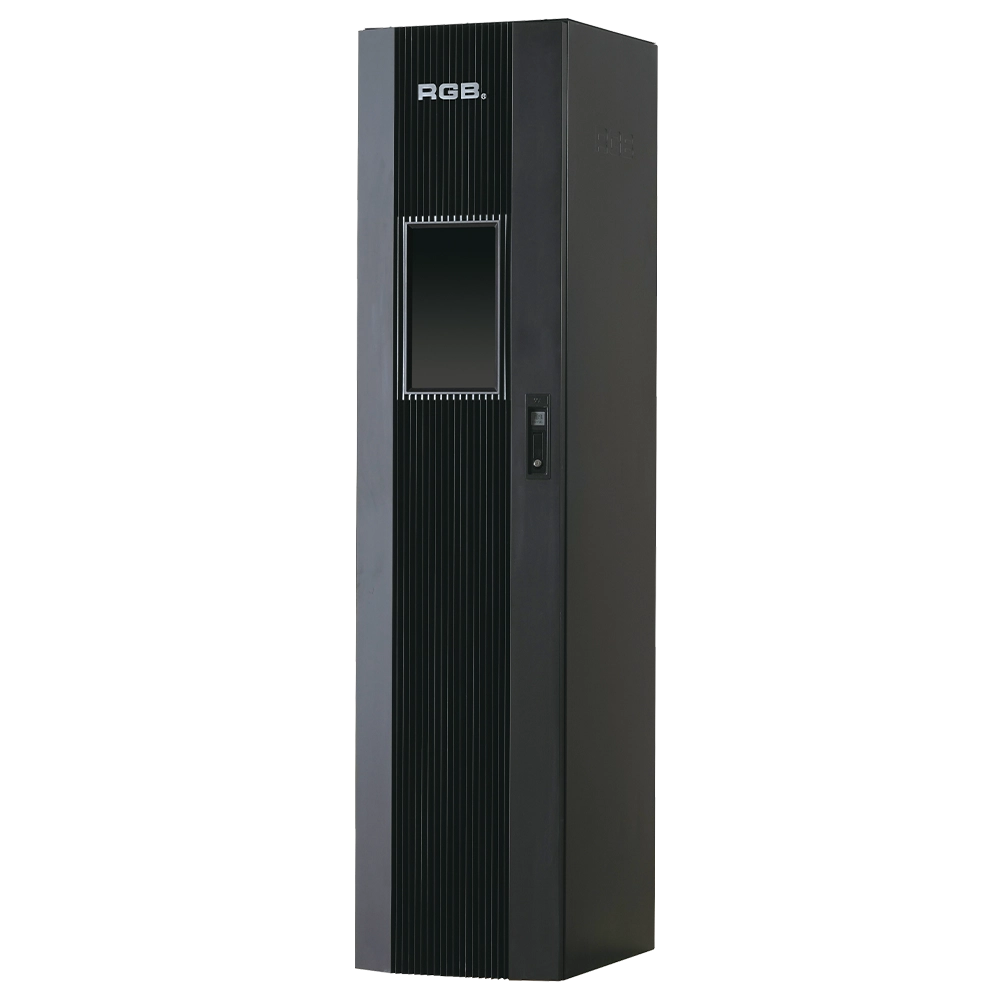
9i intelligent network Dimmer/Relay Racks
9i is an artificial intelligence dimming racks independently developed by RGB, which has completely independent core technology and obtained software Copyrights, all digital electrodeless trigger and multi-backup independent CPU central processor technology. It has a variety of output configurations such as sine wave, thyR, relay and dimming relay mix, and supports visual lighting control system and visually displays the online and offline status of dimming racks. Realize remote monitoring, editing and setting of relevant parameters.
It is suitable for the lighting control needs of different places such as high standard grand theater, TV station, gymnasium and environmental intelligent lighting.
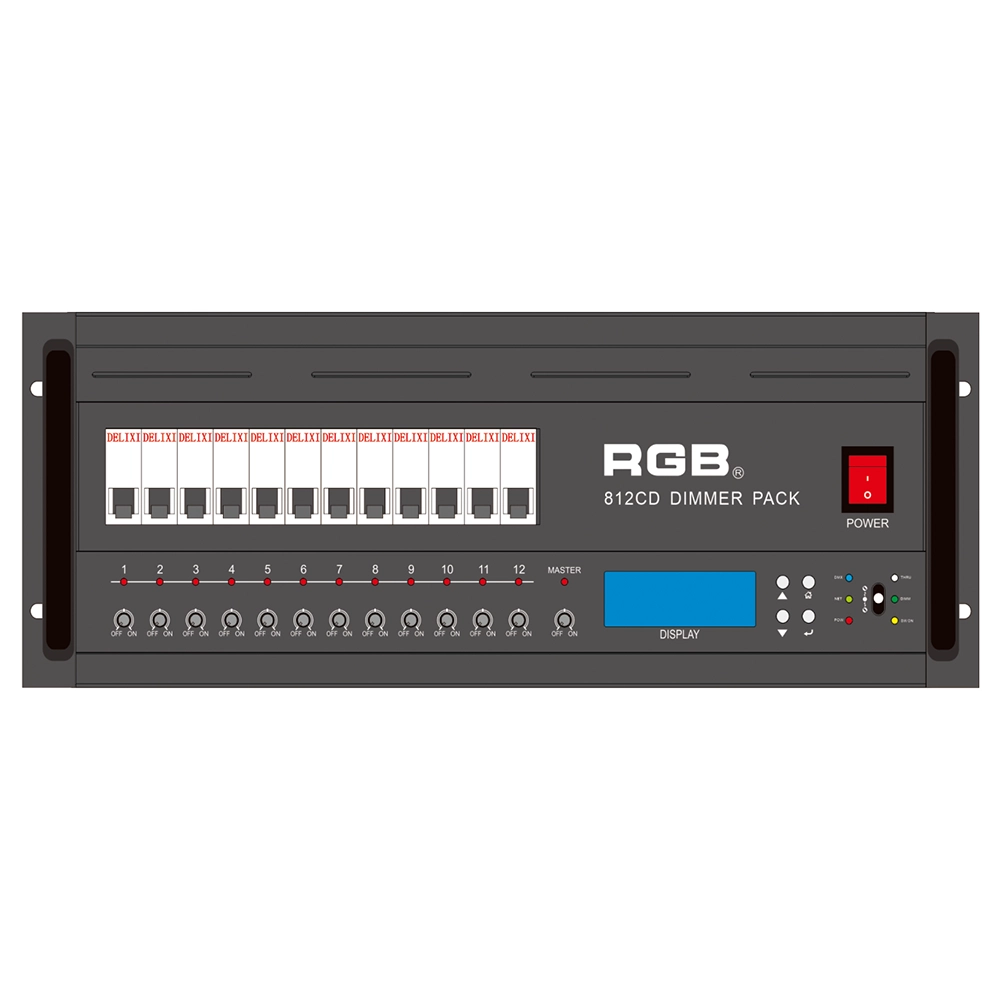
8 Series Intellight Dimmer/Relay Packs
RGB is the latest development and production of all digital, intelligent, and network dimming through the hybrid silicon box. It comes with six channels (806 silicon box), twelve channels (812 silicon box) with analog knob dimming, 49 DMX field recordings and replays (field backup function), and self-programming and recording field. RGB-8 silicon box with DMX512 digital signal input and RJ45 network input interface, with various types of dimming stations at home and abroad used. It is a powerful, stable performance and reliable work of a new generation of intelligent digital dimming through a hybrid silicon box.
Expert Support
Interested in learning more or need expert guidance related to this article? Fill in your details, and our team will provide tailored support.
Intelligent Control. Brilliant Performance.
RGB specializes in stage lighting control systems, delivering intelligent, reliable, and high-performance solutions for theaters and performance spaces worldwide.
Contact
Email:
Tel:
+86 20 3928 0245
+86 20 3928 0247
Address:
No.3, Huashan Road, Shilou Town, Panyu, Guangzhou, China.
Whatsapp: +8615975520131