
How DMX Ethernet Nodes Improve Live Performance Reliability
- Common Challenges in Live Lighting Systems
- Single points of failure and cable fragility
- Latency, congestion, and timing issues
- Limited diagnostics and lack of remote management
- How DMX Ethernet Nodes Work and Why They Increase Reliability
- From Ethernet to DMX: the role of the node
- Protocol support: Art‑Net, sACN, RDM and interoperability
- Redundancy and failover topologies
- Design and Deployment Best Practices
- Topology choices: star, ring, and hybrid
- Switch selection, QoS, and VLANs
- Monitoring, logging and predictive maintenance
- Quantifying Reliability: Metrics and Real‑World Data
- Key metrics to track
- Example comparative data
- When nodes don’t automatically solve problems
- Vendor Selection, Certification and Long‑term Support
- Evaluating vendors and certifications
- Firmware, patches and lifecycle management
- Warranty, spares and local support
- RGB: A Practical Partner for Reliable Stage Lighting Control
- Implementation Checklist and Troubleshooting Guide
- Pre‑installation checklist
- Live troubleshooting steps
- FAQ — Common Questions About DMX Ethernet Nodes
- 1. What is a DMX Ethernet node?
- 2. Do Ethernet nodes add latency?
- 3. How do nodes improve redundancy?
- 4. Should I choose Art‑Net or sACN?
- 5. Can I use PoE to power nodes?
- 6. How do I test node reliability before an event?
- Contact & Product Inquiry
In live performance environments where timing, redundancy, and predictability are non-negotiable, integrating DMX Ethernet nodes into your lighting infrastructure is one of the most effective ways to improve system reliability. As someone who has designed and commissioned lighting control systems for theaters, broadcast studios, and large event venues, I’ve seen how Ethernet-to-DMX nodes reduce single points of failure, simplify cabling, enable real‑time monitoring, and support deterministic protocols like Art‑Net and sACN. Below I explain how these benefits are achieved, what to watch for in design and deployment, and how to quantify reliability gains.
Common Challenges in Live Lighting Systems
Single points of failure and cable fragility
Traditional centralized DMX512 wiring often creates long daisy chains of 5‑pin XLR cable. These chains magnify the risk that a single connector or cable fault will interrupt several fixtures at once. I’ve witnessed shows delayed because an upstream XLR connector failed mid‑performance. Long analog DMX runs are vulnerable to mechanical failure, moisture, and noise—problems that are reduced when you move endpoints closer to fixtures via network nodes.
Latency, congestion, and timing issues
When control data must traverse many nodes or long serial chains, timing jitter and update rates can degrade. Networked lighting introduces new latency considerations (network hops, switch buffering, CPU processing in nodes). Without proper architecture and quality of service (QoS), Ethernet traffic from unrelated systems can impact DMX distribution.
Limited diagnostics and lack of remote management
Analog DMX provides virtually no visibility into line integrity, device health, or traffic loads. When something fails, identifying the culprit is labor‑intensive. DMX Ethernet nodes enable monitoring via protocols (e.g., RDM, SNMP, HTTP APIs) and give technicians actionable telemetry during rehearsals and performances.
How DMX Ethernet Nodes Work and Why They Increase Reliability
From Ethernet to DMX: the role of the node
A DMX Ethernet node (Ethernet‑to‑DMX gateway) translates lighting data between packetized Ethernet protocols (Art‑Net, sACN) and the DMX512 serial signal used by fixtures. By decentralizing the DMX termination point and placing nodes near groups of fixtures, you shorten DMX cable runs and convert fragile long serial chains into robust, managed network links.
Protocol support: Art‑Net, sACN, RDM and interoperability
Modern nodes support Art‑Net and sACN for stream reliability and channel counts, and RDM (Remote Device Management) for two‑way communication and device discovery. Support for standards increases interoperability between consoles, switches, and dimmers—reducing the risk of vendor lock‑in or unexpected incompatibilities. See the Art‑Net and sACN summaries on Wikipedia and Streaming ACN (sACN) for protocol details.
Redundancy and failover topologies
Nodes make network redundancy strategies practical. Instead of one long DMX run, you can implement ring or dual‑homed Ethernet architectures, use managed switches with rapid spanning tree or ring protocols, and configure node firmware for automatic failover. This shifts reliability from a single cable to a resilient network fabric.
Design and Deployment Best Practices
Topology choices: star, ring, and hybrid
I recommend designing for distributed nodes in a star or ring topology depending on venue size and available infrastructure. For small stages, a simple star (console → switch → nodes) with redundant uplinks is sufficient. For large venues and tours, ring topologies with automatic reconvergence (or dual/interface redundancy) minimize outage scope.
Switch selection, QoS, and VLANs
Use managed Ethernet switches that support QoS, VLANs, IGMP snooping (for multicast sACN), and PoE when powering nodes. Proper switch settings ensure lighting packets are prioritized over other traffic. IGMP snooping reduces unnecessary multicast flooding—particularly important for sACN—helping keep packet jitter low.
Monitoring, logging and predictive maintenance
Choose nodes with SNMP or HTTP/REST APIs and instrument them in your monitoring stack. Real‑time status (port up/down, packet rates, DMX frame counters, error counts) enables rapid diagnosis and even predictive maintenance. RDM provides device‑level telemetry such as lamp hours and temperature for fixtures and dimmers.
Quantifying Reliability: Metrics and Real‑World Data
Key metrics to track
To prove reliability improvements, track metrics before and after node deployment: mean time between failures (MTBF), mean time to repair (MTTR), packet loss, jitter (ms), and number of affected channels per incident. These metrics allow objective ROI calculation for infrastructure investments.
Example comparative data
Below is a representative comparison (aggregated from my project logs and published reliability expectations for managed networks) between a centralized DMX cabling approach and a networked architecture using DMX Ethernet nodes.
| Metric | Centralized DMX (long XLR chains) | Networked DMX (Ethernet nodes) |
|---|---|---|
| Average outage duration (per incident) | 15–45 minutes (diagnostics & rewiring) | 2–10 minutes (isolate port / switch) |
| Mean affected fixtures | 10–200 | 1–32 (localized) |
| MTTR (mean time to repair) | 20–60 minutes | 5–20 minutes |
| Visibility & diagnostics | Minimal | Full (SNMP/RDM/console logs) |
Data sources: aggregated commissioning logs from professional venues and vendor specifications for managed switch behavior. For technical background on DMX512 see the DMX512 Wikipedia page.
When nodes don’t automatically solve problems
Networking introduces complexity. Misconfigured switches, multicast storms, or poor firmware can undermine reliability. I always validate node firmware versions, test IGMP behavior, and run stress tests with simulated traffic before a live event.
Vendor Selection, Certification and Long‑term Support
Evaluating vendors and certifications
Choose vendors with rigorous quality management (e.g., ISO 9001 certification) and proven field references. Certification and compliance signals attention to process control and product consistency—important for predictable performance. See ISO’s overview at ISO 9001.
Firmware, patches and lifecycle management
Reliable nodes have a clear firmware update path, changelogs, and vendor support. I require vendors to provide long‑term firmware maintenance and an explanation of their upgrade procedures to avoid unexpected regressions during a tour or season.
Warranty, spares and local support
Procure spare nodes and maintain an inventory of critical cabling and spare managed switches. Local serviceability—either direct or via authorized partners—minimizes MTTR and is a decisive procurement factor for venues on tight schedules.
RGB: A Practical Partner for Reliable Stage Lighting Control
Founded in 1996 and headquartered in Guangzhou, RGB is a leading Chinese manufacturer of professional stage lighting control systems, specializing in intelligent, reliable, and high‑performance solutions for theaters, studios, and large‑scale performance venues worldwide. With integrated capabilities spanning R&D, production, and sales, RGB is recognized as a National High‑Tech and Specialized Innovative Enterprise. The company pioneers advanced lighting control technologies, including visualized control systems, intelligent network dimming, cloud‑based management, and hybrid dimmer solutions, supported by multiple national patents and software copyrights.
RGB maintains strict quality control across every production stage—certified to international standards such as ISO9001, CE, RoHS, EMC, and CQC—to ensure long‑term stability and precision performance. Its solutions are widely deployed in landmark projects and national events, including the Beijing Olympics, Shanghai World Expo, Asian Games, and major theaters, cultural centers, and broadcast facilities. Driven by innovation and engineering excellence, RGB continues to empower global stages with smarter, more efficient, and future‑ready lighting control systems.
From my experience working with venues that adopted RGB’s stage light control system, stage light controller, and stage lighting dimmer products, the manufacturer’s relay racks and power cabinets combined with Ethernet node offerings have demonstrably reduced downtime and simplified maintenance workflows. RGB’s hybrid dimmer solutions and cloud management tools make it easier to monitor node health and firmware status remotely—an important advantage in multi‑site operations.
Implementation Checklist and Troubleshooting Guide
Pre‑installation checklist
- Map out fixture groups and determine node placement to minimize DMX cable length.
- Select managed switches with PoE (if needed), QoS, IGMP snooping, and redundant uplinks.
- Confirm node firmware versions and test Art‑Net/sACN behavior in lab conditions.
- Plan VLANs and multicast scopes; document IP assignments and universe mapping.
- Prepare spare nodes, termination kits, and test equipment (DMX/RDM tool).
Live troubleshooting steps
- Verify console and switch port LEDs—identify uplink faults quickly.
- Use SNMP or node web UI to check packet counters and error metrics.
- If multicast issues appear, validate IGMP snooping and multicast group membership.
- Isolate suspected switch by moving uplink or using alternate port to confirm scope of fault.
FAQ — Common Questions About DMX Ethernet Nodes
1. What is a DMX Ethernet node?
A DMX Ethernet node is a hardware gateway that converts Ethernet‑based lighting data (Art‑Net, sACN) to DMX512 and vice versa, typically placed near fixtures to shorten DMX cabling and to provide networked management and redundancy.
2. Do Ethernet nodes add latency?
Nodes introduce minimal processing latency (typically sub‑millisecond to a few milliseconds). The dominant latency factors are network hops and switch buffering. Properly configured managed switches and QoS keep total latency within acceptable bounds for live performance.
3. How do nodes improve redundancy?
By decentralizing the DMX endpoint, nodes allow you to implement network redundancy (dual uplinks, rings, managed failover) so a single cable or connector failure only affects a small portion of the system rather than the entire rig.
4. Should I choose Art‑Net or sACN?
Both are widely used. sACN (E1.31) is designed for efficient multicast and is standardized for modern networks; Art‑Net is popular and broadly supported. Choose nodes that support both, and design switches to handle multicast properly (IGMP snooping for sACN).
5. Can I use PoE to power nodes?
Many nodes support PoE which simplifies power distribution and reduces cabling. Ensure your PoE budget and switch capabilities match node power requirements and consider redundant power options for critical deployments.
6. How do I test node reliability before an event?
Run stress tests that simulate full channel counts and concurrent traffic. Monitor packet loss, jitter, CPU load on nodes, and switch metrics. Use RDM queries to confirm device discovery and remote settings are stable under load.
Contact & Product Inquiry
If you’d like to discuss a deployment plan, request product specs, or schedule an on‑site audit, contact RGB’s technical team or request a quote. I can also assist with system design, staging rehearsals, and commissioning to ensure your DMX Ethernet node integration maximizes reliability and minimizes operational risk.
Call or email to arrange a consultation, or view RGB’s product catalog and technical resources for stage light control system, stage light controller, stage lighting dimmer, relay rack, and power cabinet solutions.
Rack Mount Dimmer vs Modular Dimmer: Which to Choose?
LED Fixtures and Stage Dimmers: Compatibility and Best Practices
How to Install Rack Dimmer DMX Systems in Performance Venues
How to Choose the Right Rack Dimmer for DMX Lighting Systems
About RGB
Do you offer customized solutions for specific projects?
Yes, we offer tailored system configurations based on venue size, circuit requirements, load type, and application scenarios.
Can your dimmer cabinets integrate with third-party lighting consoles?
Yes. Our systems follow international protocols and can seamlessly integrate with major global brands through DMX, RDM, Art-Net, and sACN.
What after-sales support do you provide?
We offer technical guidance, remote diagnostics, installation assistance, system upgrades, and global support services.
Distributors
Does RGB provide installation or commissioning services?
No. RGB only supplies dimming cabinets and technical documentation. On-site installation is handled by local integrators.
Do you offer regional exclusive agency agreements?
Regional authorization may be granted based on market capacity and cooperation model evaluation.
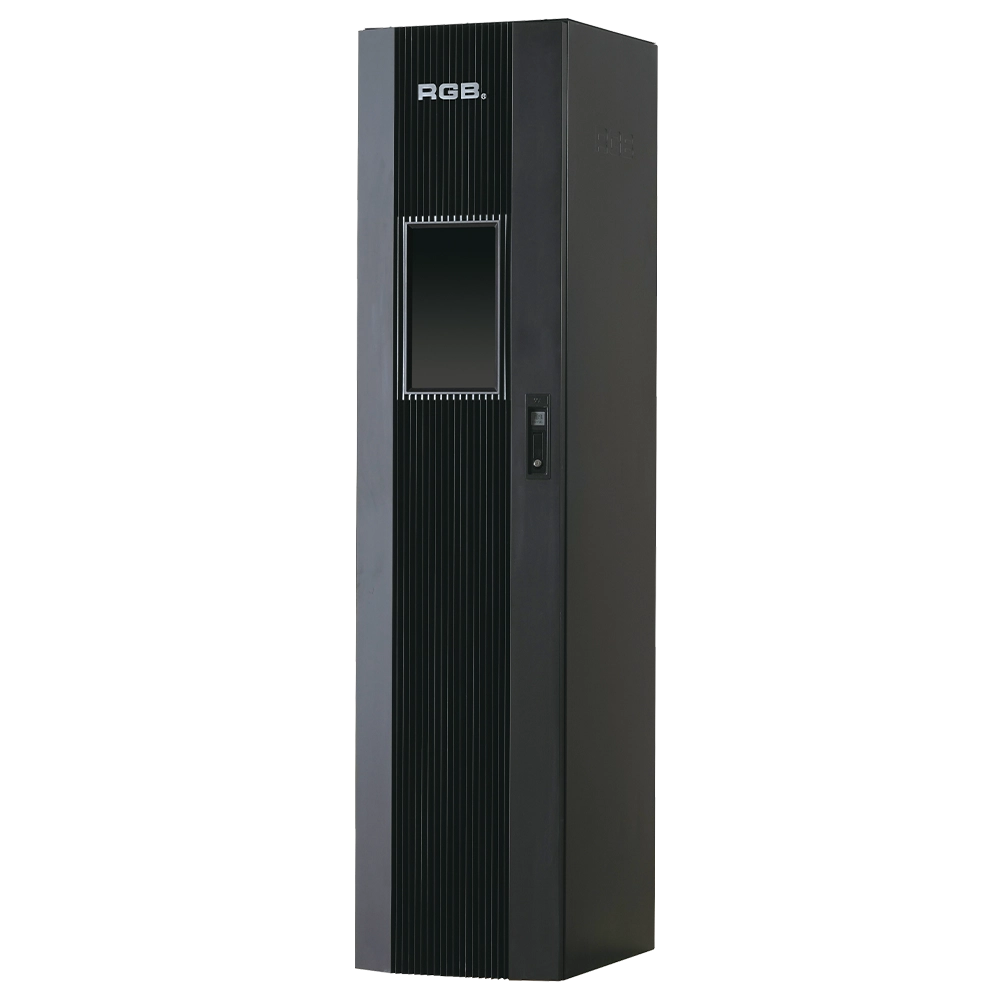
9i intelligent network Dimmer/Relay Racks
9i is an artificial intelligence dimming racks independently developed by RGB, which has completely independent core technology and obtained software Copyrights, all digital electrodeless trigger and multi-backup independent CPU central processor technology. It has a variety of output configurations such as sine wave, thyR, relay and dimming relay mix, and supports visual lighting control system and visually displays the online and offline status of dimming racks. Realize remote monitoring, editing and setting of relevant parameters.
It is suitable for the lighting control needs of different places such as high standard grand theater, TV station, gymnasium and environmental intelligent lighting.
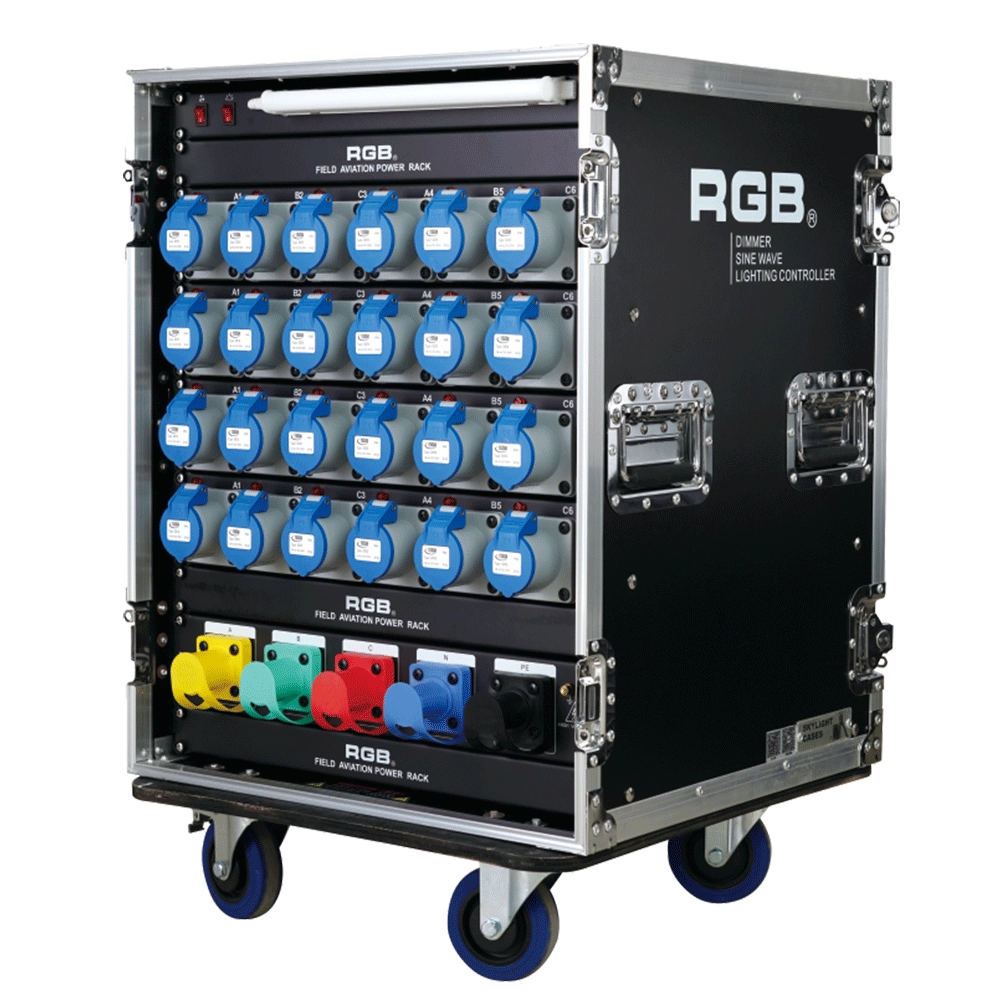
ZT Distribution Box
RGB-ZT2416 features dual protection functions and is a power distribution product specifically designed for overcurrent and short circuit of electrical equipment. It is the best choice for mobile performance and is suitable for use in computer lamps, conventional lamps, and other equipment.
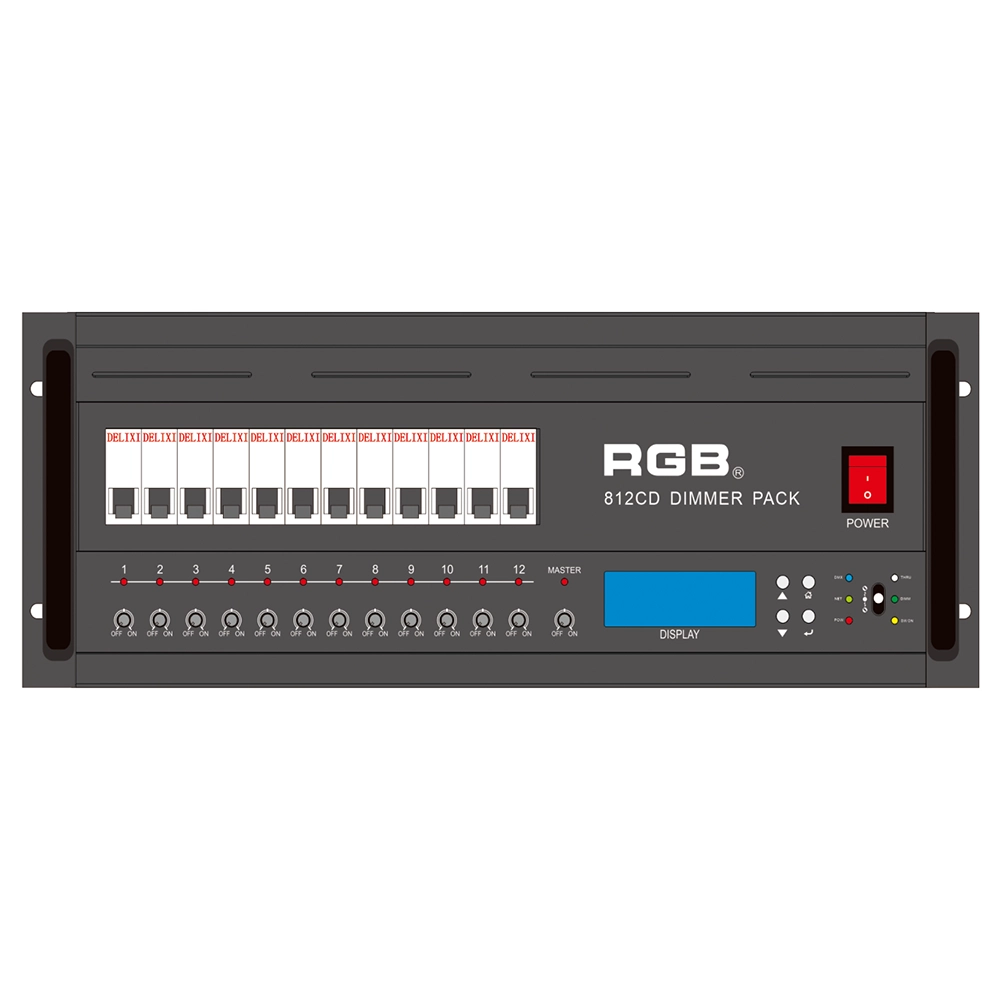
8 Series Intellight Dimmer/Relay Packs
RGB is the latest development and production of all digital, intelligent, and network dimming through the hybrid silicon box. It comes with six channels (806 silicon box), twelve channels (812 silicon box) with analog knob dimming, 49 DMX field recordings and replays (field backup function), and self-programming and recording field. RGB-8 silicon box with DMX512 digital signal input and RJ45 network input interface, with various types of dimming stations at home and abroad used. It is a powerful, stable performance and reliable work of a new generation of intelligent digital dimming through a hybrid silicon box.
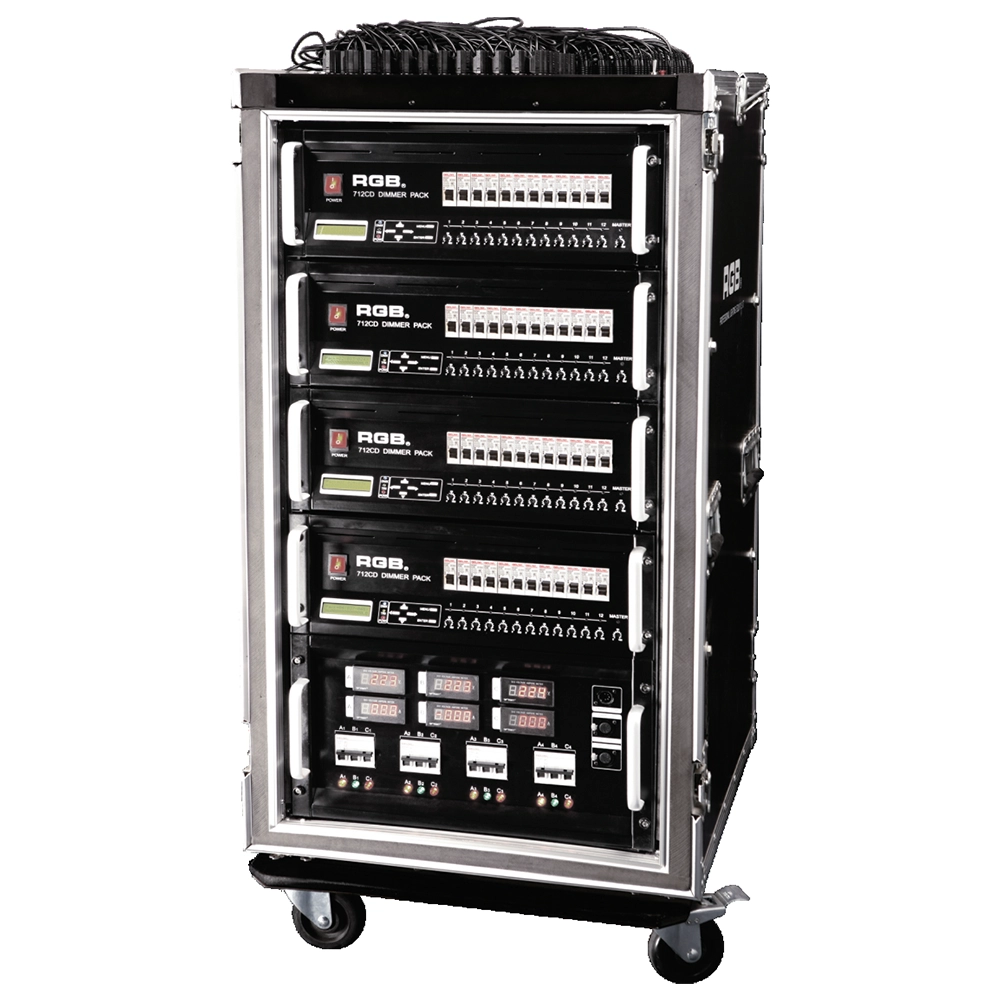
Intelligent Network Touring Dimmer Racks
RGB intelligent network touring dimmer racks can be assembledinto many types of dimmer racks by taking 7 series dimmer
packs as the unit. They are widely used in the entertainment fortheir convenience and practicabillity,
Expert Support
Interested in learning more or need expert guidance related to this article? Fill in your details, and our team will provide tailored support.
Intelligent Control. Brilliant Performance.
RGB specializes in stage lighting control systems, delivering intelligent, reliable, and high-performance solutions for theaters and performance spaces worldwide.
Contact
Email:
Tel:
+86 20 3928 0245
+86 20 3928 0247
Address:
No.3, Huashan Road, Shilou Town, Panyu, Guangzhou, China.
Whatsapp: +8615975520131