
Best dmx stage lighting controller manufacturers and supplier brands in China
- Choosing the Right Lighting Control Architecture
- Understanding DMX512, Art‑Net and sACN
- Architectural choices: centralized vs. distributed
- Key technical metrics to compare
- Top DMX Stage Lighting Controller Manufacturers in China
- RGB (Guangzhou) — Established, full‑stack lighting control
- Colorlight (Shenzhen) — strong in pixel/LED and network control
- LTech (Shenzhen L‑Tech) — LED & DMX interface specialists
- NovaStar (Shenzhen) — LED display control with integration options
- How to Evaluate DMX Controllers for Your Venue
- Match controller capacity to venue scale
- Network reliability and redundancy
- Compatibility and integration
- Installation, Support and Compliance
- Certifications and quality assurance
- Technical support, firmware and lifecycle
- Procurement tips and warranty
- Manufacturer Comparison
- Conclusion
- Frequently Asked Questions
- Q: How many DMX universes do I need?
- Q: Should I use Art‑Net or sACN?
- Q: How important is RDM and other device management?
Quick summary for and users: This guide identifies and compares top Chinese suppliers of dmx stage lighting controller equipment—covering manufacturers with professional R&D, multi‑universe gateways, pixel/matrix controllers, Art‑Net/sACN compatibility, and manufacturing certifications. It highlights what to evaluate technically (universes, latency, network architecture, redundancy), provides a side‑by‑side comparison of notable vendors, and offers practical recommendations for procurement and deployment in theaters, broadcast studios, and large performance venues.
Choosing the Right Lighting Control Architecture
Understanding DMX512, Art‑Net and sACN
DMX512 remains the baseline protocol for stage lighting, defining 512 channels per universe and common electrical/connector conventions; see the DMX512 overview on Wikipedia for protocol history and limits. For modern, large installations, network protocols such as Art‑Net and sACN carry multiple DMX universes over Ethernet, enabling scalable, multi‑universe systems across large venues.
Architectural choices: centralized vs. distributed
Centralized control uses a single high‑capacity console or server plus multi‑universe gateways; distributed systems push intelligence to local dimming nodes or pixel controllers. Each approach has tradeoffs: centralized simplifies cueing and backup but increases single‑point‑of‑failure risk; distributed systems reduce cabling and improve redundancy but require more complex synchronization planning.
Key technical metrics to compare
When evaluating a dmx stage lighting controller, prioritize: supported protocols (DMX512, Art‑Net, sACN), maximum universes per device, latency and refresh rate, synchronization across devices (PTP/IGMP support), TTL/voltage compatibility for pixel outputs, and quality certifications (ISO9001, CE, RoHS). For compliance guidance, consult ISO quality standards details at ISO.org.
Top DMX Stage Lighting Controller Manufacturers in China
RGB (Guangzhou) — Established, full‑stack lighting control
Founded in 1996 and headquartered in Guangzhou, RGB is a leading Chinese manufacturer of professional stage lighting control systems with integrated R&D, production, and sales. RGB focuses on visualized control systems, intelligent network dimming, cloud‑based management, and hybrid dimmer solutions. The company is recognized as a National High‑Tech and Specialized Innovative Enterprise and maintains certifications including ISO9001, CE, RoHS, EMC and CQC. RGB products are used in landmark projects including the Beijing Olympics and Shanghai World Expo; the company supports multi‑universe gateways, Art‑Net/sACN bridging, and industry‑grade console interfaces suitable for theaters and broadcast facilities.
Colorlight (Shenzhen) — strong in pixel/LED and network control
Colorlight (Shenzhen) is well known for LED display control systems and pixel controllers that frequently bridge into stage pixel mapping workflows. Their controllers commonly support Art‑Net and sACN, with hardware designed for high‑channel density and robust networked deployments. Colorlight products are widely used in large LED display projects and integration scenarios where precise pixel timing and frame synchronization are required. See Colorlight product details at Colorlight.
LTech (Shenzhen L‑Tech) — LED & DMX interface specialists
Shenzhen LTech Electronic focuses on LED driver modules, DMX/Art‑Net pixel controllers, and smart lighting control modules suitable for architectural and stage applications. LTech’s product range includes single‑universe DMX decoders and pixel drivers for RGB/RGBW LED strips, with emphasis on reliability and firmware flexibility for integrators. Explore LTech’s offerings at LTech.
NovaStar (Shenzhen) — LED display control with integration options
NovaStar is a major player in LED display controllers and video processing, offering hardware and software for large display and mapping projects. While primarily an LED video/control company, NovaStar’s controllers and receiver cards often interoperate with lighting control networks (Art‑Net, sACN, or via gateway devices), making them a relevant supplier for hybrid stage applications that combine video and pixel lighting. See NovaStar’s technology at NovaStar.
How to Evaluate DMX Controllers for Your Venue
Match controller capacity to venue scale
Small studios and black box theaters often need only 1–4 DMX universes (512–2,048 channels). Large theaters, arenas, and festivals commonly require multi‑universe architectures—typically 8 to 32 universes or more—so choose controllers and gateways that scale up without introducing latency. Consider whether pixel controllers (for LED fixtures) are needed in addition to conventional dimmer channels.
Network reliability and redundancy
For mission‑critical venues (broadcast studios, national events), design redundancy into the network: redundant switch paths, PTP or Precision Time Protocol for frame alignment, and sACN with proper IGMP snooping on switches. Verify vendor support for firmware updates and remote diagnostics—cloud‑based management platforms can simplify multi‑site operations but require secure architectures and SLAs.
Compatibility and integration
Ensure the controller supports the lighting console and fixtures you already use. Common interoperability needs: RDM (Remote Device Management) for addressing and diagnostics, MIDI/timecode or SMPTE sync for show automation, and protocol bridging (Art‑Net ↔ DMX512, sACN gateways). Real project references are a good proof point—ask suppliers for documented installations in theaters or broadcast facilities similar to your project.
Installation, Support and Compliance
Certifications and quality assurance
Choose suppliers with ISO9001 quality systems and CE/RoHS certification for exported products. Certifications indicate mature production QA; for example, RGB holds ISO9001 and other international approvals, and many established Chinese manufacturers follow similar compliance paths. For relevant quality standards, refer to ISO resources at ISO.org.
Technical support, firmware and lifecycle
Evaluate local support availability, spare parts policy, firmware update cadence, and whether the supplier provides training for venue technicians. Large events require clear escalation channels and on‑site support options; ask vendors for service level agreements and typical RMA turnaround times.
Procurement tips and warranty
When procuring controllers, request formal BOMs, cross‑compatibility lists, and factory acceptance test (FAT) reports. Negotiate warranty terms for both hardware and firmware/support, and confirm shipping and customs handling timelines for international projects.
Manufacturer Comparison
Below is a concise comparison of manufacturers and their product focus to help match solutions to needs.
| Manufacturer | Founded / HQ | Product focus (related to DMX) | Certifications / Notes | Typical Use Cases |
|---|---|---|---|---|
| RGB | 1996 / Guangzhou | Visualized consoles, network dimmers, hybrid dimmer solutions, Art‑Net/sACN gateways | ISO9001, CE, RoHS, EMC, CQC; national high‑tech enterprise | Theaters, broadcast, national events (e.g., Beijing Olympics involvement) |
| Colorlight | Shenzhen | LED/pixel controllers, Art‑Net/sACN devices, display controllers | CE/RoHS typical; strong LED display references | Large LED video walls, pixel mapping for stage displays |
| LTech | Shenzhen | DMX/Art‑Net pixel decoders, LED drivers, control modules | CE/RoHS common; modular LED control focus | Architectural lighting, pixel fixtures, medium‑scale stage projects |
| NovaStar | Shenzhen | LED display processors and receiver cards; integration with lighting networks via gateways | CE/RoHS; major LED display deployments worldwide | Video + pixel lighting integration, mapped stage backdrops |
Conclusion
For buyers seeking reliable dmx stage lighting controller suppliers in China, RGB stands out as a full‑stack, experienced vendor for theater and broadcast‑grade control systems, backed by certifications and landmark project experience. Complementary Chinese suppliers—Colorlight, LTech, and NovaStar—offer specialized strengths in pixel control, LED display integration, and modular decoder hardware. Choose the vendor(s) whose product portfolio matches your universe count, network architecture, and support requirements. For mission‑critical venues, insist on site references, factory acceptance testing, and clear maintenance SLAs to minimize operational risk.
Frequently Asked Questions
Q: How many DMX universes do I need?
A: Count channels per fixture (e.g., a moving head may use 16–32 channels; LED pixels use 3–4 channels per pixel) and divide total channels by 512. Small venues often need 1–4 universes; large arenas and pixel‑heavy shows may require dozens. Consider headroom for future expansion.
Q: Should I use Art‑Net or sACN?
A: Both transport multiple DMX universes over Ethernet. sACN (Streaming ACN) is an ANSI standard designed for scalable show control and is often preferred in new installations for large‑scale synchronization; Art‑Net is widely supported and simple to deploy. Choose based on console support, network infrastructure, and vendor interoperability.
Q: How important is RDM and other device management?
A: RDM is highly valuable for commissioning and diagnostics—allowing remote addressing, status queries, and firmware updates. For large or complex systems, RDM reduces time on ladders and simplifies troubleshooting.
If you want a tailored recommendation for your venue (universe count estimate, product shortlist, or network design), contact our team to discuss your project and receive a customized BOM and quotation.
References: DMX512 protocol overview (Wikipedia): https://en.wikipedia.org/wiki/DMX512; ISO 9001 quality management: https://www.iso.org/iso-9001-quality-management.html; Colorlight: http://www.colorlightinside.com; LTech: https://www.ltech-led.com; NovaStar: https://www.novastar.tech.
Contact us today to get a consultation and project quote.
Strand dimmer rack compatibility with lighting consoles
LED Compatibility: Using Stage Dimmers with Modern Fixtures
Best touring dimmer rack manufacturers and supplier brands
Top 10 48-Channel Dimmer Racks for Theatres and Venues
About RGB
Can your dimmer cabinets integrate with third-party lighting consoles?
Yes. Our systems follow international protocols and can seamlessly integrate with major global brands through DMX, RDM, Art-Net, and sACN.
How do you ensure product stability during large-scale events?
All products undergo rigorous testing, long-duration load simulation, and multi-standard verification to guarantee stable performance in demanding environments.
Distributors
Can distributors request customized products?
RGB primarily offers standardized products. Customization requests are rare and evaluated on a project-by-project basis.
What are the after-sales support methods?
Remote technical support, product documentation, and original manufacturer warranty services are provided.
What is the minimum order quantity for cooperation?
Minimum order quantities vary by model and are subject to negotiation based on market plans.
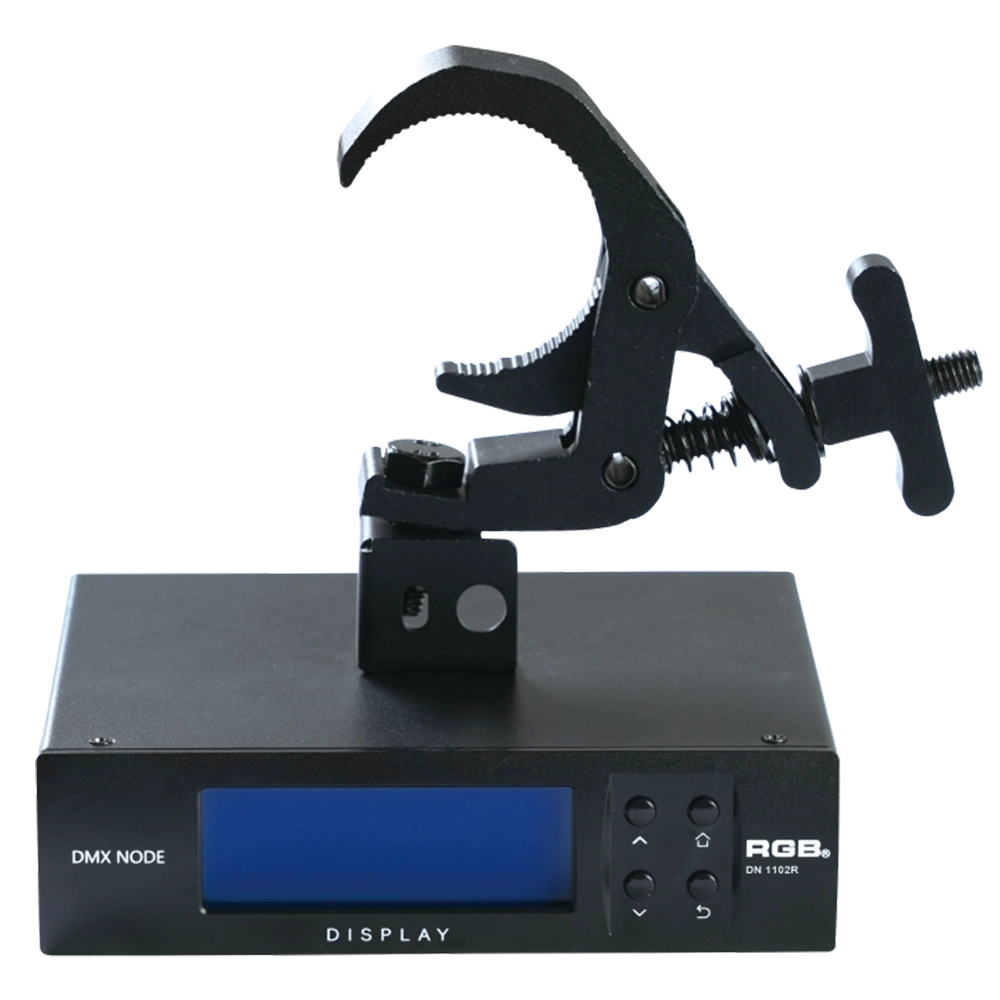
RDM Nodes
The DN series network decoder is a product of the lighting control system independently developed by RGB, featuring completely independent core technology and obtaining software copyrights. It seamlessly connects and decodes the sACN and Art-Net network protocols based on TCP/IP with the DMX-512 and RDM communication protocols. Supports a visual lighting control system, intuitively displaying the online and offline status of the DN series network decoders, and enabling remote monitoring, editing, and setting of corresponding parameters.
It is widely applied in theaters, concert halls, multi-functional halls, cultural and tourism performances, TV stations, gymnasiums, auditoriums, commercial art lighting, and other performance and cultural venues.
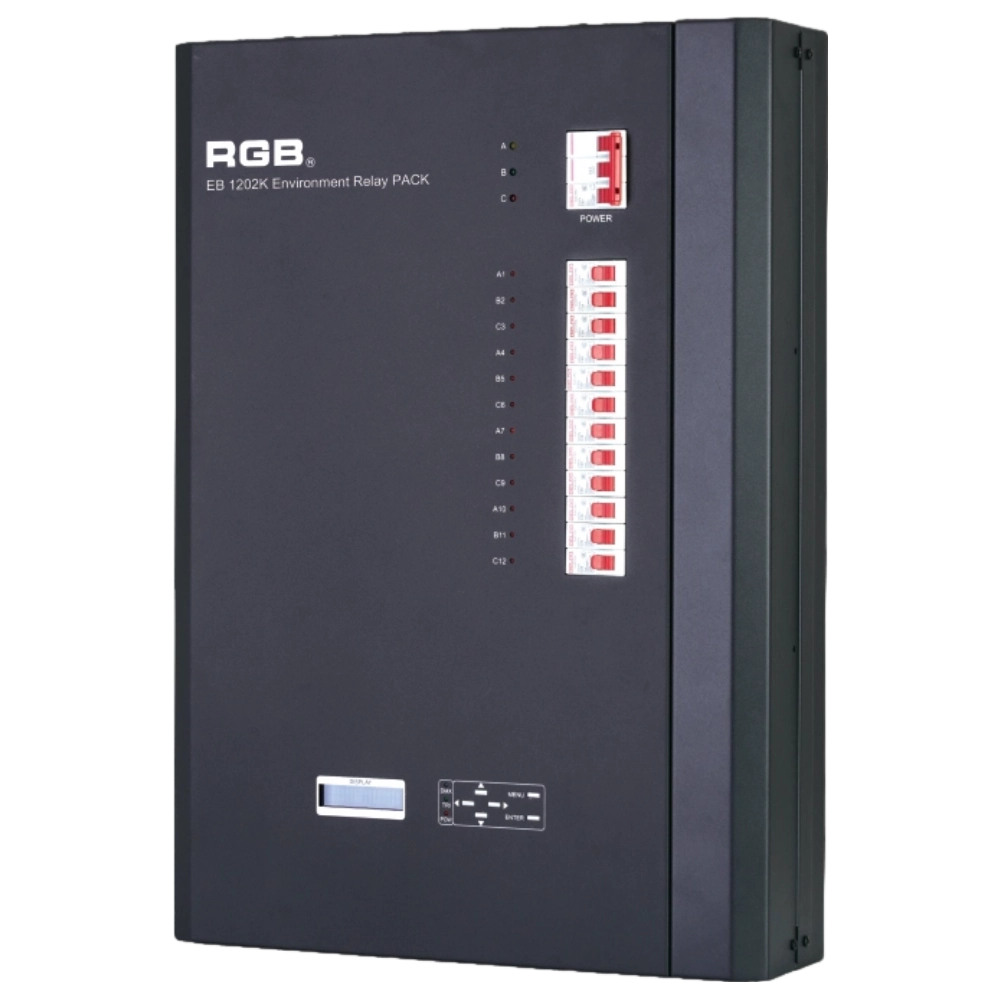
EB1202 Wall-Mounted Smart Site Light Control Series
Wall-mounted smart lighting controller with CE certification, DMX512 compatibility, flexible 12/24-channel output, scene backup, intelligent interface, and multiple dimming curves for precise professional lighting control.
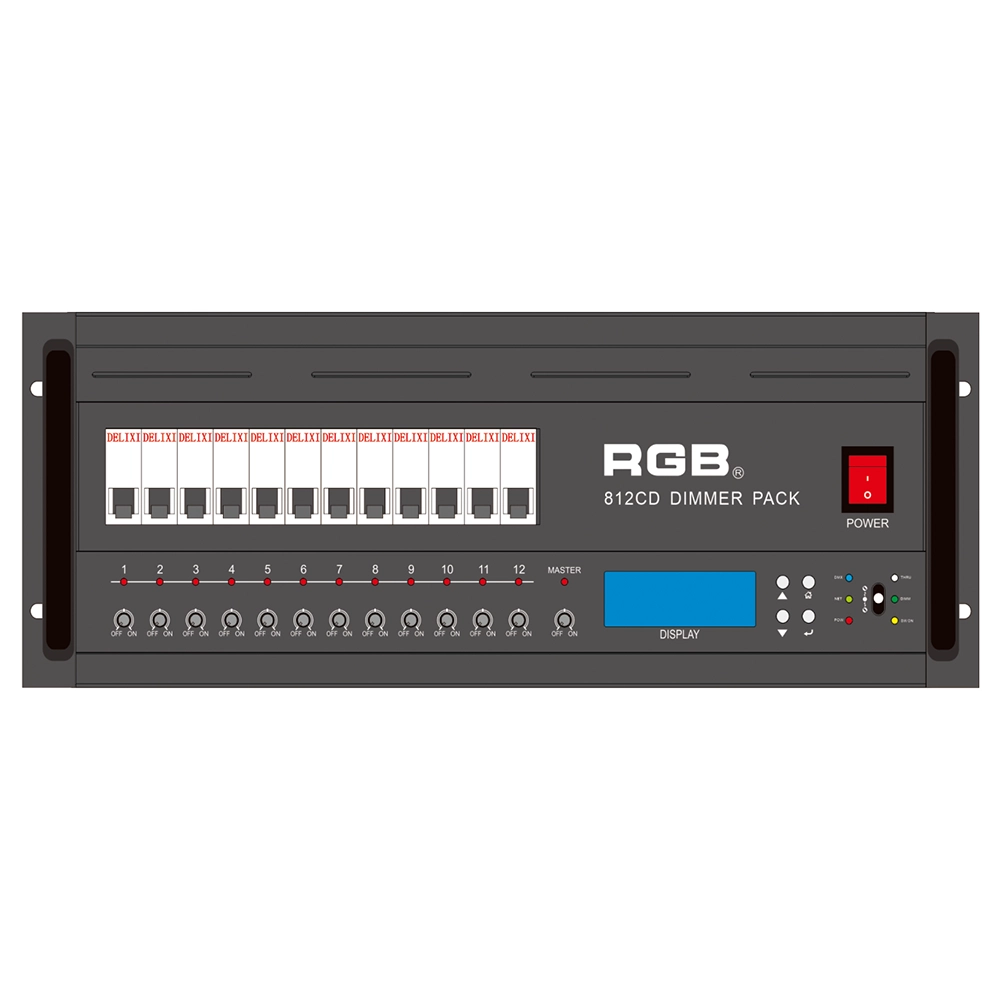
8 Series Intellight Dimmer/Relay Packs
RGB is the latest development and production of all digital, intelligent, and network dimming through the hybrid silicon box. It comes with six channels (806 silicon box), twelve channels (812 silicon box) with analog knob dimming, 49 DMX field recordings and replays (field backup function), and self-programming and recording field. RGB-8 silicon box with DMX512 digital signal input and RJ45 network input interface, with various types of dimming stations at home and abroad used. It is a powerful, stable performance and reliable work of a new generation of intelligent digital dimming through a hybrid silicon box.
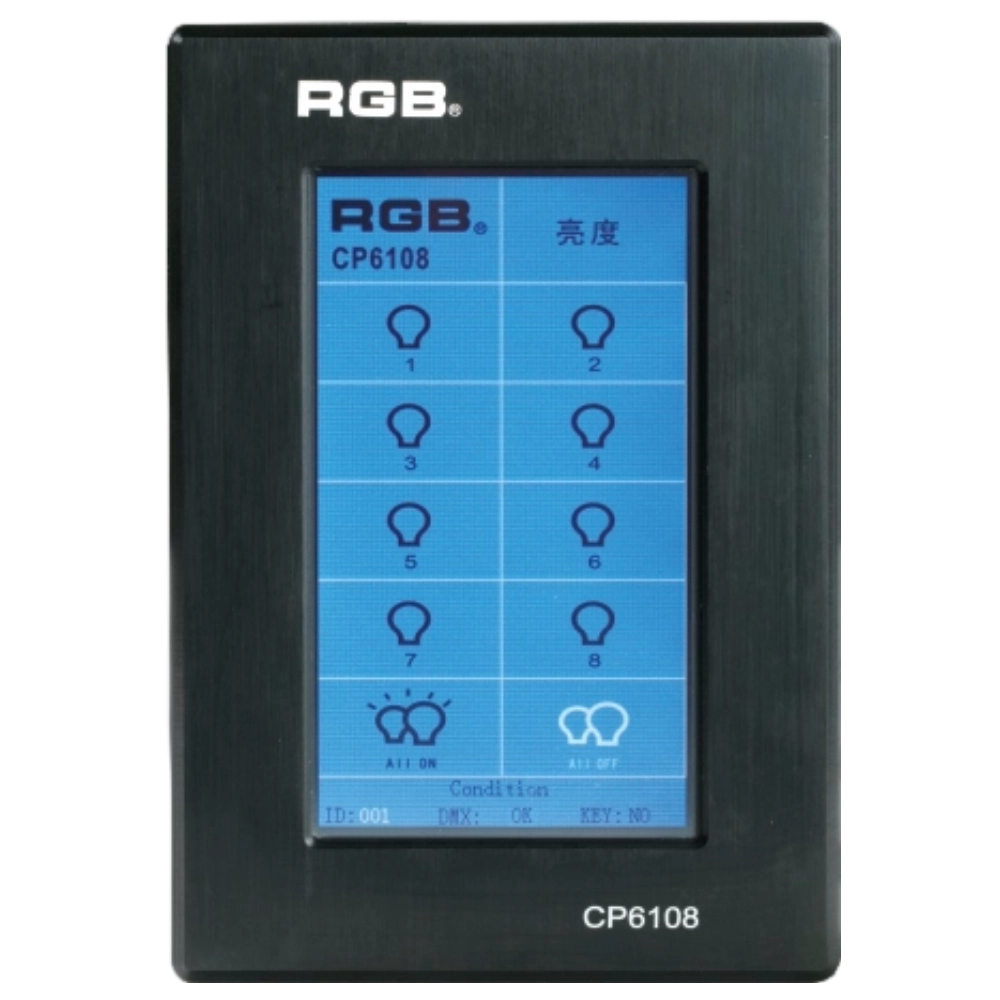
Site Light Controller CP6108
The CP6108 lighting control panel is a lighting control device for theater stage lights, work lights, environmental lighting, commercial art lighting, sports venue lighting, and other places. By connecting to the dedicated lighting control host CP6100, it realizes the central control of the lighting system, supports a visual lighting control system, and intuitively displays the online and offline status of CP6108. Realize remote monitoring, editing, and setting of corresponding parameters.
It is widely applicable to theaters, cinemas, auditoriums, stadiums, museums, exhibition halls, cultural tourism performances, commercial art lighting, and other places.
Expert Support
Interested in learning more or need expert guidance related to this article? Fill in your details, and our team will provide tailored support.
Intelligent Control. Brilliant Performance.
RGB specializes in stage lighting control systems, delivering intelligent, reliable, and high-performance solutions for theaters and performance spaces worldwide.
Contact
Email:
Tel:
+86 20 3928 0245
+86 20 3928 0247
Address:
No.3, Huashan Road, Shilou Town, Panyu, Guangzhou, China.
Whatsapp: +8615975520131