
The Ultimate Guide to Digital Dimmer Packs: DMX Control and Analog vs. Digital Explained
|
- Introduction
- What is a digital dimmer pack?
- How does a DMX dimmer pack work?
- What is the difference between an analog and a digital dimmer pack?
- Can you use LED lights with a digital dimmer pack?
- How do you connect a digital dimmer pack to a DMX controller?
- How do you set the DMX address on a dimmer pack?
- What are the common applications of a digital dimmer pack?
- Conclusion
- Call to Action
Introduction
Lighting has the profound ability to shape the atmosphere of any venue, transforming a blank stage into a dynamic visual experience. However, the true magic of a professional production does not just come from the lights themselves, but from the sophisticated systems used to control them. At the heart of this infrastructure is the digital dimmer pack.
Whether you are designing a complex theatrical rig or setting up a portable system for a touring band, understanding how to regulate your power output is critical. This comprehensive guide will explore the essential components of digital dimmer packs, how they integrate with DMX systems, and the crucial differences between modern and legacy lighting control.
What is a digital dimmer pack?
A digital dimmer pack is a specialized piece of electrical equipment designed to regulate the voltage supplied to conventional lighting fixtures. Instead of simply turning a light on or off, it allows operators to incrementally adjust the intensity of the light from 0% to 100%, giving lighting designers total control over the mood and visibility of a scene.
Unlike traditional wall switches that manage a single domestic circuit, these robust devices are built for high-capacity, multi-circuit professional environments. According to Wikipedia, modern professional dimmers use semiconductor technology and are generally controlled by digital networks like DMX to safely and efficiently reduce light output. This solid-state engineering ensures smooth fades and consistent performance without the excessive heat buildup found in older resistance-based systems.
In professional event production, you will typically encounter these devices structured as a channel dimming system. A single unit might contain 4, 6, 12, or even 24 independent channels, each capable of powering and dimming one or more lighting fixtures simultaneously. By centralizing the power distribution into these packs, operators can manage massive lighting rigs directly from a central control booth.
How does a DMX dimmer pack work?
A DMX dimmer pack functions by receiving a multiplexed digital signal from a lighting console and translating that data into specific electrical power outputs. Developed in 1986 by the United States Institute for Theatre Technology, the DMX512 protocol is the undisputed global standard for digital communication networks used to control stage lighting and special effects.
When a lighting operator moves a fader on their console, the board broadcasts a continuous stream of data across a "DMX universe"—a single data link containing 512 discrete channels of information. The dimmer pack constantly listens to this entire stream. If the pack is specifically assigned to channels 1 through 4, its internal microprocessor pulls only the data tagged for those specific channels and ignores the remaining 508.
Once the microprocessor reads the intended intensity level (represented by a digital value between 0 and 255), it instructs internal power components—typically TRIACs or Silicon Controlled Rectifiers (SCRs)—to alter the AC voltage waveform. By rapidly chopping the power wave before it reaches the fixture (a process known as phase-control dimming), the pack precisely dictates the brightness of the connected lamp without causing unwanted flickering.
What is the difference between an analog and a digital dimmer pack?
The primary difference between an analog and a digital dimmer pack lies in how they receive and process control signals. In an older analog system, control is achieved using low-voltage DC signals, typically ranging from 0 to 10 volts. A 10V signal tells the pack to output full brightness, while 0V triggers a total blackout.
Because of this analog methodology, each individual channel on the dimmer pack requires its own dedicated physical wire running all the way from the lighting console. If you were operating a modest 24-channel analog system, you needed a massive, heavy multiconductor cable with at least 25 individual wires (one for each channel, plus a common ground). Troubleshooting a broken wire in these massive snakes was a notorious nightmare for stagehands and technicians.
Digital dimmer packs revolutionized the industry by utilizing multiplexing technology. Instead of one wire per channel, a digital system uses a single lightweight cable to transmit data for up to 512 channels simultaneously. This transition offers several major advantages over analog:
- Reduced Cabling: A single DMX cable replaces massive, heavy analog snakes, drastically cutting down installation time.
- Enhanced Precision: Digital signals do not suffer from voltage drop over long distances, ensuring exact intensity matching across all fixtures.
- Advanced Diagnostics: Modern digital packs provide error reporting, custom programmable dimming curves, and onboard testing sequences directly on the unit.
Can you use LED lights with a digital dimmer pack?
Using LED lights with a traditional digital dimmer pack is a nuanced issue that frequently confuses newcomers to stage lighting control. Standard digital dimmer packs are engineered primarily for resistive loads, such as conventional incandescent or halogen lighting fixtures. They achieve their dimming effect by physically slicing the AC voltage waveform, which works perfectly for a heated tungsten filament.
However, most modern LED fixtures contain complex internal drivers that require a constant, unadulterated power supply. If you plug a standard stage LED into a traditional phase-cut digital dimmer pack and attempt to dim it from your console, you will experience severe flickering, unpredictable strobing, or complete fixture failure. In many cases, feeding "dirty" or chopped power into an LED will permanently fry the fixture's internal circuitry.
To control modern LED fixtures properly, you typically bypass the traditional dimmer pack entirely. Professional LEDs have their own built-in decoders and native dimming capabilities. The standard workflow is simple:
- Direct Power: Supply the LED fixtures with constant, non-dimmed wall or relay power.
- Direct Data: Run your DMX data cable directly into the fixture's input.
- Internal Processing: Let the LED's internal computer handle the brightness and color mixing locally based on the DMX signal.
There is one notable exception to this rule: if you are using specific retrofit "dimmable" LED bulbs (like those used in modern chandeliers or practical stage props), you can occasionally use them with a pack. However, you must ensure you are using a specialized forward-phase or reverse-phase digital dimmer explicitly rated for LED loads to prevent flickering and ensure a smooth dimming curve.
How do you connect a digital dimmer pack to a DMX controller?
Connecting your equipment relies on a specific networking structure known as a daisy chain topology. Unlike home computer networks that use a central router or star configuration, DMX devices must be linked sequentially in a single, continuous line to ensure the data packet reaches every device intact.
To establish a proper connection, follow these fundamental steps:
- Start at the Console: Run a dedicated 120-ohm shielded DMX cable (typically with a 3-pin or 5-pin XLR connector) from the DMX OUT port on your lighting controller.
- Enter the Pack: Connect the other end of that cable into the DMX IN port of your first digital dimmer pack.
- Continue the Chain: If your rig requires more capacity, link subsequent packs by connecting a new cable from the DMX OUT (or DMX THRU) port of the first unit to the DMX IN port of the next unit.
Finally, to ensure absolute signal integrity and prevent data reflections that cause erratic fixture behavior, you must secure the end of the line. This is done by plugging a DMX terminator (a specialized connector housing a 120-ohm resistor bridging pins 2 and 3) into the final open output port of the last device in your daisy chain.
How do you set the DMX address on a dimmer pack?
Setting the DMX address is the process of telling your digital dimmer pack which specific channel data it should respond to within the 512-channel universe. Because the DMX controller broadcasts all 512 channels continuously across the daisy chain topology, the pack needs a definitive starting reference point to pull the correct instructions.
On modern equipment, this addressing process is highly intuitive. Most digital dimmer packs feature a backlit LCD or LED screen alongside a simple four-button menu system (usually labeled Menu, Up, Down, and Enter). You navigate to the addressing mode and use the arrows to select your starting channel. For instance, if you set a 4-channel pack to Address 001, it will automatically control its outputs via channels 1, 2, 3, and 4.
To avoid overlapping signals and misbehaving lights, the next device in your chain must be addressed logically. Following the previous example, the second 4-channel pack must be set to Address 005 (controlling channels 5, 6, 7, and 8). It is worth noting that older or budget-friendly dimmer packs might use an array of small physical DIP switches instead of a digital screen. Addressing these legacy units requires basic binary math—flipping a specific combination of switches to equal the desired starting channel—but the underlying logic remains identical.
What are the common applications of a digital dimmer pack?
The most prominent application for a digital dimmer pack is in traditional theatrical and stage lighting control. Many performing arts venues still rely heavily on incandescent par cans, ellipsoidal reflectors (Lekos), and Fresnel fixtures to create warm, natural skin tones on stage. Dimmer packs serve as the hidden workhorses that allow board operators to execute dramatic blackouts and subtle atmospheric shifts during a live performance.
Beyond live entertainment, they are widely utilized in permanent architectural and commercial lighting installations. Large venues such as museums, art galleries, and houses of worship use high-capacity, rack-mounted dimmer packs to manage house lights and intricate accent lighting. These systems are frequently integrated with automated timers or architectural wall panels to adjust the room's ambiance seamlessly throughout the day.
Finally, film and television studios rely heavily on premium digital dimmers. Because modern digital camera sensors are incredibly sensitive to light fluctuations, studios require high-end dimmer packs that offer advanced dimming curves and absolutely flicker-free operation. Similarly, mobile entertainers and event production companies use portable "shoebox" style packs to easily run automated chase sequences, bringing high-energy, synchronized lighting to temporary event spaces.
Conclusion
Digital dimmer packs have fundamentally revolutionized the way production professionals manage their visual environments. By replacing heavy, cumbersome analog wiring with streamlined digital multiplexing, these devices have made large-scale stage lighting control more accessible, precise, and reliable than ever before.
While the lighting industry continues to aggressively adopt intelligent LED technology, the traditional dimmer pack remains an absolute necessity for integrating conventional lighting fixtures into modern rigs. Whether you are illuminating a high-school drama production, outfitting a massive commercial venue, or touring with a band, mastering your channel dimming system ensures you retain total creative command over your production.
Call to Action
If you are ready to upgrade your lighting system or need expert advice on selecting the perfect digital dimmer pack for your venue, contact us today for a free consultation!
Latest News
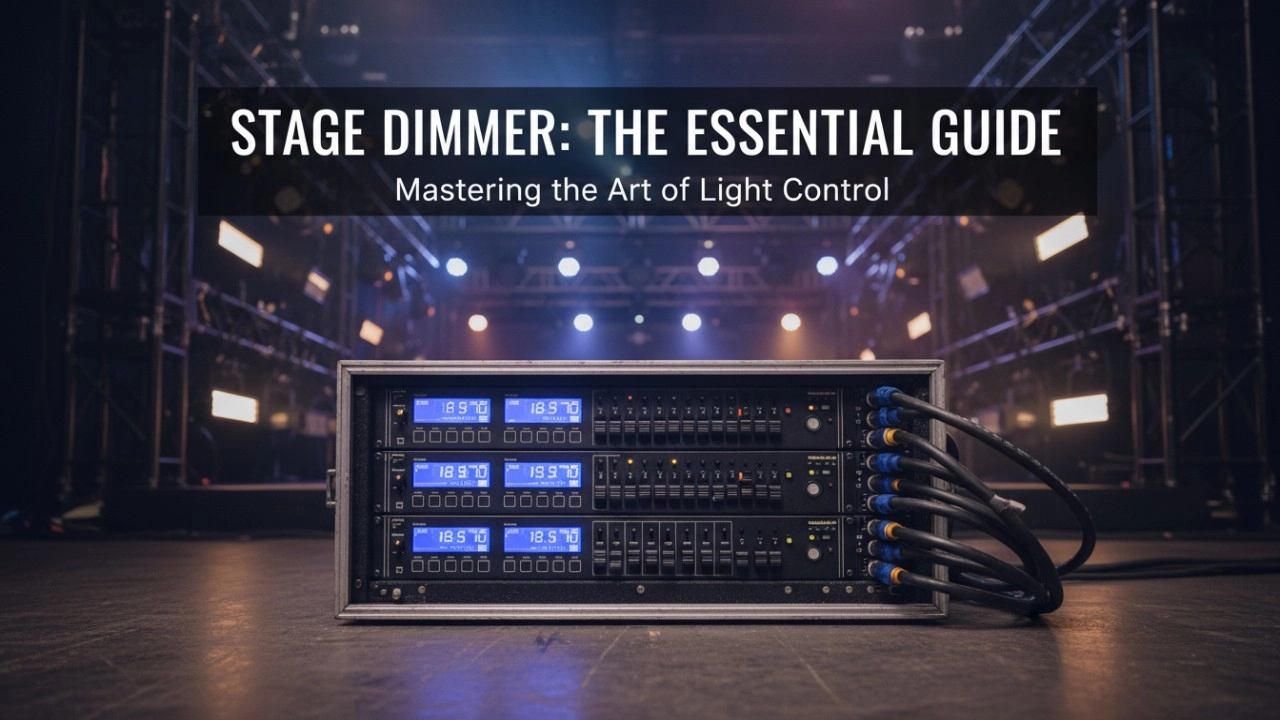
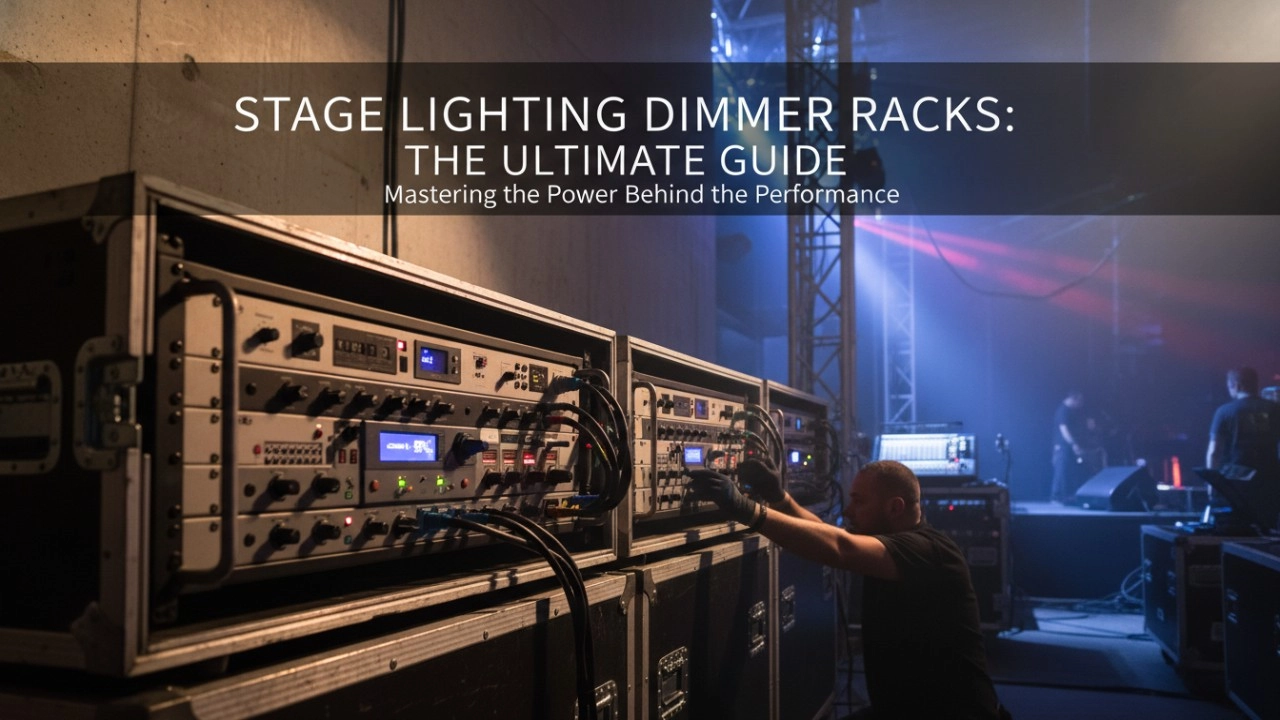
A comprehensive 2026 guide to selecting high-performance stage lighting dimmer racks. We review top hybrid systems, explore SCR vs sine wave technology, and analyze essential features like ThruPower for modern venues.
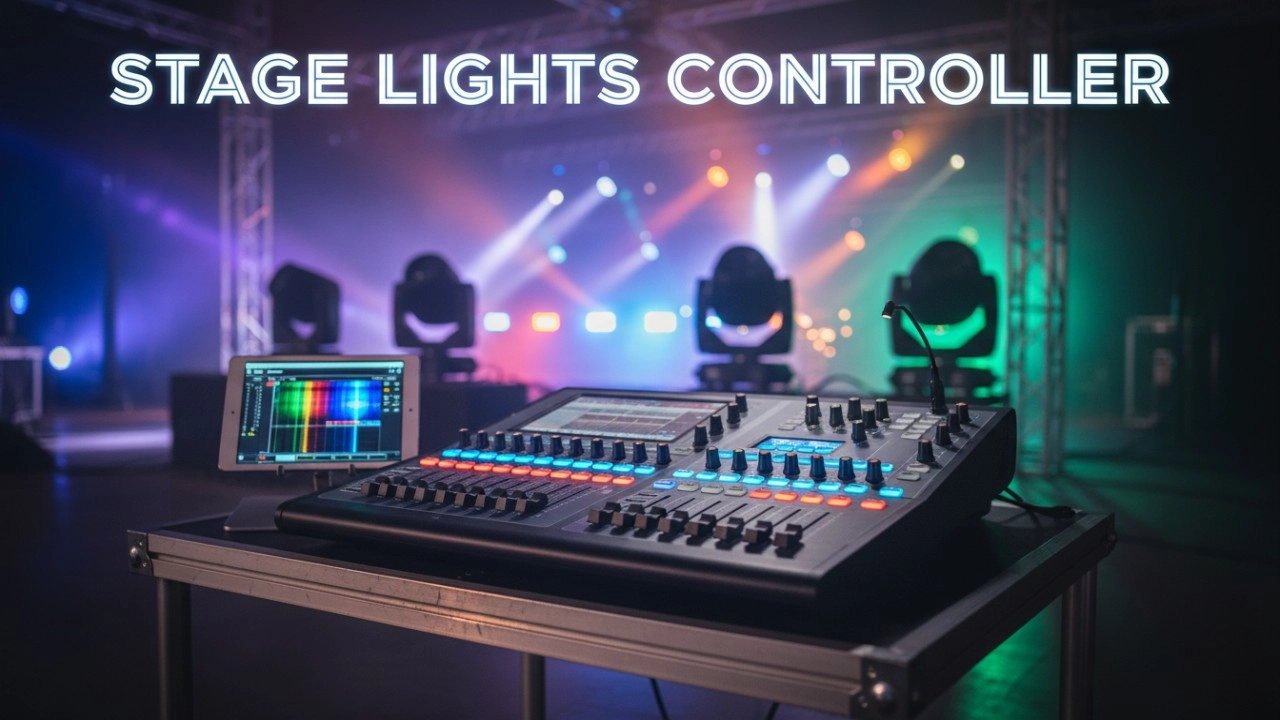
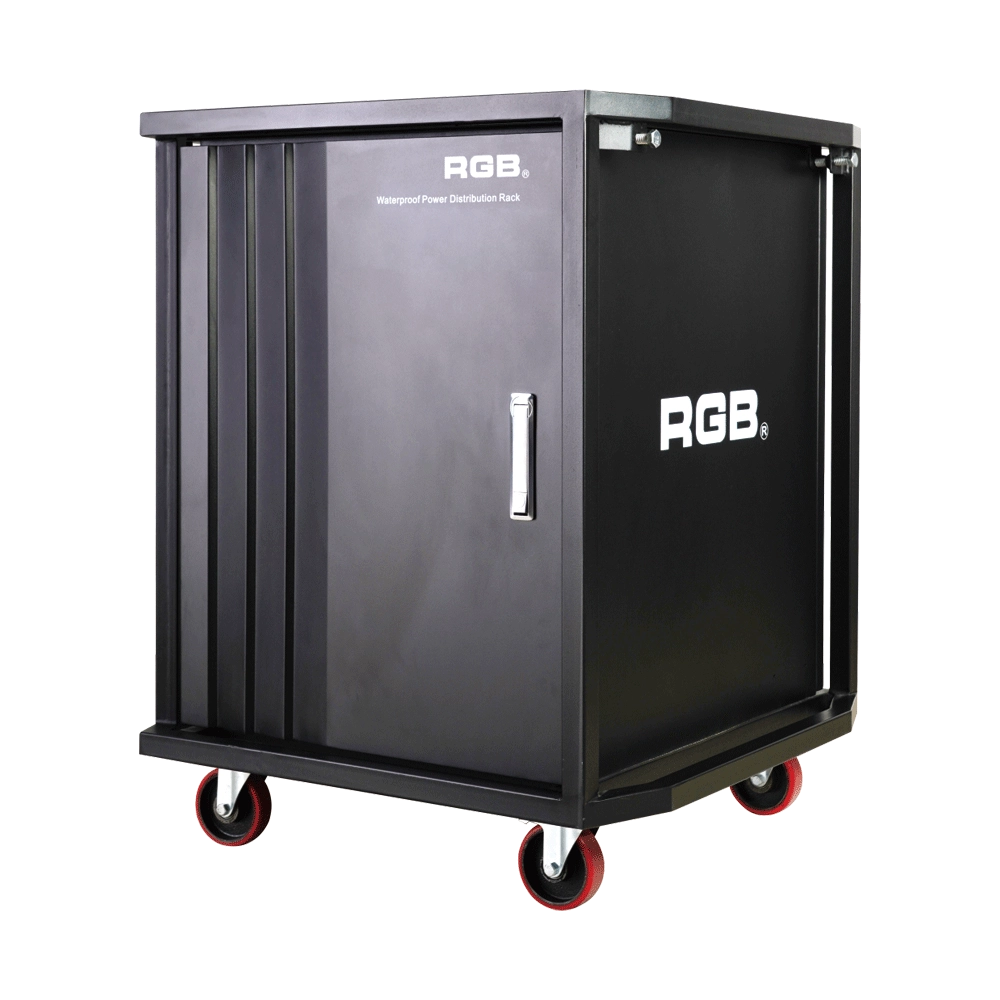
Multifunction Waterproofing Racks Of RGB-W Series
With the continuous development of flow performance, the requirement for performance is more demanding. In order to facilitate the transportation and make it easier to carry for all the equipment used in the performance, the stage light and sound equipment will be installed into a cabinet, for example, the power supply system. During the transportation process, it is inevitable for a collision or crash to take place. If the cabinet material is not strong enough, it may lead to deformation and even damage the equipment inside. Moreover, most of the existing cabinets are not waterproof. It will be very dangerous for the flow performance, as it is normal and inevitable to encounter rainy days. As the equipment inside the cabinets is electriferous, it might cause damage to the electronic equipment at least and even cause casualties at worst. Meanwhile, most of the existing cabinets can only be installed with one kind of equipment with a single variety.
In order to overcome the above-mentioned technical flaw, the RGB company has developed a new type of waterproofing multifunction cabinet of the W series. The waterproofing cabinet of the W series meets the need for the installation of dimming and tone-tuning devices, transportation, and utilization.
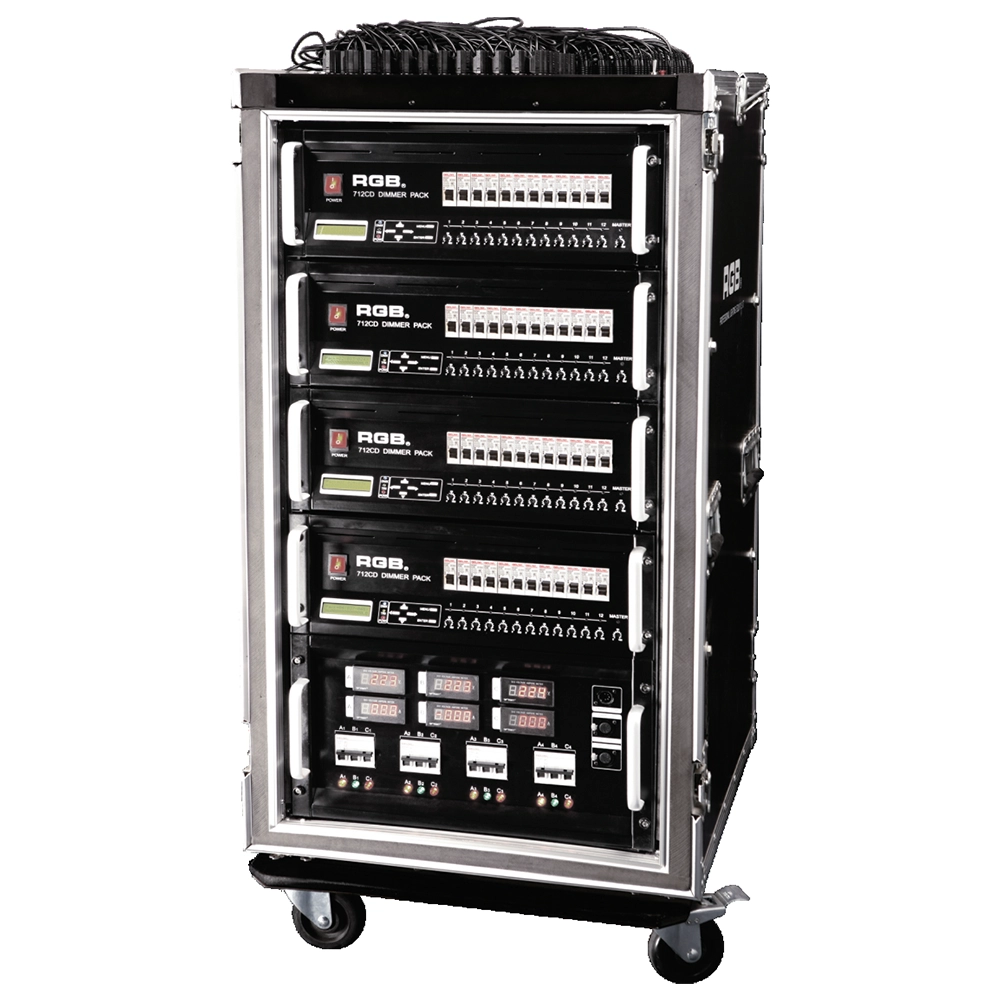
Intelligent Network Touring Dimmer Racks
RGB intelligent network touring dimmer racks can be assembledinto many types of dimmer racks by taking 7 series dimmer
packs as the unit. They are widely used in the entertainment fortheir convenience and practicabillity,
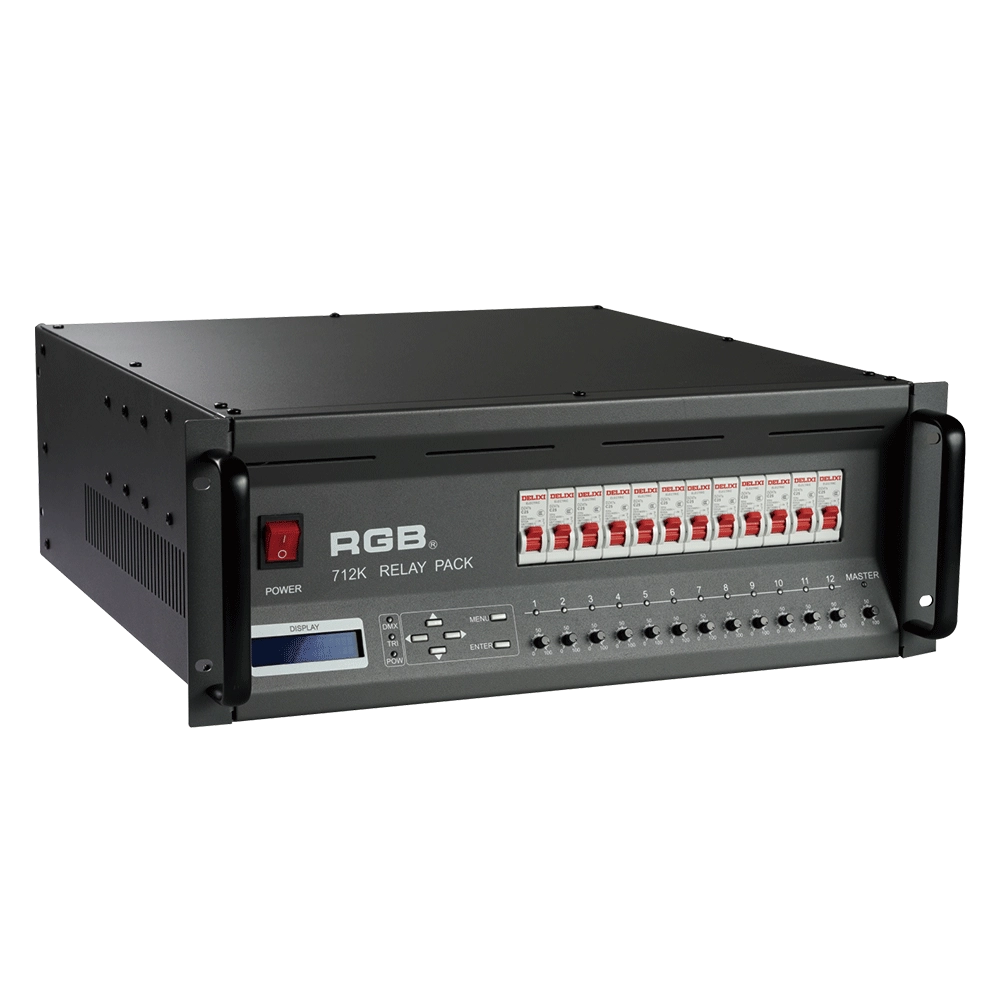
Alloy Relay Packs
High-performance DMX512 relay dimming unit with 512 addressable circuits, phase-loss protection, dual-signal amplification, 20A output per channel, and robust design for reliable stage and mobile lighting applications.
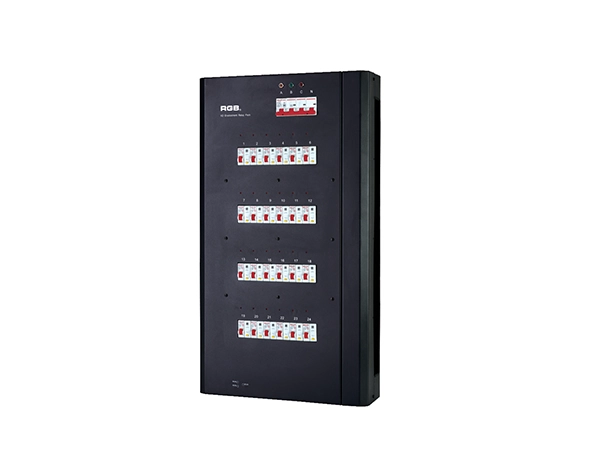
K2 Intelligent Network Relay Racks
K series is the newly developed and produced product of all-weather smart network relay cabinet. It has two major indoor and outdoor waterproof series and has multiple network control modes, such as double DMX512, sACN, ART-net, etc, which can control any equipment like resistive, inductive and capacitive and so on
K series has two major series from the perspective of function, namely, K2 ordinary type and KW2 waterproof type. It has two modes of installation, one is hanging on the wall, and the other is cabinet. It has three specifications of output circuit, namely, 24, 48 and 60 respectively.
K series applies to different performance places, such as, outdoor cultural tourism, TV station, theater, stadium and ambient intelligence lighting and so on.
Expert Support
Interested in learning more or need expert guidance related to this article? Fill in your details, and our team will provide tailored support.
Intelligent Control. Brilliant Performance.
RGB specializes in stage lighting control systems, delivering intelligent, reliable, and high-performance solutions for theaters and performance spaces worldwide.
Contact
Email:
Tel:
+86 20 3928 0245
+86 20 3928 0247
Address:
No.3, Huashan Road, Shilou Town, Panyu, Guangzhou, China.
Whatsapp: +8615975520131