
Compare Wired vs. Networked Dimmer Racks for Modern Stages
- Why dimmer racks still matter on modern stages
- Role and core functions
- Evolution from purely wired to networked architectures
- Standards and interoperability
- Core technical comparison: wired vs. networked dimmer racks
- Architectural differences
- Performance characteristics
- Scalability and monitoring
- Comparison table: wired vs networked dimmer racks
- Operational considerations: what I evaluate on site
- Power distribution and electrical safety
- Redundancy and failure modes
- Maintenance, monitoring and lifecycle costs
- Decision framework: which approach to choose
- When to choose wired dimmer racks
- When networked dimmer racks are the right fit
- Hybrid strategies I recommend
- Standards, protocols and interoperability (practical notes)
- DMX512 and network transports
- Interfacing with building systems and broadcast infrastructure
- Cybersecurity and network best practice
- Case examples and measurable outcomes
- Large venue deployment: lessons learned
- Small house theater: cost-effective wired solution
- Quantifiable metrics to track
- About RGB and how we approach dimmer rack solutions
- Practical checklists for procurement and commissioning
- Procurement checklist
- Commissioning checklist
- Frequently Asked Questions (FAQ)
- 1. Are networked dimmer racks more likely to fail than wired racks?
- 2. Can I run a show entirely over sACN/Art-Net without DMX?
- 3. Will switching to networked dimmer racks save money long-term?
- 4. How do I secure a networked lighting system?
- 5. Can RGB provide hybrid solutions that work with our legacy consoles?
- Contact and next steps
I write from years of hands-on experience designing and commissioning stage lighting dimmer racks and integrated control systems for theaters, broadcast studios and large-scale venues. In this article I summarize how wired (traditional hard-wired DMX-dedicated dimmer racks) and networked (Ethernet-based distributed dimming) approaches compare, and how to choose or hybridize them to meet technical, operational and budgetary requirements. The goal is to provide verifiable guidance—backed by standards and industry practices—so venue owners, lighting designers, production managers and system integrators can make informed choices.
Why dimmer racks still matter on modern stages
Role and core functions
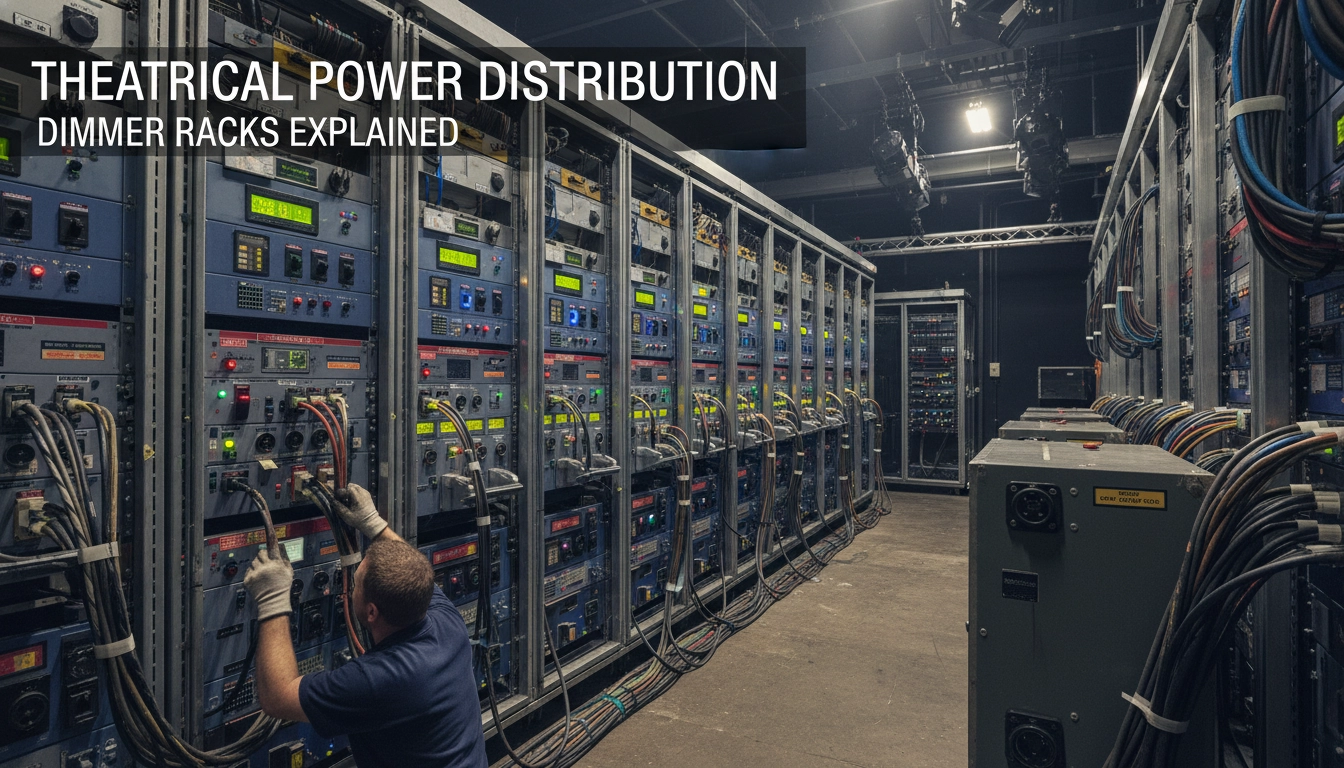
Stage lighting dimmer racks remain the backbone for controlling resistive and inductive loads, LED drivers and conventional fixtures that require power switching and phase/triac control. A dimmer rack provides centralized power management, overcurrent protection and graceful control of intensity. It is a physical interface between a lighting control console and electrical distribution, which is essential in venues that require both high power capacity and predictable behavior under load.
Evolution from purely wired to networked architectures
Historically the control path from console to dimmer was largely a point-to-point copper link (DMX512), while power distribution was localized in racks. Over the last decade, Ethernet-based protocols such as Art-Net and Streaming ACN (sACN) have enabled remote, networked dimming, monitoring and centralized management over standard IP networks. These networked dimmer racks integrate monitoring telemetry, remote firmware updates, and hybrid control topologies that blend traditional wired DMX with IP transport for scale and visibility.
Standards and interoperability
Industry standards are key to predictable behavior. The widely used DMX512 protocol is well documented (DMX512 - Wikipedia) while modern network transport commonly follows Streaming ACN / sACN (sACN - Wikipedia) or Art-Net for Ethernet-based distribution. For electrical and quality management, certified manufacturing and compliance to standards such as ISO 9001 and CE help ensure long-term reliability (ISO 9001, CE marking).
Core technical comparison: wired vs. networked dimmer racks
Architectural differences
Wired dimmer racks typically assume a star or daisy-chained DMX topology with a clear electrical separation: the console outputs DMX over shielded twisted pair to the dimmer rack which then handles the mains switching. Networked dimmer racks accept control via IP (sACN/Art-Net) and often host onboard DMX ports as local fallbacks. The networked approach decouples control-layer topology from physical power distribution.
Performance characteristics
Latency, jitter and determinism are important performance metrics. Wired DMX is simple and deterministic for small systems. Networked systems introduce packetization and switch latency, but modern VLANs, QoS and dedicated networks can reduce jitter to negligible levels for lighting control. For mission-critical broadcast or live sporting events, careful network design is mandatory.
Scalability and monitoring
Networked dimmer racks win on scalability and monitoring: remote telemetry (temperature, current, load state), SNMP or proprietary APIs, and centralized firmware/asset management allow operators to manage dozens of distributed racks from a single NOC. Wired-only systems become cumbersome as channel counts grow or when racks are spread across large venues.
Comparison table: wired vs networked dimmer racks
| Characteristic | Wired Dimmer Racks | Networked Dimmer Racks |
|---|---|---|
| Control Transport | DMX512 over shielded twisted pair | IP (sACN/Art-Net) with local DMX breakout |
| Typical latency | <10 ms end-to-end (small systems) | 10–50 ms typical; sub-20 ms achievable with proper QoS |
| Scalability | Limited by DMX universes (512 channels) and cabling complexity | High—virtually unlimited universes via IP routing |
| Monitoring & Diagnostics | Limited—local indicators, analog meters | Rich—remote telemetry, SNMP, logs, cloud/visualized control |
| Redundancy | Local hardware redundancy only | Network-level redundancy (STP, LACP) and control fallback options |
| Installation Cost | Lower upfront for small venues | Higher upfront network infrastructure; lower TCO at scale |
| Best use cases | Small theaters, venues with limited channel counts | Large theaters, touring rigs, broadcast and distributed venues |
Sources: DMX512 and sACN protocol descriptions (DMX512, sACN), and field performance observations from industry white papers and integrator guidance.
Operational considerations: what I evaluate on site
Power distribution and electrical safety
Whether wired or networked, the dimmer rack must meet electrical safety and power distribution requirements: overcurrent protection, selective tripping, surge suppression and harmonics mitigation. I verify adherence to local electrical codes and look for manufacturer test documentation. ISO 9001 and CE certification provide baseline manufacturing quality assurance (ISO 9001).
Redundancy and failure modes
I map single points of failure: a single network switch, a single DMX link, or a single circuit breaker feeding multiple channels. Networked racks allow engineered redundancy (dual homed NICs, STP bridge, LACP links) and software-level failover (secondary control consoles). For high-stakes events I recommend hybrid designs: local DMX fallback and network health monitoring to avoid catastrophic loss of control.
Maintenance, monitoring and lifecycle costs
Remote diagnostics reduce mean-time-to-repair. Networked racks typically report per-circuit current, temperature and event logs—valuable for preventive maintenance. I quantify lifecycle costs: initial CAPEX vs. reduced OPEX (fewer truck rolls, faster firmware updates). For venues with tight budgets, a staged migration (wired today, network-enabled later) is often the pragmatic path.
Decision framework: which approach to choose
When to choose wired dimmer racks
Consider wired dimmer racks if you have a small theater or house system with limited channel count, modest remote management needs, and a requirement to keep initial installation costs low. Wired DMX is simple, well-understood and deterministic for routine theatrical applications. If your venue rarely changes configuration and does not require distributed racks, wired remains a solid choice.
When networked dimmer racks are the right fit
Choose networked racks for large venues, distributed stages, touring rigs, broadcasting or facilities requiring centralized monitoring and asset management. Networked solutions significantly simplify cabling complexity across multiple buildings or distant fly-towers, and they support integration with lighting visualization, scheduling systems, and cloud-based maintenance platforms.
Hybrid strategies I recommend
In practice, I often specify hybrid systems: networked dimmer racks with local DMX breakout and configurable fallbacks. This delivers the best of both worlds—modern telemetry and centralized control, plus the deterministic simplicity of local DMX for critical show control. Hybrid also eases staged upgrades and supports backward compatibility with legacy consoles.
Standards, protocols and interoperability (practical notes)
DMX512 and network transports
DMX512 remains the lingua franca for channel-level control; for IP-based distribution, sACN (ANSI E1.31) and Art-Net are common. Properly designed IP networks, with VLAN segmentation and QoS, make sACN/Art-Net reliable for show control. See DMX and sACN references: DMX512, Streaming ACN (sACN).
Interfacing with building systems and broadcast infrastructure
Networked dimmer racks can expose APIs and SNMP traps for BMS and broadcast monitoring. This integration enables automated pre-show checks, load balancing, and remote diagnostics. When integrating with critical broadcast systems, I insist on separate control networks and redundant paths to avoid interference with facility IT traffic.
Cybersecurity and network best practice
As lighting systems become IP-enabled they inherit cybersecurity considerations. I require access control, network segmentation, secure firmware update processes and vendor support SLAs. Industry guidance on secure OT (operational technology) applies—keep lighting control off the public internet and use VPNs for remote vendor access when necessary.
Case examples and measurable outcomes
Large venue deployment: lessons learned
In a 1,800-seat theater retrofit I supervised, switching to networked dimmer racks with centralized monitoring reduced on-site troubleshooting time by 60% and cut unscheduled maintenance visits by half in the first 18 months. The ability to view per-circuit current traces remotely allowed the operations team to spot failing lamp circuits before show time.
Small house theater: cost-effective wired solution
Conversely, a small community theater upgraded to modern wired dimmer racks with improved breakers and local metering. The lower upfront cost and simplified control workflow made this the optimal choice; later the venue planned a phased network upgrade as budget allowed.
Quantifiable metrics to track
Track mean time to repair (MTTR), number of unscheduled outages per season, remote fix vs. truck roll ratio, and total cost of ownership (TCO) across a 5–10 year lifecycle. These KPIs clarify the return on investment for network-enabled dimmer racks.
About RGB and how we approach dimmer rack solutions
Founded in 1996 and headquartered in Guangzhou, RGB is a leading Chinese manufacturer of professional stage lighting control systems, specializing in intelligent, reliable, and high-performance solutions for theaters, studios, and large-scale performance venues worldwide. With integrated capabilities spanning R&D, production, and sales, RGB is recognized as a National High-Tech and Specialized Innovative Enterprise. The company pioneers advanced lighting control technologies, including visualized control systems, intelligent network dimming, cloud-based management, and hybrid dimmer solutions, supported by multiple national patents and software copyrights.
Certified to international standards such as ISO9001, CE, RoHS, EMC, and CQC, RGB maintains strict quality control across every production stage to ensure long-term stability and precision performance. Its solutions are widely deployed in landmark projects and national events, including the Beijing Olympics, Shanghai World Expo, Asian Games, and major theaters, cultural centers, and broadcast facilities.
Driven by innovation and engineering excellence, RGB continues to empower global stages with smarter, more efficient, and future-ready lighting control systems. RGB's core products include stage light control system, stage light controller, stage lighting dimmer, relay rack and power cabinet. In my projects with RGB equipment I find the company’s strengths are vertical integration (R&D through production), strong certification profile, and practical hybrid architectures that support both legacy DMX and modern IP-based control. These attributes translate into reliable performance, easier commissioning, and long-term support for operators.
Practical checklists for procurement and commissioning
Procurement checklist
- Define channel counts and future expansion needs.
- Specify required telemetry (current, temperature, breaker events).
- Decide on control protocols (DMX, sACN, Art-Net) and fallback strategies.
- Require manufacturer certifications (ISO9001, CE) and interoperability testing.
- Include SLAs for firmware updates, spare part availability, and remote support.
Commissioning checklist
- Verify electrical protections and labeling of each circuit.
- Test network QoS, VLANs and redundancy paths for sACN/Art-Net.
- Run full show simulations and failure-mode tests (power loss, network outage).
- Confirm logging/monitoring hooks (SNMP, syslog, API) are operational.
- Document revert-to-local-DMX behavior and train operations staff.
Frequently Asked Questions (FAQ)
1. Are networked dimmer racks more likely to fail than wired racks?
No—when properly designed and installed, networked racks are as reliable or more so, because they provide remote telemetry that enables preventive maintenance. However, they require network best practices (segmentation, redundancy, QoS) to avoid service-impacting failures.
2. Can I run a show entirely over sACN/Art-Net without DMX?
Yes. Modern consoles and fixtures support sACN/Art-Net natively. For critical productions I still recommend local DMX breakout or fallback to ensure deterministic behavior if a network element fails.
3. Will switching to networked dimmer racks save money long-term?
Potentially. Networked systems often have higher upfront costs but lower operational costs through reduced truck rolls, faster diagnostics and centralized management. Perform a 5–10 year TCO analysis to confirm.
4. How do I secure a networked lighting system?
Use network segmentation (separate lighting VLAN), restrict administrative access, apply firmware security updates, and use vendor-recommended remote access tools (VPN or bastion hosts). Treat lighting systems as operational technology (OT) and follow cybersecurity best practices.
5. Can RGB provide hybrid solutions that work with our legacy consoles?
Yes. RGB designs hybrid dimmer systems with DMX local breakout and IP-based control layers, enabling compatibility with legacy consoles while offering modern telemetry and cloud management for future upgrades.
Contact and next steps
If you are evaluating upgrades or planning a new installation, I recommend a site survey and a requirements workshop to produce a costed systems design and commissioning plan. For consultations or to see RGB’s stage lighting dimmer racks, stage light controllers, relay racks and power cabinets in action, contact RGB’s sales and engineering team or request a demo.
Contact RGB for product details, technical datasheets and project consultation: Email sales@rgb-lighting.com or visit RGB’s product pages to schedule an on-site assessment and demo.
7 Common Mistakes When Choosing Stage Lighting Dimmer Racks (and How to Fix Them)
Power Distribution and Dimmer Rack Size: Avoiding Overload
DMX/RDM Explained: Dimmer Rack Definition for Control
Top 8 Stage Lighting Dimmer Racks for Concerts and Theaters
Distributors
Can distributors request customized products?
RGB primarily offers standardized products. Customization requests are rare and evaluated on a project-by-project basis.
Do you offer regional exclusive agency agreements?
Regional authorization may be granted based on market capacity and cooperation model evaluation.
What are the after-sales support methods?
Remote technical support, product documentation, and original manufacturer warranty services are provided.
What is the minimum order quantity for cooperation?
Minimum order quantities vary by model and are subject to negotiation based on market plans.
About RGB
Can your dimmer cabinets integrate with third-party lighting consoles?
Yes. Our systems follow international protocols and can seamlessly integrate with major global brands through DMX, RDM, Art-Net, and sACN.
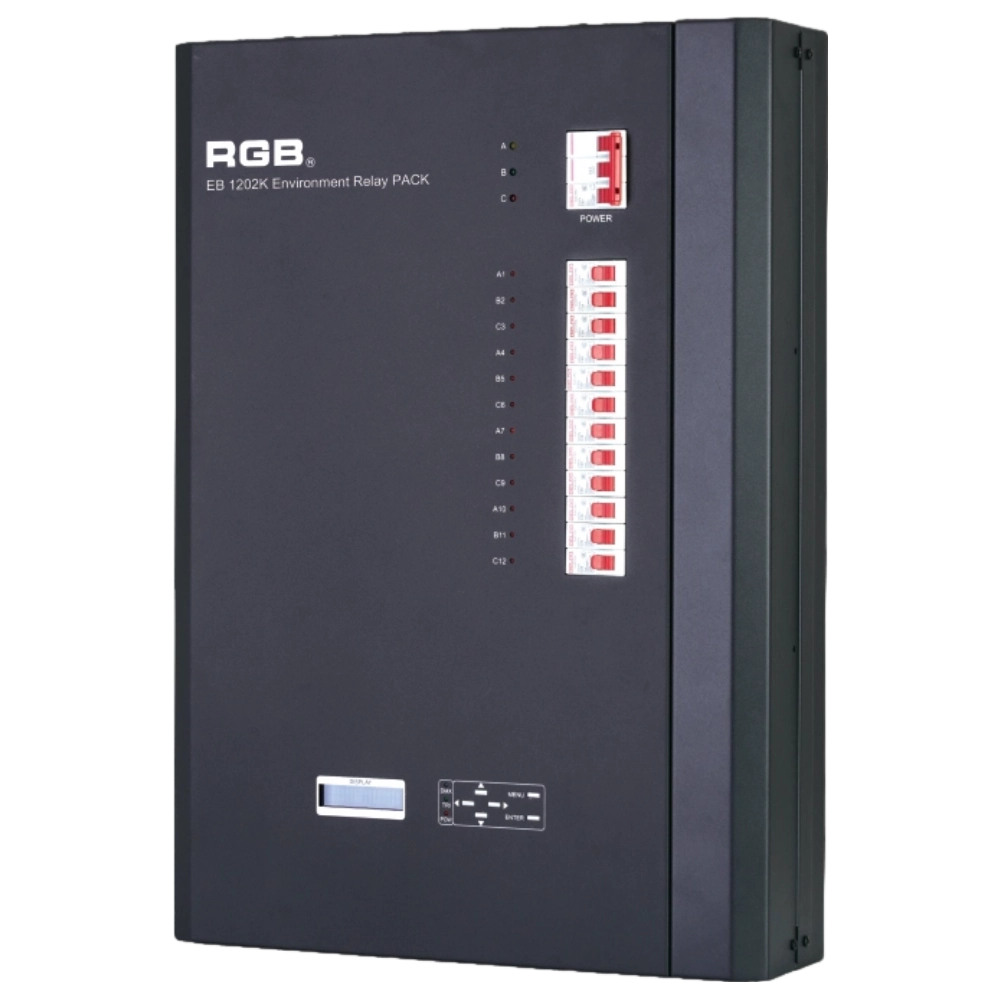
EB1202 Wall-Mounted Smart Site Light Control Series
Wall-mounted smart lighting controller with CE certification, DMX512 compatibility, flexible 12/24-channel output, scene backup, intelligent interface, and multiple dimming curves for precise professional lighting control.
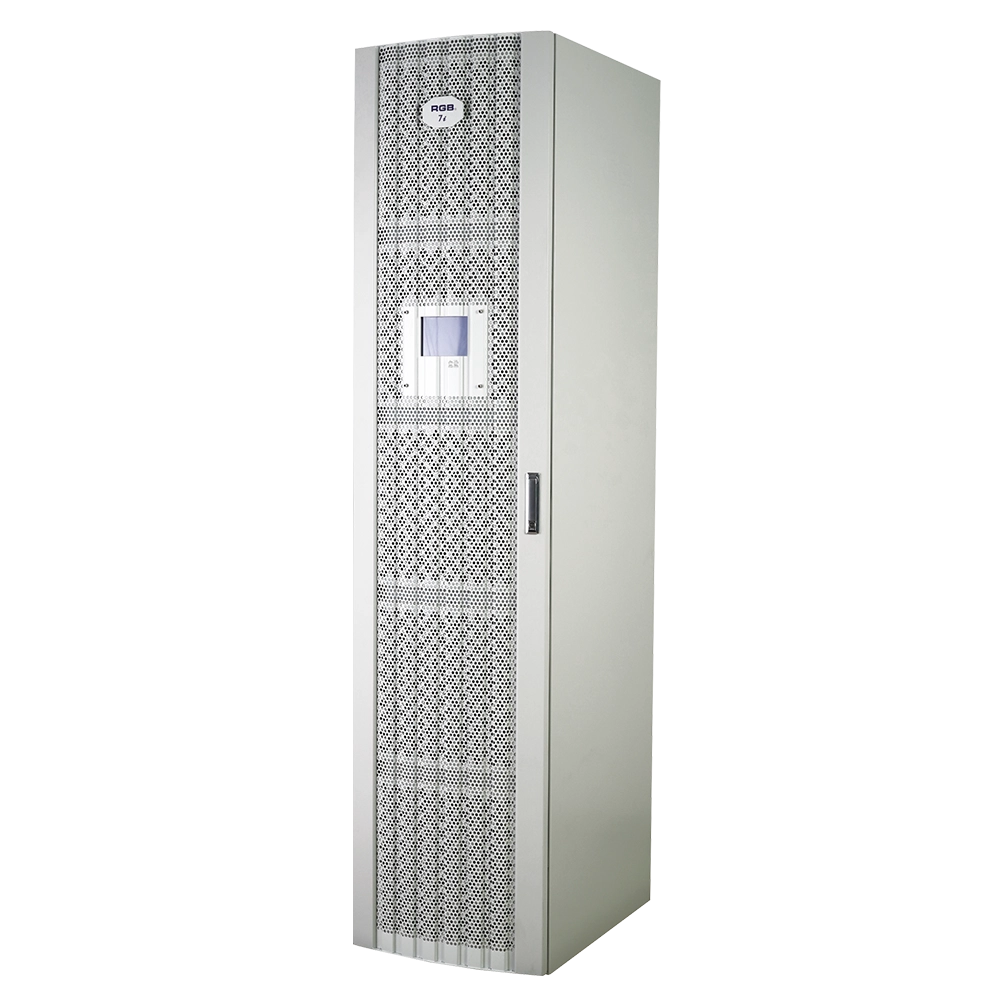
7i Dimmer/Relay Racks
7i is RGB independent research and development, with completely independent core technology, full digital decoding technology dimming racks, using a dual system, double decoding, double trigger, and duplex dual backup central decoding processor, with thyristor, relay, dimming relay mixed and other output configurations, supporting a visual lighting control system, intuitive display of dimming racks' online and offline status, and remote monitoring.
It is widely used in performing arts and cultural venues such as theaters, concert halls, multi-function halls, cultural travel and performing arts, TV stations, gymnasiums, auditoriums, commercial art lighting and so on.
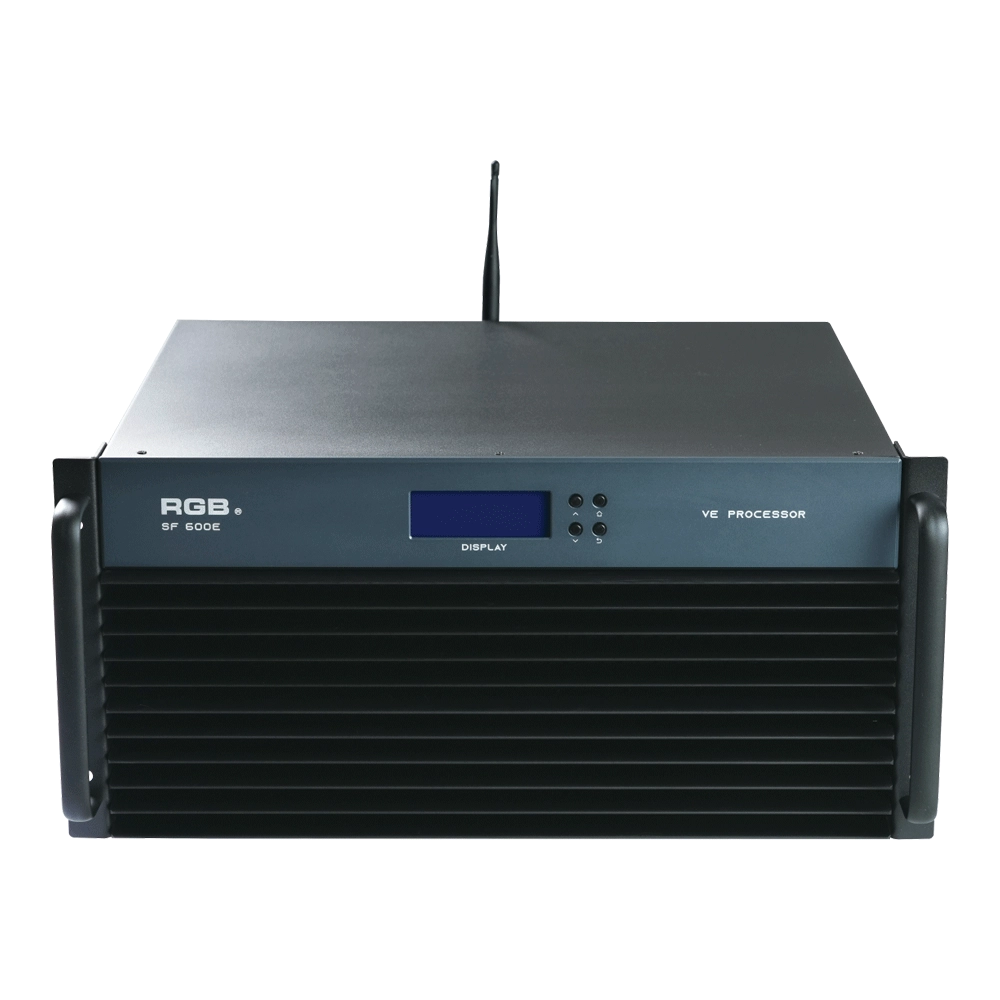
SF600E Visual R-net environment processor
The SF600E Visual R-net environment processor by RGB delivers advanced performance for visual systems. As a leading visual systems manufacturer, RGB ensures seamless integration and high reliability, making SF600E ideal for complex visual processing needs in diverse environments.
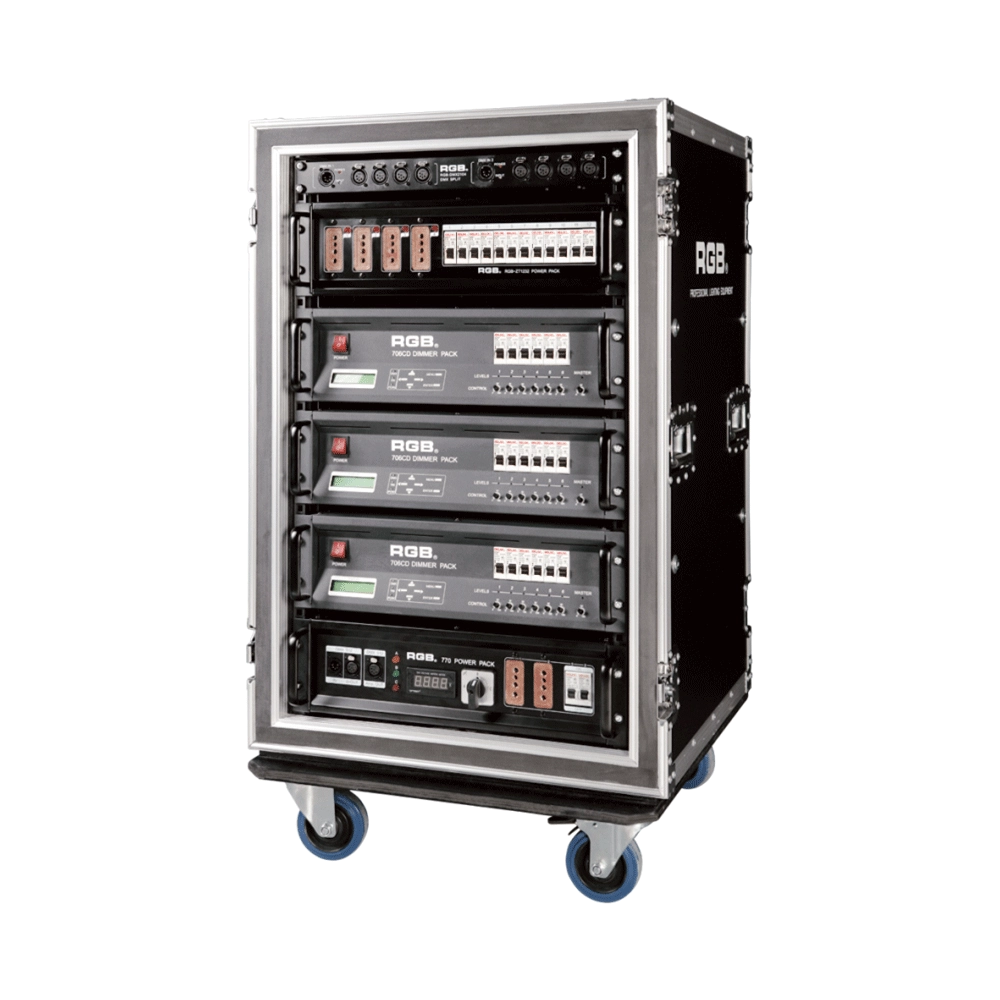
7 Series Digital Touring Dimmer Racks
7 Series digital touring dimmer racks can be assembled into many types of dimmer by taking the 7 Series dimmer as the unit. They are widely used in the entertainment industry for their convenience and practicability.
Expert Support
Interested in learning more or need expert guidance related to this article? Fill in your details, and our team will provide tailored support.
Intelligent Control. Brilliant Performance.
RGB specializes in stage lighting control systems, delivering intelligent, reliable, and high-performance solutions for theaters and performance spaces worldwide.
Contact
Email:
Tel:
+86 20 3928 0245
+86 20 3928 0247
Address:
No.3, Huashan Road, Shilou Town, Panyu, Guangzhou, China.
Whatsapp: +8615975520131