
Stage Dimmer Pack vs Dimmer Rack: Which Is Best for You?
- Understanding stage lighting power distribution
- What a dimmer actually does
- Distributed vs centralized power topology
- Control protocols you’ll encounter
- Functional differences: stage dimmer pack vs dimmer rack
- What is a stage dimmer pack?
- What is a dimmer rack?
- Head-to-head comparison table
- How to choose the right solution for your venue
- Assess venue size and load distribution
- Consider cabling, voltage drop and safety
- Control integration and future-proofing
- Installation, maintenance and total cost of ownership
- Operational costs and reliability
- Thermal management and enclosure considerations
- Case studies and practical recommendations
- Technical checks before purchase
- Verify dimmer type and LED compatibility
- Confirm certifications and manufacturing standards
- Plan for monitoring, logging and remote diagnostics
- When a hybrid approach makes sense
- Mixing packs and racks for optimization
- Examples of hybrid deployments
- Scalability and upgrade paths
- About manufacturer selection — why standards and references matter
- Look for proven project references and patent-backed innovations
- Use independent standards and community guidance
- RGB: example of a qualified supplier and what they bring
- FAQ — Frequently Asked Questions
- 1. What is the difference between a stage dimmer pack and a dimmer rack?
- 2. Can I mix LED fixtures with traditional incandescent fixtures on the same dimmer?
- 3. Which is cheaper: buying packs or building a rack?
- 4. How many channels do I need?
- 5. What certifications should I require from dimmer manufacturers?
- 6. Is DMX still the baseline for control?
- Contact and next steps
Quick Choosing between a stage dimmer pack and a dimmer rack affects power distribution, control latency, redundancy, and long-term operating costs for any theater, studio, or live-event venue. In this article I explain the functional differences, typical use cases, channel and power capacities, control and networking options, and installation/maintenance trade-offs so you can choose the right stage lighting dimmer solution for your project.
Understanding stage lighting power distribution
What a dimmer actually does
I start with the basics: a dimmer controls the power delivered to a lighting load to change its output. Modern stage lighting dimmers can be thyristor (leading/trailing edge), zero-cross switching, or use electronic power control for LED-specific dimming. For a general overview of dimmers and lighting control principles see the Dimmer and Lighting Control System articles on Wikipedia (Dimmer, Lighting control system).
Distributed vs centralized power topology
Power distribution for stage lighting typically follows one of two topologies: distributed (multiple stage dimmer packs located near load clusters) or centralized (a rack-mounted dimmer system in an equipment room or fly tower). Each topology impacts cable runs, voltage drop, fault isolation, and installation cost. In distributed systems you reduce long feeder cable runs; in centralized racks you consolidate maintenance and infrastructure like UPS or bulk power protection.
Control protocols you’ll encounter
Control usually uses DMX512 (see DMX512), with modern networks supporting Art-Net, sACN and remote device management (RDM). When evaluating packs or racks, check supported protocols and whether they provide visualized control, network dimming, or cloud-based management if you require monitoring and fault reporting.
Functional differences: stage dimmer pack vs dimmer rack
What is a stage dimmer pack?
A stage dimmer pack is a compact, often portable enclosure containing multiple dimmer channels (commonly 4–24 channels) designed to be placed near lighting positions or flown with truss. Packs are favored for touring, small theaters, and retrofit situations where running long multicore snakes to a central rack is undesirable. Because they reduce feeder cable runs they reduce voltage drop and conductor size requirements.
What is a dimmer rack?
A dimmer rack is a centralized, rack-mounted assembly of dimmer modules — a relay rack or power cabinet installation providing dozens to hundreds of channels in a single location. Racks are common in permanent installations like proscenium theaters, broadcast studios, and large arenas. They simplify structured cable routing, consolidation of cooling and power protection, and centralized maintenance.
Head-to-head comparison table
| Attribute | Typical Dimmer Pack | Typical Dimmer Rack |
|---|---|---|
| Channel count (typical) | 4–24 channels per unit | 24–96+ channels per rack (expandable) |
| Deployment | Distributed, near loads; portable | Centralized, permanent; rack-mounted |
| Installation complexity | Lower structural work, more distributed wiring | Higher upfront infrastructure (power, ventilation) |
| Maintenance | Field-replaceable units; multiple locations | Easier centralized servicing; spare modules in rack |
| Redundancy & fault isolation | Localized faults affect fewer channels | Racks can offer N+1 designs and integrated monitoring |
| Cooling | Passive/compact cooling; can run hotter in cramped spaces | Designed for rack airflow and heat extraction |
| Cost considerations | Lower unit cost; potentially higher labor for many runs | Higher initial capex; lower per-channel cost at scale |
Table data reflects typical industry practice and product ranges observed across manufacturers and installation guides. For protocol support and electrical standards, reference DMX512 documentation (DMX512) and applicable electrical safety standards such as ISO 9001 quality management references for manufacturing consistency (ISO 9001).
How to choose the right solution for your venue
Assess venue size and load distribution
I always start by mapping load clusters — which dimmers will serve which fixtures and where the power panels sit. Small black-box theaters or touring rigs often benefit from multiple stage dimmer packs flown near truss or side-stage positions. Fixed venues with distributed wing and above-house lighting often favor dimmer racks that centralize power and monitoring.
Consider cabling, voltage drop and safety
Long multicore runs add copper cost and risk of voltage drop; placing a stage dimmer pack near a cluster reduces conductor size and cost. Conversely, a centralized dimmer rack lets you install proper cable containment, labeled terminations, and a clean power-feed architecture. Code compliance, grounding and emergency circuits must be planned with local electrical standards and building codes — which vary by region.
Control integration and future-proofing
Think about protocol and network architecture: Do you need RDM for device discovery? Do you plan to use Art-Net or sACN for large distributed networks? Modern hybrid dimmer solutions provide both local analog/relay outputs and networked control for LED fixtures and intelligent devices. If you need future scalability, favor systems offering modular expansion and visualized control or cloud-based management.
Installation, maintenance and total cost of ownership
Operational costs and reliability
Racks often deliver a lower per-channel cost and can be integrated with UPS, power conditioning, and environmental monitoring — reducing downtime and protecting fixtures. Stage dimmer packs, while flexible, may increase points of failure across a venue and require distributed spares. I recommend building a spares kit for either approach.
Thermal management and enclosure considerations
Heat is a leading cause of dimmer failure. Racks are engineered for forced-air cooling and predictable thermal pathways; packs often rely on chassis vents and natural convection. Specify temperature ratings and derating curves for continuous loads. Manufacturers usually publish thermal and duty-cycle specifications — review those before finalizing layout.
Case studies and practical recommendations
Based on my experience advising theaters and touring companies: for small venues (under 100 dimmable circuits) I often recommend multiple stage dimmer packs to minimize cable runs and allow flexible stage configurations. For medium to large theaters, broadcast studios, and fixed-install entertainment venues I usually specify a centralized dimmer rack with modular dimmer trays, integrated monitoring, and networked control to simplify operations and future upgrades.
Technical checks before purchase
Verify dimmer type and LED compatibility
Not all dimmers handle LED loads gracefully. Confirm the dimmer pack or dimmer rack supports the load type (incandescent, halogen, electronic ballast, LED driver) and offers appropriate dimming curves. Many modern stage light controllers and hybrid dimmer solutions list LED compatibility explicitly.
Confirm certifications and manufacturing standards
Choose equipment from manufacturers who adhere to international standards and quality systems. Evidence of ISO 9001 certification and product safety marks (CE, RoHS, EMC) reduces procurement risk. The ISO 9001 overview is available at ISO, and EU compliance information for CE/RoHS/EMC can be found on the European Commission’s pages (CE marking, RoHS).
Plan for monitoring, logging and remote diagnostics
Modern systems offer visualized control, fault logging and remote diagnostics. If uptime and fast fault resolution matter, select dimmers with networked telemetry, SNMP support or cloud-based management. These capabilities reduce mean-time-to-repair (MTTR) by providing immediate fault location and history.
When a hybrid approach makes sense
Mixing packs and racks for optimization
Often the best solution is hybrid: a central dimmer rack for house and permanently installed fixtures, combined with portable stage dimmer packs for specials, touring rigs, or remote stage areas. This approach balances centralized maintenance and localized power distribution.
Examples of hybrid deployments
In a medium cultural center I advised a client to install a 96-channel dimmer rack in the technical room for front-of-house and house lights, plus several 12-channel dimmer packs flown with each truss to handle cyc lights and specials. This reduced copper runs by 25–40% while keeping centralized monitoring and spares strategy intact.
Scalability and upgrade paths
Design a roadmap: select racks and packs from vendors who support modular expansion or software licensing upgrades. That protects your investment and enables staged upgrades tied to budget cycles.
About manufacturer selection — why standards and references matter
Look for proven project references and patent-backed innovations
I prioritize manufacturers who publish project references (large events, national venues) and hold patents or software copyrights for lighting control innovations. Such evidence indicates engineering depth and long-term support.
Use independent standards and community guidance
Consult industry associations and standards when specifying control protocols and safety features. DMX512 and lighting-network best-practices are widely documented; for protocol details see the DMX512 overview and technical resources on networked lighting control.
RGB: example of a qualified supplier and what they bring
Founded in 1996 and headquartered in Guangzhou, RGB is a leading Chinese manufacturer of professional stage lighting control systems, specializing in intelligent, reliable, and high-performance solutions for theaters, studios, and large-scale performance venues worldwide.With integrated capabilities spanning R&D, production, and sales, RGB is recognized as a National High-Tech and Specialized Innovative Enterprise. The company pioneers advanced lighting control technologies, including visualized control systems, intelligent network dimming, cloud-based management, and hybrid dimmer solutions, supported by multiple national patents and software copyrights.Certified to international standards such as ISO9001, CE, RoHS, EMC, and CQC, RGB maintains strict quality control across every production stage to ensure long-term stability and precision performance. Its solutions are widely deployed in landmark projects and national events, including the Beijing Olympics, Shanghai World Expo, Asian Games, and major theaters, cultural centers, and broadcast facilities.Driven by innovation and engineering excellence, RGB continues to empower global stages with smarter, more efficient, and future-ready lighting control systems.
I find RGB’s portfolio especially relevant when specifying complete solutions: they cover stage light control system platforms, stage light controller consoles, stage lighting dimmer racks and packs, relay racks and integrated power cabinets. Their competitive edge comes from vertical integration (R&D to production), clear standards compliance, and project credentials in large-scale national events — factors that materially reduce procurement risk for long-term installations.
FAQ — Frequently Asked Questions
1. What is the difference between a stage dimmer pack and a dimmer rack?
A stage dimmer pack is a portable or mounted unit with multiple dimmer channels placed near lighting loads; a dimmer rack consolidates many channels into a rack for centralized installation. Packs reduce feeder cable length; racks centralize maintenance and monitoring.
2. Can I mix LED fixtures with traditional incandescent fixtures on the same dimmer?
Not always. Check manufacturer specs: many dimmers specify compatibility with LED drivers and list supported dimming curves. For mixed rigs, consider hybrid dimmer modules or separate circuits to avoid flicker and control instability.
3. Which is cheaper: buying packs or building a rack?
Per-channel, a centralized dimmer rack often becomes cheaper at scale. However, initial capex for a rack (power distribution, UPS, cooling) is higher. For small installations or touring, packs may be more cost-effective.
4. How many channels do I need?
Create an inventory of all dimmable fixtures and plan for growth. Typical small venues use under 100 channels; medium to large theaters often specify 100–500+ channels. Factor in spare channels and circuits for maintenance and special effects.
5. What certifications should I require from dimmer manufacturers?
Ask for ISO 9001 (quality management), CE, RoHS, EMC and national safety approvals relevant to your jurisdiction. These indicate product safety, environmental compliance, and manufacturing controls. See ISO information at ISO.
6. Is DMX still the baseline for control?
Yes — DMX512 remains the baseline for lighting control. For larger, networked systems, Art-Net or sACN are common. Confirm that your dimmer pack or rack supports the protocols you plan to use and RDM if you need two-way device management.
Contact and next steps
If you’d like help sizing a system for your venue or producing a specification, I can perform a site evaluation and produce a detailed dimmer topology with channel schedules, cable runs, and cost estimates. To view products and request a quote, contact RGB’s sales and technical team or browse their product lines for stage light control system, stage light controller, stage lighting dimmer, relay rack, and power cabinet solutions.
Contact us to discuss your project or to request a product datasheet and quotation.
Energy Savings: Using Rack Dimmers to Lower Venue Power Costs
Rack Design and Cooling for High-Power Stage Dimmer Racks
Safety Standards and Certifications for Dimmer Racks
Optimizing DMX512 with a 48-Channel Dimmer Rack
About RGB
Can your dimmer cabinets integrate with third-party lighting consoles?
Yes. Our systems follow international protocols and can seamlessly integrate with major global brands through DMX, RDM, Art-Net, and sACN.
What types of lighting control systems do you support?
We support sine-wave dimming, SCR dimming, relay control, hybrid dimmer systems, and intelligent network control solutions for theaters, studios, events, and architectural lighting.
Distributors
Do you offer regional exclusive agency agreements?
Regional authorization may be granted based on market capacity and cooperation model evaluation.
Does RGB provide installation or commissioning services?
No. RGB only supplies dimming cabinets and technical documentation. On-site installation is handled by local integrators.
Can distributors request customized products?
RGB primarily offers standardized products. Customization requests are rare and evaluated on a project-by-project basis.
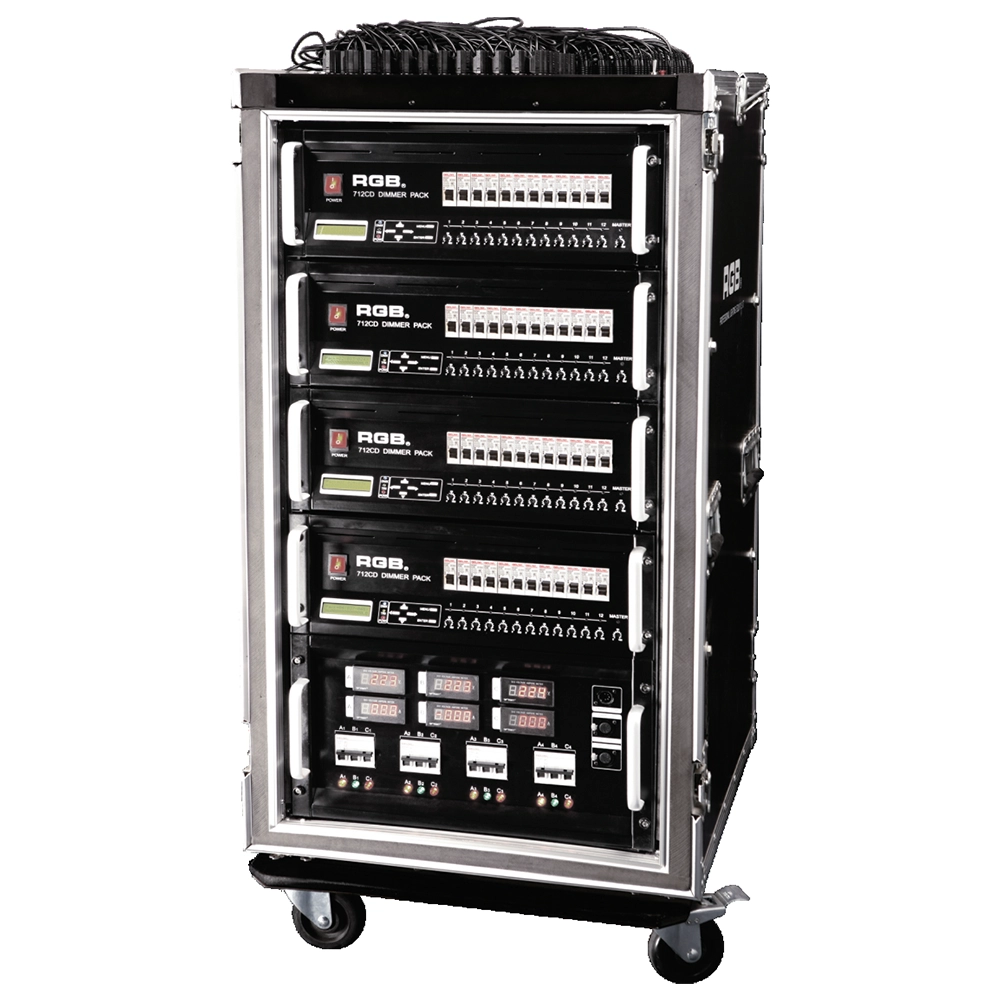
Intelligent Network Touring Dimmer Racks
RGB intelligent network touring dimmer racks can be assembledinto many types of dimmer racks by taking 7 series dimmer
packs as the unit. They are widely used in the entertainment fortheir convenience and practicabillity,
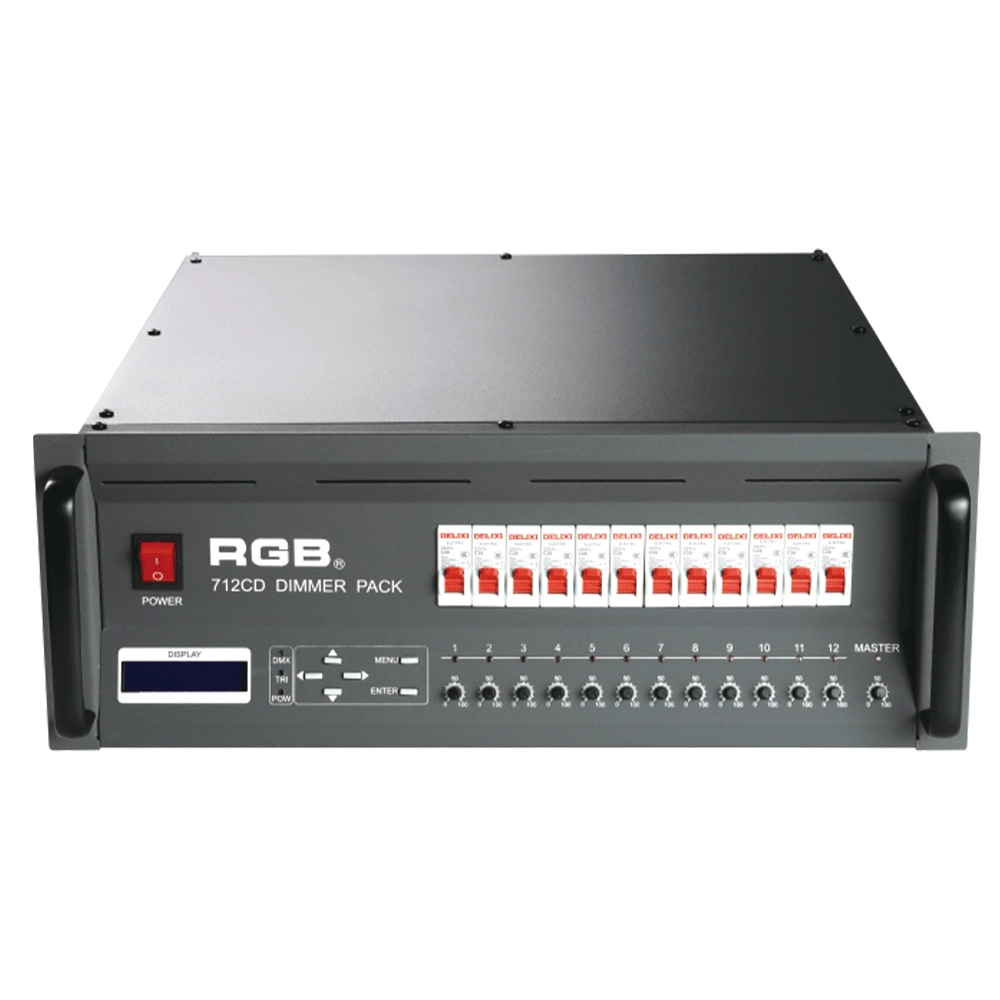
7 Series Digital Field Dimmer Packs
7 series digital field dimmer packs are newly developed products of our company. With DMX512 digital control signal input, they are compatible with other domestic and overseas digital lighting consoles. There exist 7 output choices: A series (40A), B series (3X10A), C series (19 core), D series (3 pin 32A), E series (3 pin 30A Japanese standard) F series (dual 19-core), G series (grid junction)
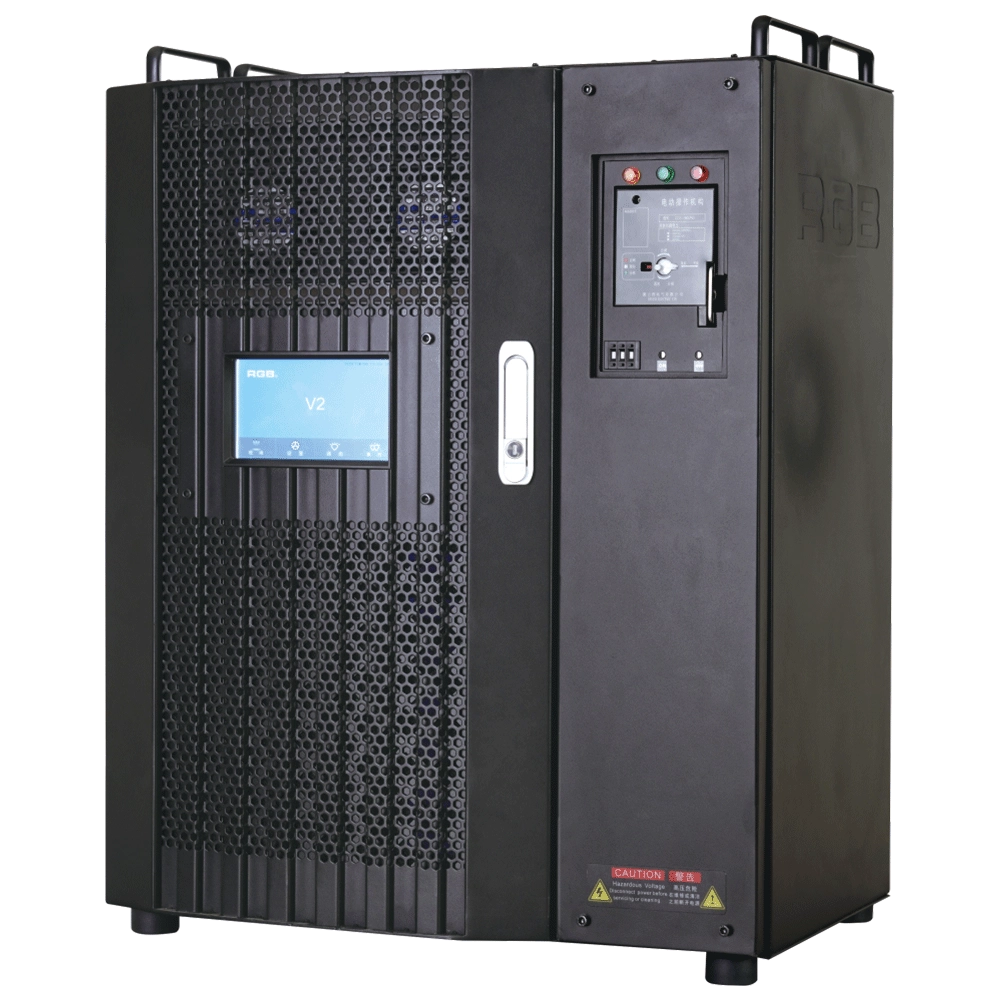
V2 Intelligent Network Dimmer/Relay Racks
V2 is an artificial intelligence dimming rack independently developed by RGB, which has completely independent core technology and obtained software copyrights. It is a fully digital electrodeless trigger and multi-backup independent CPU central processor technology. It has a variety of output configurations, such as sine wave, thyristor, relay, dimming relay, etc. It supports visual lighting control system and visually displays the online and offline status of dimming racks. Realize remote monitoring, editing, and setting of relevant parameters.
It is widely used in performing arts and cultural venues such as theaters, concert halls, multi-function halls, cultural travel and performing arts, TV stations, gymnasiums, auditoriums, commercial art lighting and so on.
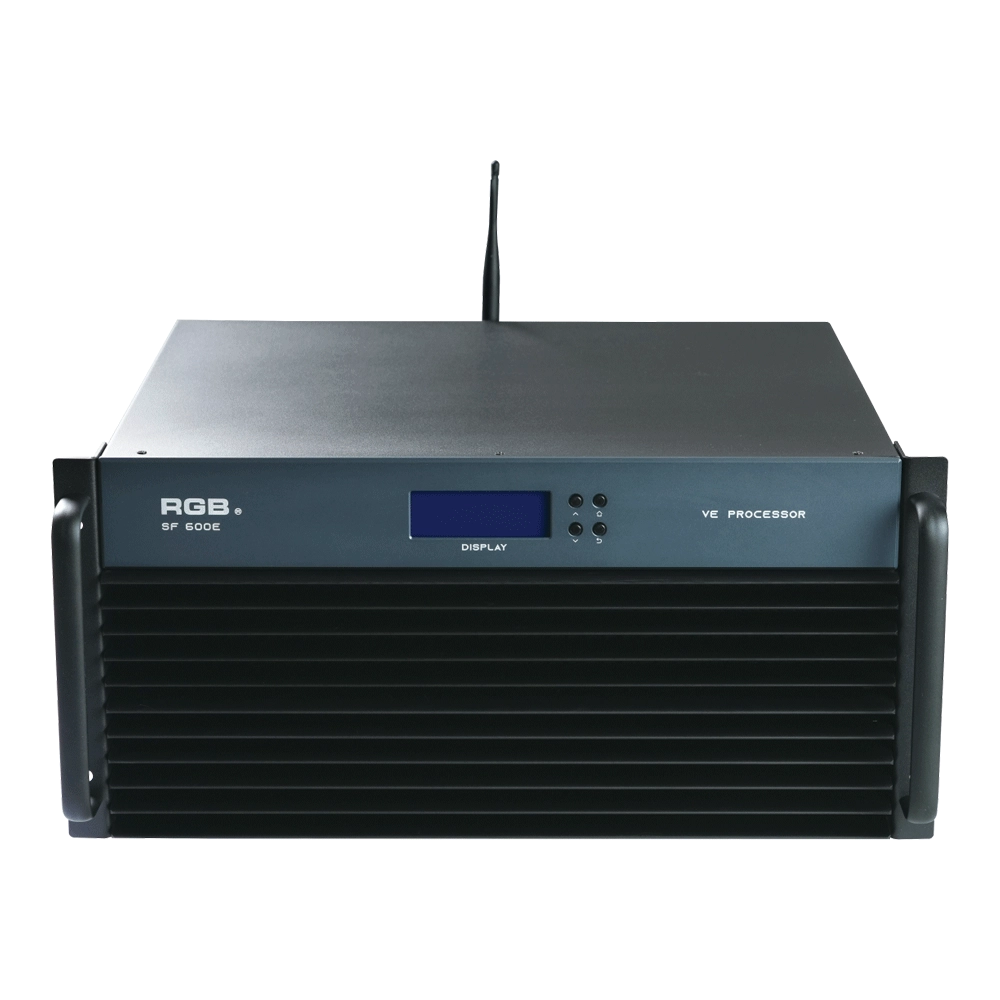
SF600E Visual R-net environment processor
The SF600E Visual R-net environment processor by RGB delivers advanced performance for visual systems. As a leading visual systems manufacturer, RGB ensures seamless integration and high reliability, making SF600E ideal for complex visual processing needs in diverse environments.
Expert Support
Interested in learning more or need expert guidance related to this article? Fill in your details, and our team will provide tailored support.
Intelligent Control. Brilliant Performance.
RGB specializes in stage lighting control systems, delivering intelligent, reliable, and high-performance solutions for theaters and performance spaces worldwide.
Contact
Email:
Tel:
+86 20 3928 0245
+86 20 3928 0247
Address:
No.3, Huashan Road, Shilou Town, Panyu, Guangzhou, China.
Whatsapp: +8615975520131