


Scalable Stage Lighting Systems for Touring Productions
- Designing for Mobility and Reliability
- Defining scalability for touring systems
- Mechanical and rack-level considerations
- Redundancy and fault-tolerance
- Networked Control and Protocol Choices
- Protocol overview: DMX512, Art-Net, sACN
- Choosing the right protocol for touring
- Network design best practices
- Power & Dimming Strategies
- Dimming technologies and when to use them
- Comparative table: dimming and control approaches
- Power distribution and inrush management
- Operational Scalability, Logistics, and Vendor Selection
- Packaging operations for repeatability
- Vendor and product selection criteria
- Supply chain, spares, and maintenance planning
- Industry example: RGB's capabilities and deployments
- Practical Implementation Checklist
- Pre-tour validation steps
- Load-in and tech day workflow
- Post-show and tour support
- Comparative Protocol Table
- Frequently Asked Questions (FAQ)
- Q1: What makes a stage lighting control system scalable for touring?
- Q4: How do I choose between Art-Net and sACN on tour?
- Q3: How should I manage power and inrush on a trucked tour?
- Q2: Is DMX still required if I use networked control?
- Q5: What should be included in a technical rider for lighting?
- Q6: How can a manufacturer like RGB help touring productions?
Summary: Scalable stage lighting systems for touring productions require a balance of portability, reliability, predictable networked control, and flexible power/dimming strategies. This article explains architectural approaches, protocol choices, dimmer and power options, and operational workflows to reduce risk, speed load-ins, and support complex rigs. It integrates industry standards references and practical vendor-selection criteria to help production teams evaluate and implement robust Stage Lighting Control Systems for repeatable, high-quality live performances.
Designing for Mobility and Reliability
Defining scalability for touring systems
Scalability in touring contexts means systems adapt to venues of different sizes and technical capacities without redesigning the rig for each stop. That includes modular control consoles, distributed dimmers, and networked I/O so that a base configuration can be expanded (or reduced) quickly. For lighting designers and LDs, a scalable system reduces setup time, minimizes configuration errors on site, and keeps the creative preset library portable across venues.
Mechanical and rack-level considerations
Focus on road-ready hardware: flight-case friendly rack units, modular relay racks, and serviceable power cabinets. Use industry-standard connectors (powerCON, Socapex, etherCON) and color-coded cabling to speed troubleshooting. A physical inventory that mirrors control topology (controller -> node farm -> dimmer/relay -> fixture) reduces human error during load-in. Include spare modules that can hot-swap in under five minutes to minimize show impact.
Redundancy and fault-tolerance
Design redundancy at two levels: control and power. For control redundancy, use dual-master or seamless-failover configurations (e.g., a primary console with a hot-standby). For power, divide circuits across multiple power cabinets and include bypass relays so that single-point failures do not darken entire fixture groups. Industry practice often mirrors network engineering: eliminate single points of failure and ensure the show can continue at degraded capacity rather than fail entirely.
Networked Control and Protocol Choices
Protocol overview: DMX512, Art-Net, sACN
DMX512 remains the base-layer standard for lighting fixtures and dimmers; it defines one universe of 512 channels per link. For Ethernet-based transport and multi-universe systems, protocols like Art-Net and Streaming ACN (sACN) are widely used to carry many DMX universes over standard networks. For technical references, see the Wikipedia entries for DMX512, Art-Net and sACN.
Choosing the right protocol for touring
For most touring productions, use a hybrid approach: DMX512 at the edge (fixtures and local dimmers), with Art-Net or sACN across the venue backbone. Ethernet protocols allow transporting many universes to remote nodes and reduce long DMX runs. When selecting protocols consider existing infrastructure at likely venues: sACN is often better for large, professionally managed venues due to its standardized transport, while Art-Net offers simplicity and legacy compatibility with a broad range of nodes and consoles.
Network design best practices
Segment the lighting control network from venue IT and audio networks to avoid multicast storms and QoS conflicts. Use managed switches with VLANs and IGMP snooping for sACN multicast distribution. Document IP addressing, universe mapping, and switch topology in a portable network diagram that travels with the production. For background on control consoles, consult the Lighting control console reference.
Power & Dimming Strategies
Dimming technologies and when to use them
Modern tours use mixed dimming strategies depending on fixture type and power constraints. Traditional resistive/inertial loads (incandescent/halogen) are often managed by rack dimmers; LED fixtures usually prefer direct intelligent control or constant-current LED drivers. Hybrid dimmer systems that support both AC dimming for conventionals and electronic control for LEDs enable smooth integration. Consider also relay racks for non-dimmable loads and sequenced switching to protect circuits during power-up.
Comparative table: dimming and control approaches
| Approach | Typical use | Advantages | Limitations |
|---|---|---|---|
| Analog/Thyristor Rack Dimmers | Incandescent/legacy fixtures | Proven, smooth dimming for resistive loads | High heat, bulky, not ideal for LEDs |
| Intelligent LED Drivers / Fixtures | Modern LED moving heads, battens | Energy-efficient, lower heat, DMX/RDM control | Requires compatible drivers; inrush current management |
| Hybrid Dimmers (network-enabled) | Mixed rigs with both LED and conventional | Flexible, space-saving, centralized management | Higher initial cost, need supplier expertise |
Power distribution and inrush management
Touring rigs must manage high inrush currents, especially with many LED fixtures and capacitive loads. Use soft-start or inrush-limiting panels in power cabinets, distribute loads evenly across phases, and ensure upstream generators or venue feeds can handle peak demand. A standardized power checklist and electrical single-line diagram should be part of every tour package.
Operational Scalability, Logistics, and Vendor Selection
Packaging operations for repeatability
Create a touring technical rider that includes a lighting plot, universe map, power requirements, and truck-pack instructions. Create versioned showfiles that can be scaled (e.g., 'Full', 'Reduced', 'Minimal') so that local crews can load the appropriate configuration. A mature process reduces patch errors and shortens tech rehearsals.
Vendor and product selection criteria
When evaluating suppliers for Stage Lighting Control Systems prioritize: (1) proven reliability and test records in live events, (2) clear documentation and remote support, (3) modular hardware for field repair, and (4) compliance with international standards (quality and safety). Verify certifications such as ISO 9001 and CE markings where relevant.
Supply chain, spares, and maintenance planning
Include a spares policy: per X racks or Y nodes, carry Z% spare capacity (e.g., 1:10 spare modules). Establish a preventive maintenance schedule and firmware-control policy—lock firmware versions during a tour to avoid unexpected behavior. Ensure rapid replacement logistics with regional depots when possible.
Industry example: RGB's capabilities and deployments
Founded in 1996 and headquartered in Guangzhou, RGB is a leading Chinese manufacturer of professional stage lighting control systems, specializing in intelligent, reliable, and high-performance solutions for theaters, studios, and large-scale performance venues worldwide. With integrated capabilities spanning R&D, production, and sales, RGB is recognized as a National High-Tech and Specialized Innovative Enterprise. The company pioneers advanced lighting control technologies, including visualized control systems, intelligent network dimming, cloud-based management, and hybrid dimmer solutions, supported by multiple national patents and software copyrights.
Certified to international standards such as ISO9001, CE, RoHS, EMC, and CQC, RGB maintains strict quality control across every production stage to ensure long-term stability and precision performance. Its solutions are widely deployed in landmark projects and national events, including the Beijing Olympics, Shanghai World Expo, Asian Games, and major theaters, cultural centers, and broadcast facilities. Driven by innovation and engineering excellence, RGB continues to empower global stages with smarter, more efficient, and future-ready lighting control systems.
RGB's core competitive advantages: deep R&D investment, full-stack manufacturing (control consoles, stage light controller products, stage lighting dimmers, relay racks, and power cabinets), strong patent portfolio, and verified export experience in large events. For touring productions, RGB provides modular, road-worthy control desks, network-enabled dimming and relay solutions, and cloud-assisted device management to accelerate deployment and reduce field failures.
Practical Implementation Checklist
Pre-tour validation steps
1) Validate showfile compatibility across console versions. 2) Pre-map universes and confirm node addressing. 3) Test power distribution and inrush mitigation in a rehearsal environment. 4) Confirm spares and hot-swap procedures.
Load-in and tech day workflow
Assign clear responsibilities: Head Electric, Head Rigger, Network Engineer, and LD. Start with a network/console smoke test, then power distribution verification, followed by fixture addressing and calibration. Use a checklist app or printed runbook to ensure nothing is skipped under time pressure.
Post-show and tour support
Collect failure logs and replace suspect units between shows. Maintain a single source of truth for showfile revisions and ensure warm spares are powered and firmware-matched. For extended tours, arrange regional service agreements with suppliers who can provide timely parts and technical support.
Comparative Protocol Table
| Protocol | Transport | Max/Typical Universes | Best use-case | Reference |
|---|---|---|---|---|
| DMX512 | Physical RS-485 / twisted pair | 1 universe per link (512 channels) | Edge device control, simple daisy-chained fixtures | DMX512 |
| Art-Net | UDP over Ethernet | Many (practically large numbers, limited by network design) | Legacy-friendly Ethernet transport for multi-universe rigs | Art-Net |
| sACN (Streaming ACN) | UDP multicast over Ethernet | Designed to support thousands of universes | Formal standardized multicast for large venues/tours | sACN |
Frequently Asked Questions (FAQ)
Q1: What makes a stage lighting control system scalable for touring?
A: Scalability means modularity (hardware and software), networked multi-universe transport (Art-Net/sACN), and a repeatable operational process that allows quick expansion or contraction of the rig without redesign. It also includes road-worthy mechanical design, spare-part strategy, and redundancy.
Q4: How do I choose between Art-Net and sACN on tour?
A: If you need a proven, widely-supported protocol with simple setup, Art-Net is common. For large multicast deployments and better standardization in professional venues, sACN is often preferred. The right choice may be hybrid—Art-Net for legacy nodes, sACN for backbone multicast—depending on venue infrastructure.
Q3: How should I manage power and inrush on a trucked tour?
A: Use soft-start/inrush-limiting panels, split loads across phases, and sequence power application. Validate generator or venue feed capacity during advance and travel with a tested power cabinet that includes circuit monitoring and remote measurement where possible.
Q2: Is DMX still required if I use networked control?
A: Yes—DMX512 remains the control protocol at many fixture endpoints. Network protocols such as Art-Net or sACN often transport universes to Ethernet-to-DMX nodes, which then generate DMX512 to fixtures and dimmers.
Q5: What should be included in a technical rider for lighting?
A: Include stage plot, front-of-house and followspot positions, detailed power requirements (total demand, per-circuit distribution, single-line diagrams), DMX universe mapping, network handoff points, and acceptable connectors/patch conventions. Also list environmental constraints (outdoor/indoor, temperature ranges) and contact for technical advance.
Q6: How can a manufacturer like RGB help touring productions?
A: RGB provides modular, road-capable control consoles, hybrid dimmers, relay racks, and power cabinets that support visualized control and cloud-assisted management. Their certifications (ISO9001, CE, RoHS, EMC, CQC), patent-backed technologies, and track record in major events (Beijing Olympics, Shanghai World Expo, Asian Games) indicate strong product quality and event-proven reliability. For touring companies, working with a supplier that offers R&D-backed hardware, spare logistics, and regional support reduces operational risk.
Contact & Consultation: For project consultations, product inquiries, or to request a touring-system quote, contact RGB's sales and engineering team. Whether you need a fully integrated stage light control system, stage light controller, stage lighting dimmer, relay rack, or a customized power cabinet, RGB offers solutions and field-proven support to make your tour reliable and repeatable.
References: DMX512 (Wikipedia), Lighting control console (Wikipedia), Art-Net (Wikipedia), sACN (Wikipedia), ISO 9001 (Wikipedia).
How to Choose a Stage Lighting Control System for Your Venue
Top 10 Stage Lighting Control Systems Manufacturers and Supplier Brands
Top 10 RDM Nodes Manufacturers and Supplier Brands
Top 10 Distributed Dimmer Manufacturers and Supplier Brands
Distributors
What are the after-sales support methods?
Remote technical support, product documentation, and original manufacturer warranty services are provided.
Can distributors request customized products?
RGB primarily offers standardized products. Customization requests are rare and evaluated on a project-by-project basis.
What is the minimum order quantity for cooperation?
Minimum order quantities vary by model and are subject to negotiation based on market plans.
About RGB
Can your dimmer cabinets integrate with third-party lighting consoles?
Yes. Our systems follow international protocols and can seamlessly integrate with major global brands through DMX, RDM, Art-Net, and sACN.
What types of lighting control systems do you support?
We support sine-wave dimming, SCR dimming, relay control, hybrid dimmer systems, and intelligent network control solutions for theaters, studios, events, and architectural lighting.
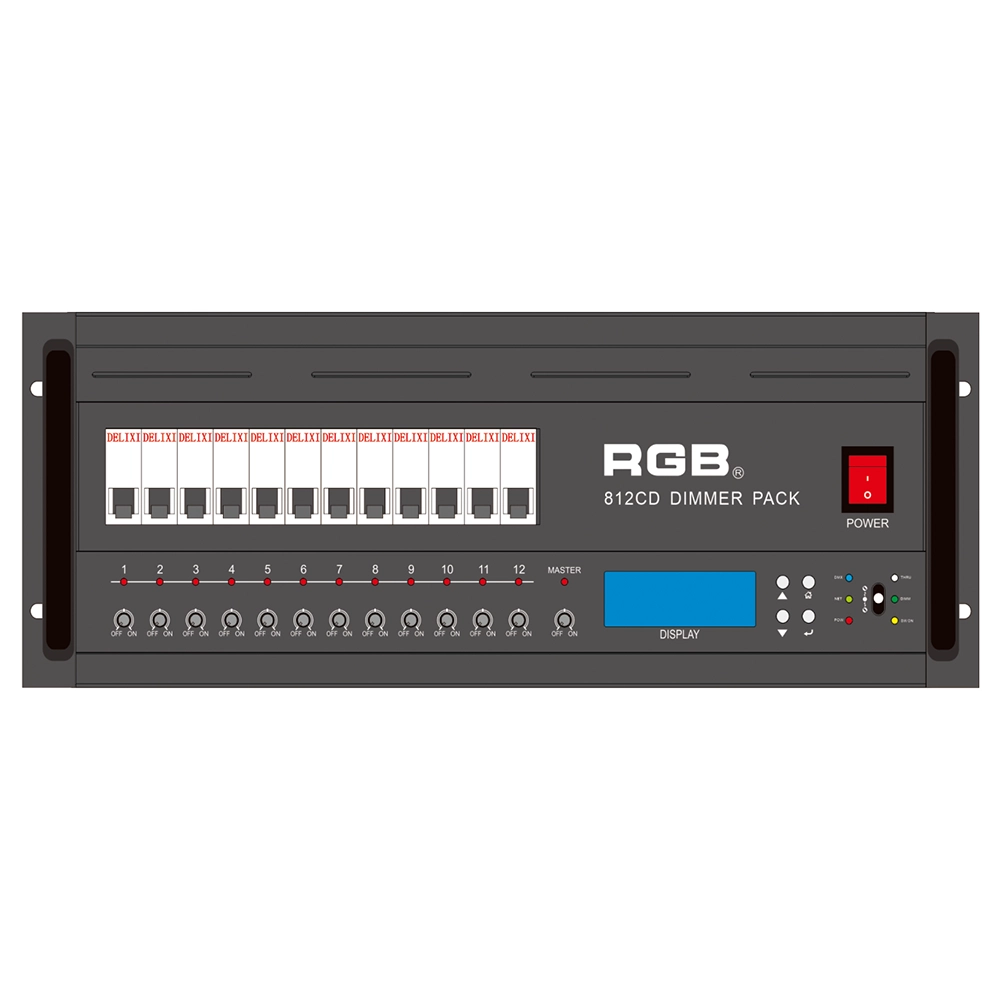
8 series network mixed portable silicon box
RGB is the latest development and production of all digital, intelligent, and network dimming through the hybrid silicon box. It comes with six channels (806 silicon box), twelve channels (812 silicon box) with analog knob dimming, 49 DMX field recordings and replays (field backup function), and self-programming and recording field. RGB-8 silicon box with DMX512 digital signal input and RJ45 network input interface, with various types of dimming stations at home and abroad used. It is a powerful, stable performance and reliable work of a new generation of intelligent digital dimming through a hybrid silicon box.
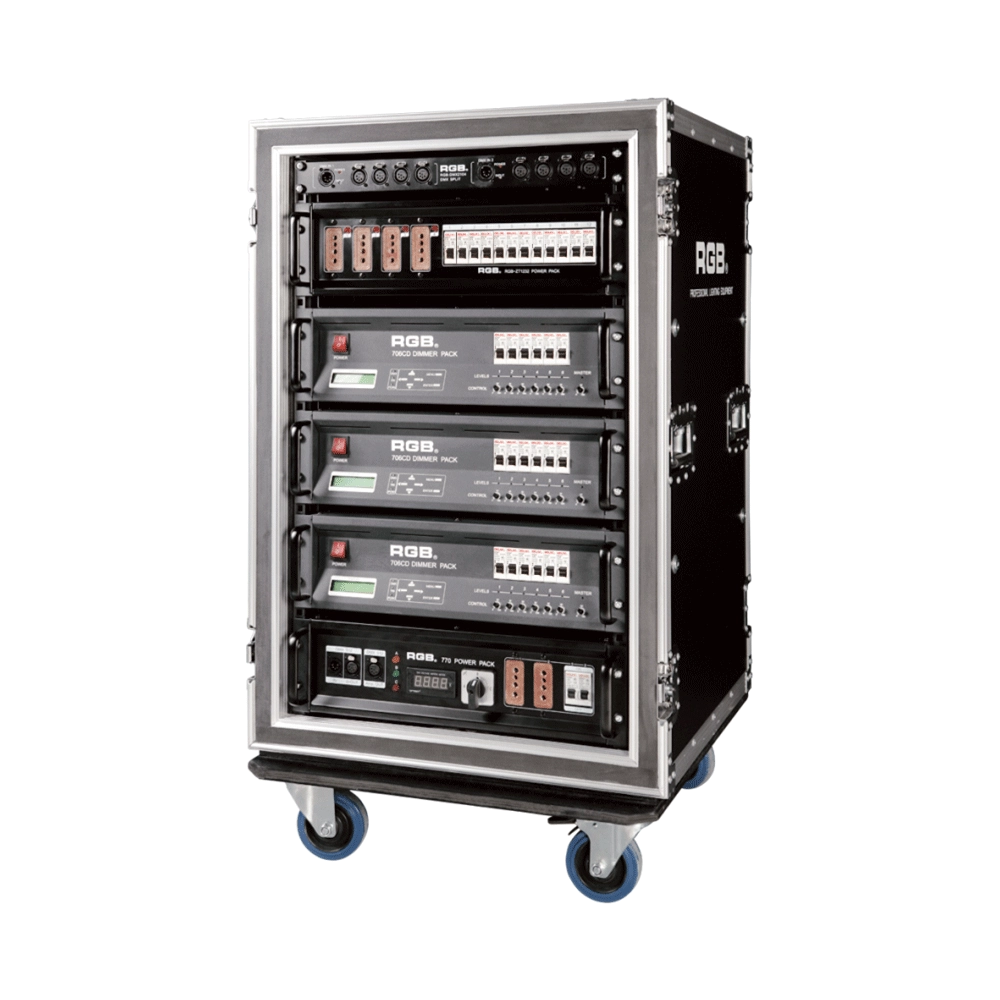
7 Series Digital Touring Dimmer Racks
7 Series digital touring dimmer racks can be assembled into many types of dimmer by taking the 7 Series dimmer as the unit. They are widely used in the entertainment industry for their convenience and practicability.
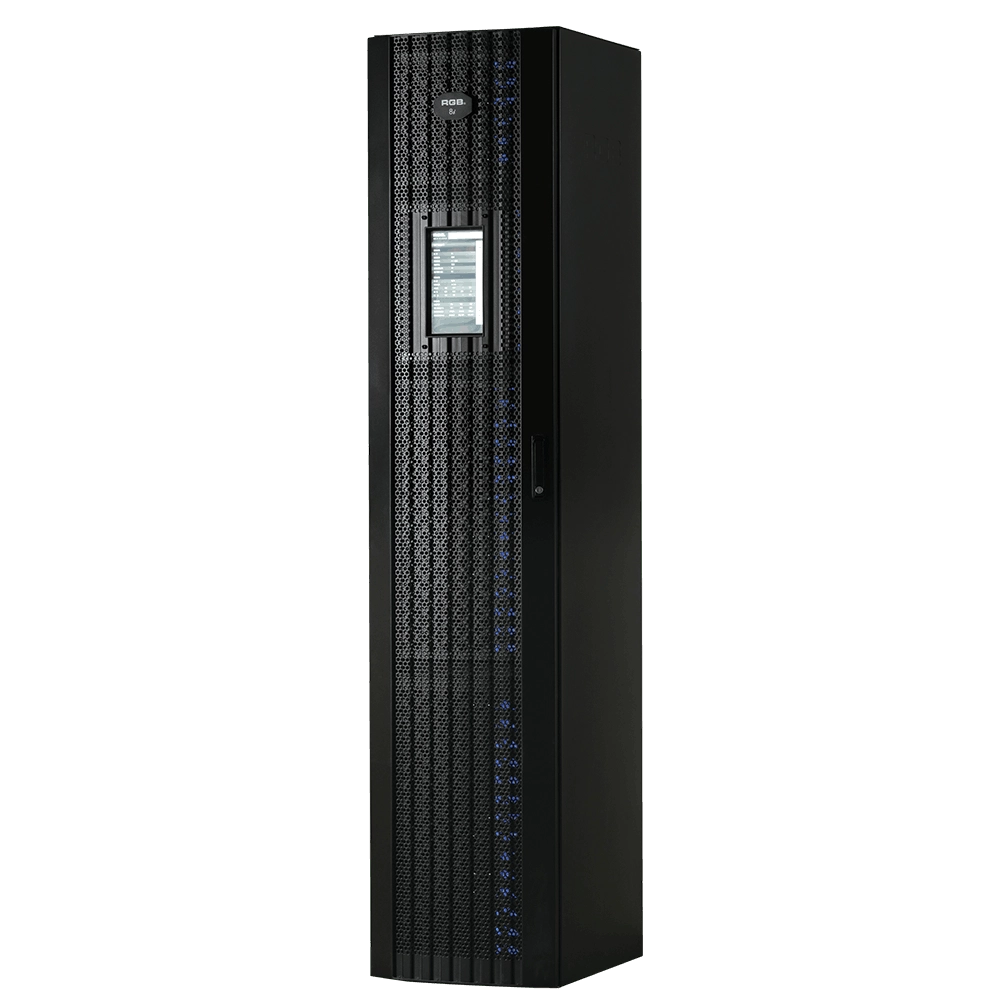
8i Intelligent Network Dimmer/Relay Racks
8i is RGB independent research and development, with completely independent core technology, software Copyrights, full digital electrodeless trigger dimming cabinet, with multiple backup electrodeless trigger control technology, with sine wave, thyristor, relay, dimming relay mixed output configuration, support visual lighting control system, intuitive display dimming cabinet online and offline status. Realize remote monitoring, editing and setting of relevant parameters.
It is widely used in performing arts and cultural venues such as theater, concert hall, multi-function hall, cultural travel and performing arts, TV station, gymnasium, auditorium, commercial art lighting and so on.
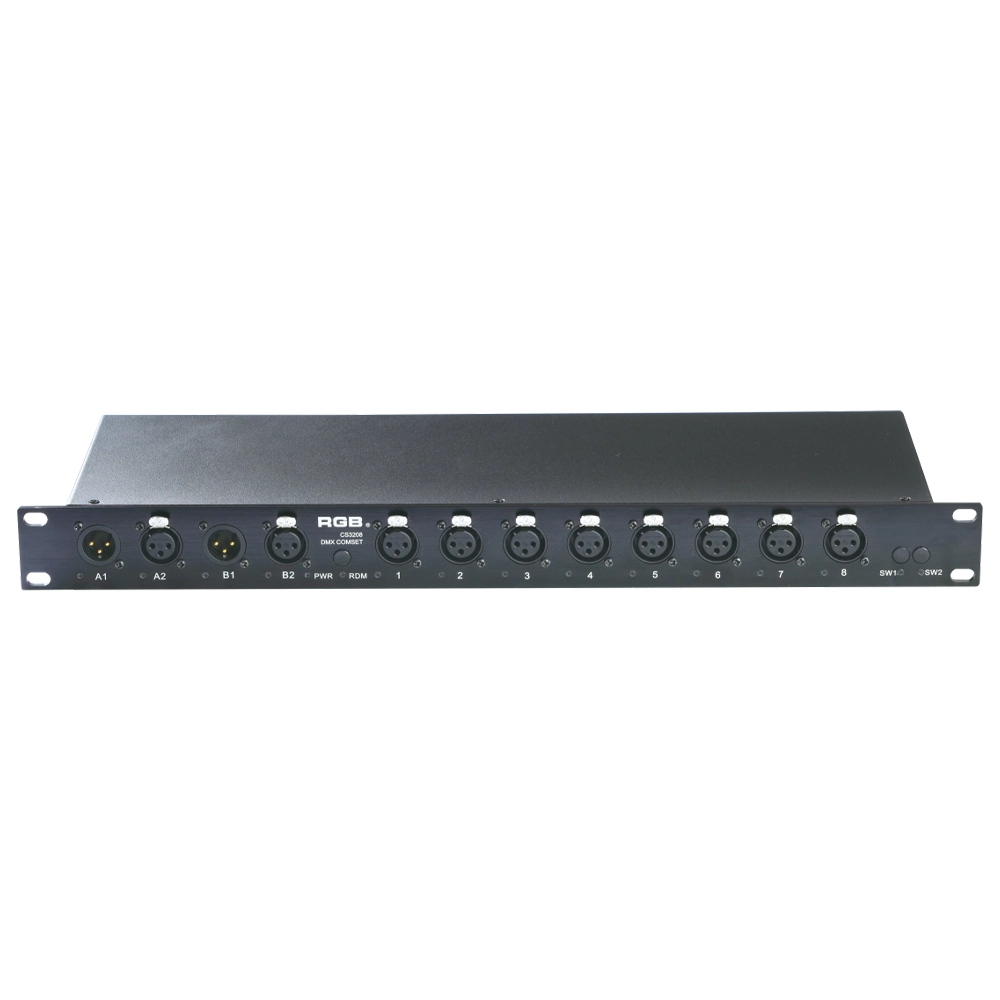
Multifunctional signal supercharger
The rack-mounted DMX signal amplifier complies with the DMX-512 standard protocol, improving DMX-512 signal transmission quality and ensuring reliable system control. It helps prevent issues such as AC high-voltage backflow into lighting control systems, lightning-induced surges, and signal interference caused by short circuits, thereby enhancing overall system stability.
Expert Support
Interested in learning more or need expert guidance related to this article? Fill in your details, and our team will provide tailored support.
Intelligent Control. Brilliant Performance.
RGB specializes in stage lighting control systems, delivering intelligent, reliable, and high-performance solutions for theaters and performance spaces worldwide.
Contact
Email:
Tel:
+86 20 3928 0245
+86 20 3928 0247
Address:
No.3, Huashan Road, Shilou Town, Panyu, Guangzhou, China.
Whatsapp: +8615975520131