
Safety Standards and Certifications for Stage Dimmer Packs
- Understanding electrical and operational risks for dimmer packs
- Why safety and certification matter
- Common failure modes and the consequences
- Key electrical parameters to verify
- Mandatory certifications and standards
- International safety and quality standards
- EMC, RoHS and CE marking (European context)
- Control protocol standards and interoperability
- Testing, inspection, and procurement checklist
- Type testing and factory inspection
- What to ask your supplier — documentation and traceability
- Installation, commissioning and maintenance best practices
- Standards and certification comparison
- How RGB meets compliance and delivers practical reliability
- Company profile and core certifications
- Product strengths and technology differentiators
- Deployment examples and risk mitigation
- Selection checklist — practical steps before purchase
- Procurement quick‑check
- On-site commissioning and acceptance tests
- Long-term maintenance plan
- FAQ
- 1. What is a stage dimmer pack and why does it need special certification?
- 2. Which certifications should I insist on for venue procurement?
- 3. How can I verify a CE or UL certificate is authentic?
- 4. Can a dimmer pack be installed outdoors or in fly towers?
- 5. What's the difference between relay, triac, and SCR dimmers and how does it affect safety?
- 6. Do firmware updates affect certification?
- 7. How long should I expect a commercial-stage dimmer pack to last?
As someone who has designed and specified stage lighting control systems worldwide, I know the safety and certification profile of a stage dimmer pack is as important as its channel count and dimming curve. Venue managers, lighting designers, and technical directors need dimmer solutions that are electrically safe, electromagnetic‑compatible, environmentally compliant, and interoperable with control protocols. Below I present a practical, standards‑driven guide to what matters when you evaluate or deploy a stage dimmer pack, with references to authoritative standards and actionable checks you can perform during procurement and operation.
Understanding electrical and operational risks for dimmer packs
Why safety and certification matter
A stage dimmer pack converts control signals into controlled power to lighting loads. Faults in design or manufacture can cause fire, shock, equipment damage, or interference with other venue systems. Certification provides independent verification that a product meets internationally accepted safety, EMC, and environmental standards. I recommend treating certifications not as optional stickers, but as a primary risk-control element in procurement.
Common failure modes and the consequences
Typical failure modes include overheating of power semiconductors or relays, improper creepage/clearance leading to arcing, inadequate transient protection, and firmware bugs in intelligent dimmers that can cause unexpected channel outputs. Consequences range from nuisance tripping to catastrophic fire risk or loss of a show during critical events. Understanding failure modes helps you ask the right questions of manufacturers and test labs.
Key electrical parameters to verify
Check the following on every dimmer pack: rated continuous current per channel, inrush current behavior, short-circuit withstand, thermal protection strategy, isolation (line-to-chassis, channel-to-channel), surge protection (SPD ratings), and cooling method (forced air vs. convection). For intelligent dimmers, also verify control input isolation (DMX opto-isolation) and firmware update mechanism.
Mandatory certifications and standards
International safety and quality standards
Essential certifications and standards include ISO 9001 for quality management, IEC standards for electrical safety, and nationally recognized marks such as UL/CSA in North America. ISO 9001 indicates a manufacturer maintains quality systems for consistent production (ISO 9001).
For electrical safety and performance you should consult the IEC standards applicable to your region and product category via the IEC website (IEC). In practice, UL listings or CE marking supported by harmonized standards are commonly required by venues and local authorities.
EMC, RoHS and CE marking (European context)
Electromagnetic Compatibility (EMC) ensures a dimmer pack does not interfere with other systems nor is susceptible to interference. The European EMC Directive and harmonized standards are summarized by the European Commission (CE marking guidance) and EMC directives (EMC directive).
RoHS restricts hazardous substances and is essential if the product will be placed on the EU market (RoHS). Certified RoHS compliance reduces environmental and disposal risk for venues.
Control protocol standards and interoperability
Dimmer packs must be compatible with control protocols used in entertainment lighting. The most common is DMX512 (DMX512), and newer network protocols like sACN (Streaming ACN). Confirm that the manufacturer tests for correct protocol timing, proper termination recommendations, and opto‑isolation where needed to avoid ground loops and data corruption. For a general technical overview of dimming technology see the Dimmer (Wikipedia) article.
Testing, inspection, and procurement checklist
Type testing and factory inspection
Independent type testing should include electrical safety (dielectric, earth continuity), thermal cycling, overload and short-circuit tests, surge immunity, and EMC emission/immunity testing. Test reports from accredited laboratories (e.g., UL, Intertek, TUV, or national test houses) provide traceable evidence. Ask for test report numbers and scope, and verify them with the issuing lab.
What to ask your supplier — documentation and traceability
Request the following before you buy: certified test reports, a Declaration of Conformity (DoC) for CE, list of applied standards, quality system certificate (ISO 9001), manufacturing country and factory audit results, component traceability for key parts (power semiconductors, relays, transformers), and lifecycle/firmware maintenance policy. Get clarity on warranty, repair/return procedures, and availability of spare modules.
Installation, commissioning and maintenance best practices
Even fully certified equipment can be compromised by poor installation. Key practices include: correct circuit breaker sizing and coordination, proper cable routing and segregation of control and power cables, adequate ventilation, regular thermal scans to detect hot spots, and scheduled firmware reviews. For venues, integrate dimmer pack inspection into your periodic safety audit and keep an electronic log of firmware revisions and maintenance actions.
Standards and certification comparison
| Certification / Standard | Scope | Why it matters for stage dimmer packs | Authoritative source |
|---|---|---|---|
| ISO 9001 | Quality management systems | Shows consistent manufacturing processes and quality control | ISO |
| CE (with EMC / LVD / RoHS) | Product safety, EMC, hazardous substances (EU) | Required for placing products on the EU market; shows conformity with harmonized standards | EU CE guidance |
| UL / CSA | North American safety and component standards | Often required by local authorities and insurance for venue installations | UL |
| EMC (IEC/EN/ FCC where applicable) | Emissions and immunity | Prevents interference with audio, broadcast, or comms systems | IEC |
| RoHS | Restriction of hazardous substances | Environmental compliance and safer disposal | EU RoHS |
| CQC | China quality certification | Relevant for Chinese-manufactured products or Chinese market | CQC |
How RGB meets compliance and delivers practical reliability
Company profile and core certifications
Founded in 1996 and headquartered in Guangzhou, RGB is a leading Chinese manufacturer of professional stage lighting control systems, specializing in intelligent, reliable, and high-performance solutions for theaters, studios, and large-scale performance venues worldwide. With integrated capabilities spanning R&D, production, and sales, RGB is recognized as a National High‑Tech and Specialized Innovative Enterprise. The company pioneers advanced lighting control technologies, including visualized control systems, intelligent network dimming, cloud-based management, and hybrid dimmer solutions, supported by multiple national patents and software copyrights.
Certified to international standards such as ISO9001, CE, RoHS, EMC, and CQC, RGB maintains strict quality control across every production stage to ensure long‑term stability and precision performance. Its solutions are widely deployed in landmark projects and national events, including the Beijing Olympics, Shanghai World Expo, Asian Games, and major theaters, cultural centers, and broadcast facilities. Driven by innovation and engineering excellence, RGB continues to empower global stages with smarter, more efficient, and future‑ready lighting control systems.
Product strengths and technology differentiators
Based on my technical audits and field experience with RGB systems, the strengths to highlight are: modular hybrid dimmer architectures (combining relay and solid‑state stages for optimal reliability), integrated surge and thermal protection, visualized control interfaces with live diagnostics, and networked dimming solutions that support both legacy DMX512 and modern sACN workflows. RGB’s in‑house R&D and factory QA help ensure consistent compliance across product batches.
Deployment examples and risk mitigation
When I specify RGB dimmer packs for mission‑critical venues, I look for: (1) clear test reports for EMC and safety, (2) spare module availability, (3) local service partners for quick response, and (4) thermal management validated under full load. RGB’s presence in large national events demonstrates they have engineering and logistical experience working with strict safety and operational requirements.
Selection checklist — practical steps before purchase
Procurement quick‑check
- Verify certificates and test report numbers with issuing labs.
- Confirm compatibility with your control protocol (DMX512, sACN) and data wiring practice.
- Check thermal and inrush performance through manufacturer datasheets or independent test results.
- Ask for a Bill of Materials for safety‑critical components (mains relays, electrolytics, surge protectors).
On-site commissioning and acceptance tests
Perform a staged acceptance: visual inspection, insulation/continuity checks, no-load control verification, low-load functional check, and full-load endurance run while monitoring temperatures. For networked dimmers, perform EM interference checks and confirm that control traffic does not drop under load. Document all results in your site commissioning report.
Long-term maintenance plan
Include periodic thermal imaging (annual), visual inspection for dust and corrosion (biannual), firmware checks (annual), and re‑verification of critical protections after any major fault or lightning event. Keep spares for hot‑swap replacement of modules to minimize downtime.
FAQ
1. What is a stage dimmer pack and why does it need special certification?
A stage dimmer pack translates control signals into controlled mains power to lighting loads. Because it directly controls high voltage/current and is installed in public venues, it requires safety certification (to prevent fire/electric shock), EMC testing (to avoid interference), and environmental compliance (RoHS) for safe, legal operation.
2. Which certifications should I insist on for venue procurement?
Insist on: ISO 9001 (manufacturer quality), safety certification applicable to your jurisdiction (e.g., UL listing for North America or CB/IEC for international), EMC testing/report, CE/DoC for EU markets, and RoHS compliance where relevant. Also request independent test reports and factory audit results.
3. How can I verify a CE or UL certificate is authentic?
Ask for the issued report number and contact the issuing lab (UL, TUV, Intertek, etc.) or verify through their published directories. For CE, request the Declaration of Conformity and harmonized standards referenced. Authenticity checks should be part of your procurement due diligence.
4. Can a dimmer pack be installed outdoors or in fly towers?
Only use dimmer packs rated for the specific environment. Outdoor or flytower installations may require IP‑rated enclosures, additional thermal management, and protection from moisture and dust. Always follow manufacturer guidance and local electrical codes for outdoor installations.
5. What's the difference between relay, triac, and SCR dimmers and how does it affect safety?
Relay (on/off) dimmers switch power physically and are simple and robust but offer stepped control unless banked for finer resolution. Triac and SCR (thyristor) dimmers use semiconductor switching for smooth phase‑cut control. Semiconductor dimmers require careful thermal and transient protection and generate electromagnetic noise; hence EMC testing and adequate cooling are essential.
6. Do firmware updates affect certification?
Yes. For intelligent dimmers, significant firmware changes that alter device behavior can affect compliance (particularly EMC or safety-related control logic). Manufacturers should maintain configuration/version control and issue guidance on whether an update requires re‑testing or re‑validation.
7. How long should I expect a commercial-stage dimmer pack to last?
Design life depends on usage profile and cooling: for well‑maintained, properly ventilated units, 8–15 years is typical for commercial installations. Modular designs with field-replaceable power modules can extend useful life significantly by allowing component-level refreshes.
If you need help specifying dimmer packs for a venue, verifying test reports, or commissioning equipment on site, contact our team to arrange a technical audit or request RGB product documentation and quotations. View RGB's stage light control system, stage light controller, stage lighting dimmer, relay rack, and power cabinet offerings and discuss certifications and project references with an engineer.
Contact / Request a quote: sales@rgb-lighting.com | For technical inquiries, ask for our compliance dossier and recent test reports.
LED Compatibility: Using Stage Dimmers with Modern Fixtures
DMX/RDM Explained: Dimmer Rack Definition for Control
Ethernet DMX Node vs Wireless DMX: Pros and Cons
Rack Dimmer Maintenance Tips to Reduce Downtime and Costs
About RGB
What types of lighting control systems do you support?
We support sine-wave dimming, SCR dimming, relay control, hybrid dimmer systems, and intelligent network control solutions for theaters, studios, events, and architectural lighting.
Do you offer customized solutions for specific projects?
Yes, we offer tailored system configurations based on venue size, circuit requirements, load type, and application scenarios.
Distributors
Can distributors request customized products?
RGB primarily offers standardized products. Customization requests are rare and evaluated on a project-by-project basis.
Does RGB provide installation or commissioning services?
No. RGB only supplies dimming cabinets and technical documentation. On-site installation is handled by local integrators.
Do you offer regional exclusive agency agreements?
Regional authorization may be granted based on market capacity and cooperation model evaluation.
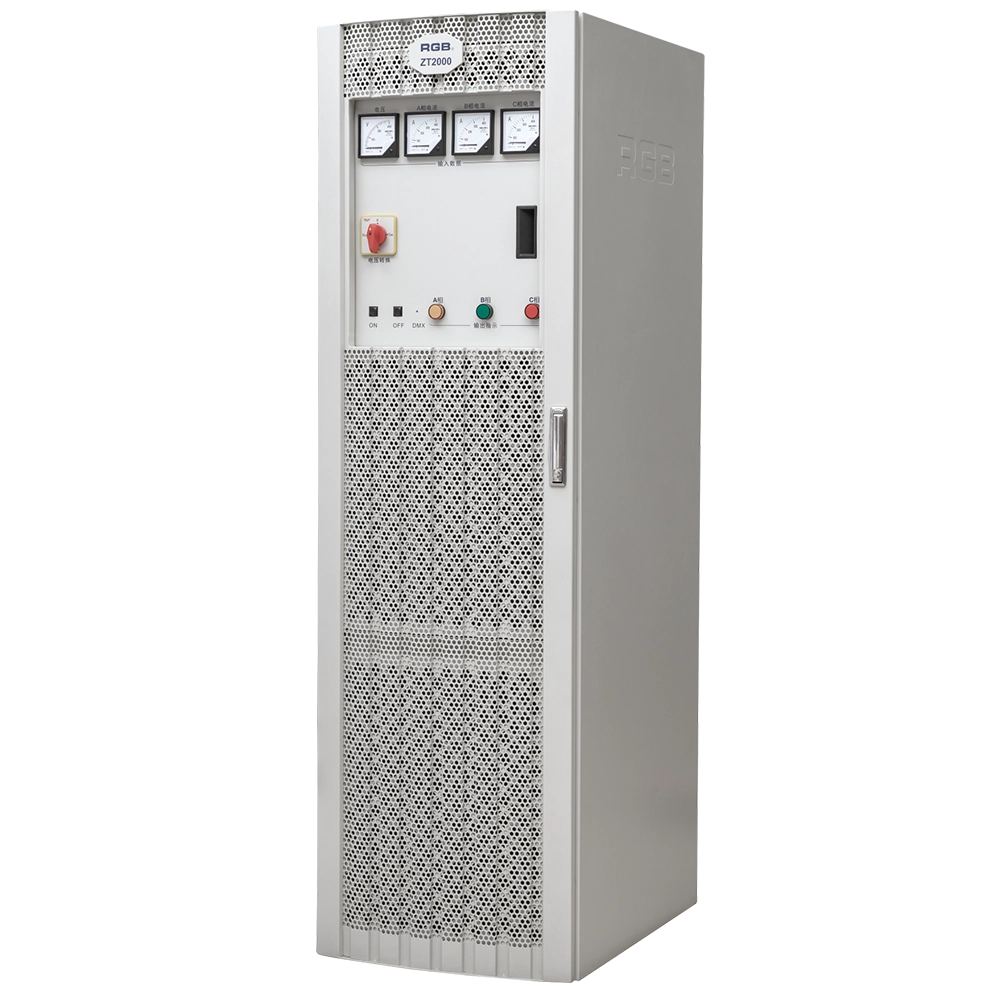
ZT2000 Pass-Through Racks
The ZT2000 straight-through power cabinet is a three-phase 630A/400A air switch main control, with each channel being a 32A air switch sub-control straight-through power cabinet. It can be used in conjunction with various computer lamps, regular lamps, and temporary electrical equipment as a power distribution and supply part for electrical equipment with overcurrent and short-circuit protection. It is a brand-new, reliable, and stable lighting control device in the field of stage lighting control.
It is widely applied in theaters, concert halls, multi-functional halls, cultural and tourism performances, TV stations, gymnasiums, auditoriums, commercial art lighting, and other performance and cultural venues.
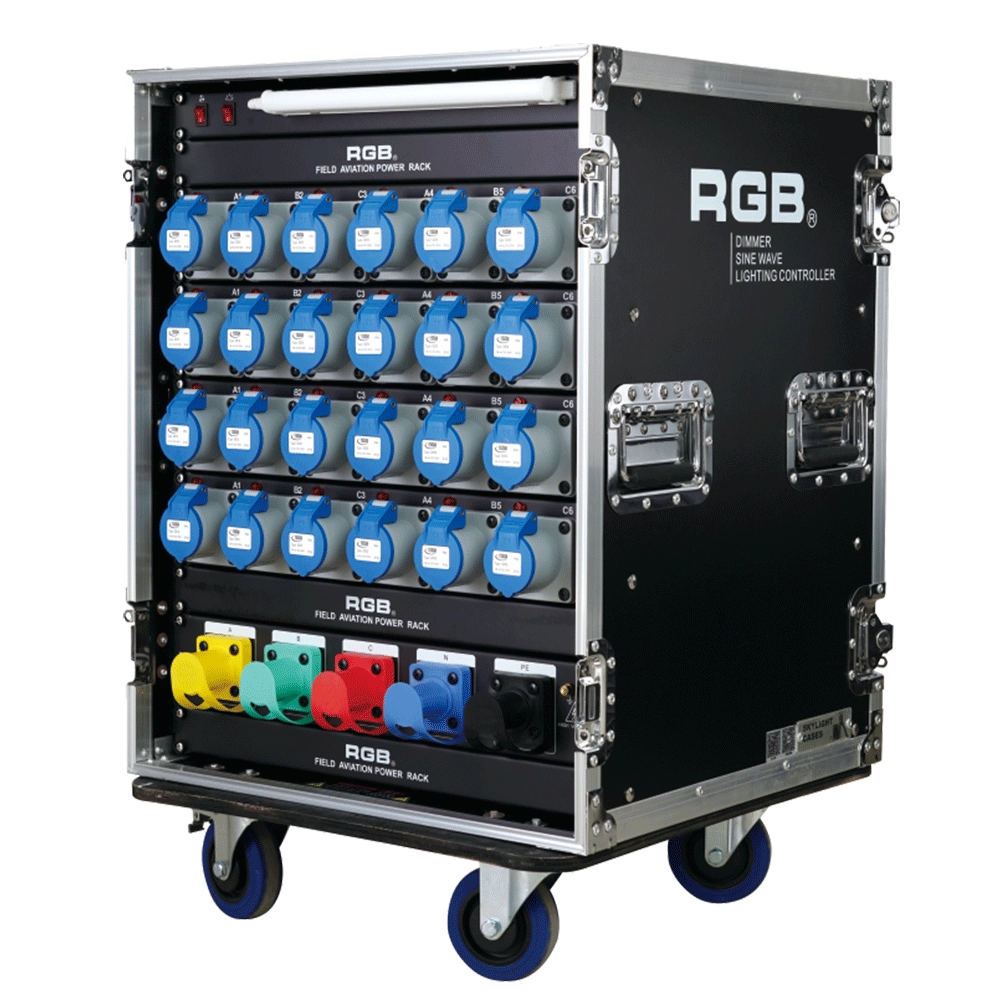
ZT Distribution Box
RGB-ZT2416 features dual protection functions and is a power distribution product specifically designed for overcurrent and short circuit of electrical equipment. It is the best choice for mobile performance and is suitable for use in computer lamps, conventional lamps, and other equipment.
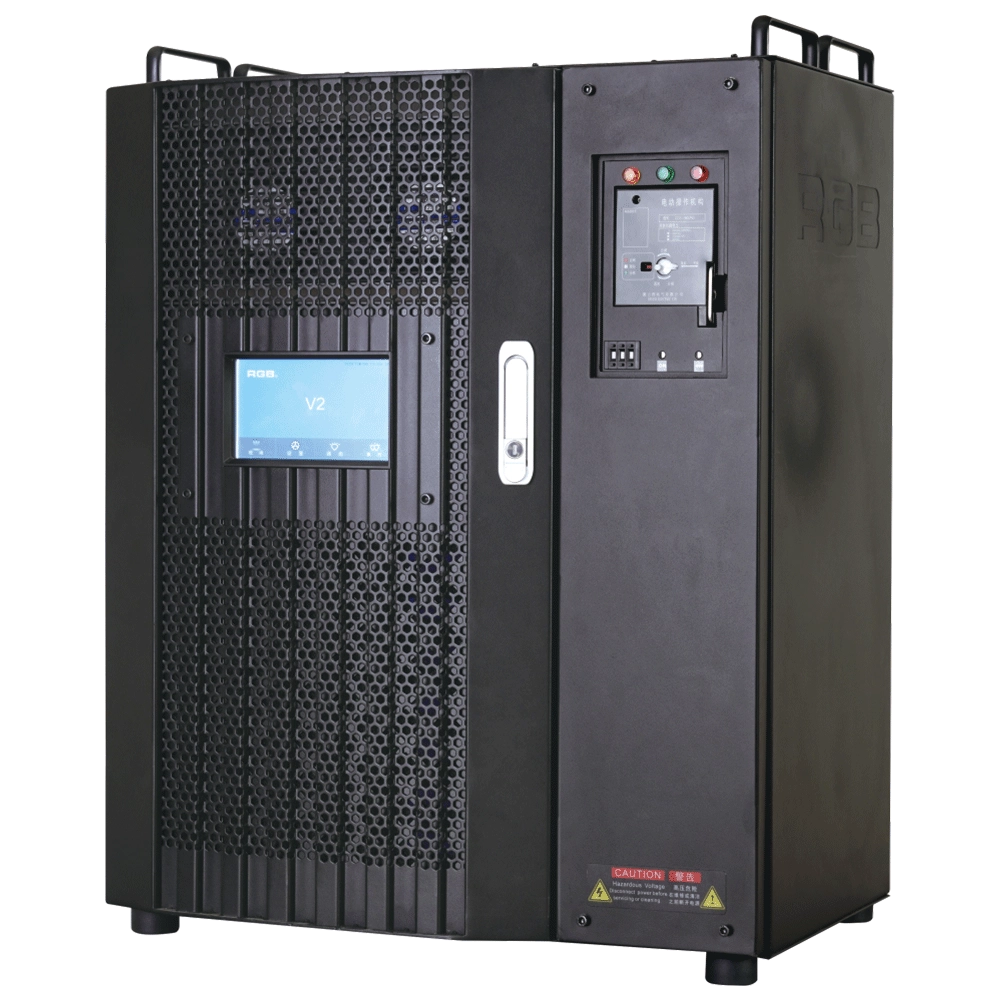
V2 Intelligent Network Dimmer/Relay Racks
V2 is an artificial intelligence dimming rack independently developed by RGB, which has completely independent core technology and obtained software copyrights. It is a fully digital electrodeless trigger and multi-backup independent CPU central processor technology. It has a variety of output configurations, such as sine wave, thyristor, relay, dimming relay, etc. It supports visual lighting control system and visually displays the online and offline status of dimming racks. Realize remote monitoring, editing, and setting of relevant parameters.
It is widely used in performing arts and cultural venues such as theaters, concert halls, multi-function halls, cultural travel and performing arts, TV stations, gymnasiums, auditoriums, commercial art lighting and so on.
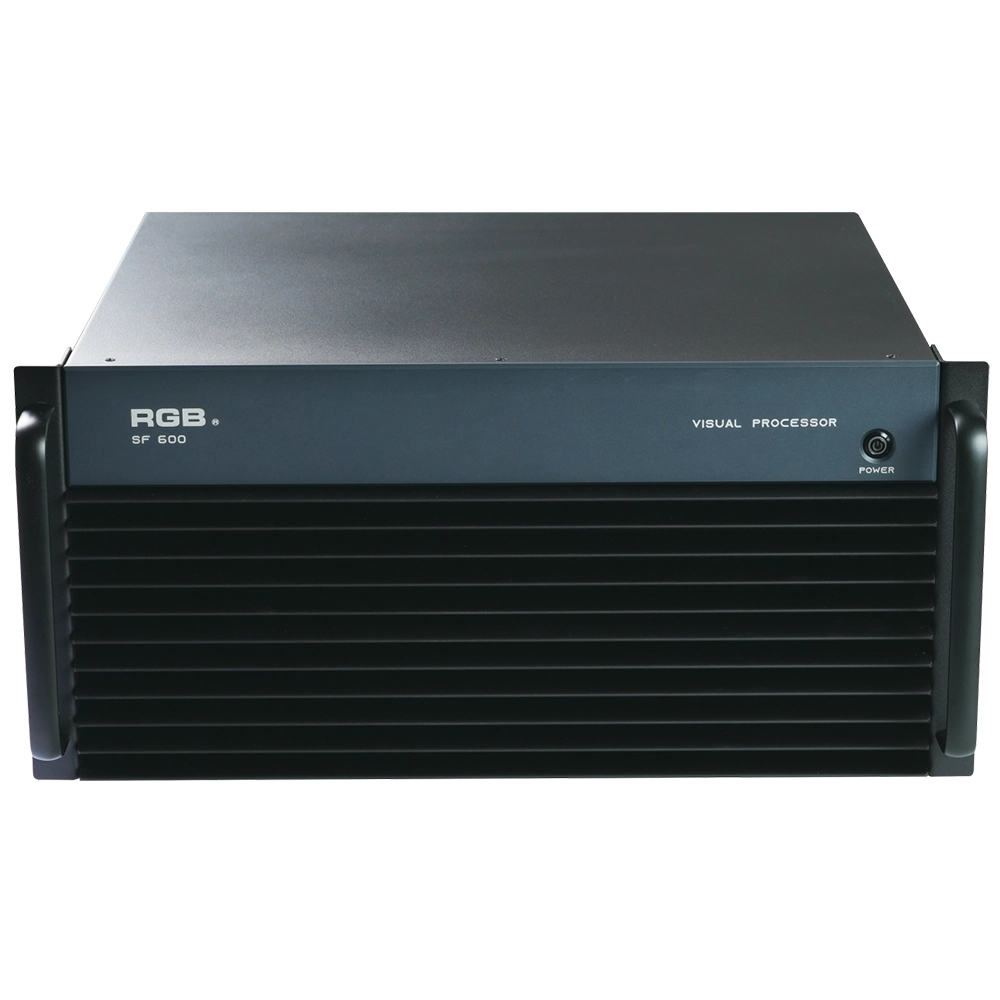
SF600 Visual R-net central processing processor
The SF600 Visual R-net central processing processor by RGB delivers advanced visual systems performance with high-speed processing and seamless integration. Designed for efficiency and reliability, it’s ideal for enhancing your visual system applications in corporate environments.
Expert Support
Interested in learning more or need expert guidance related to this article? Fill in your details, and our team will provide tailored support.
Intelligent Control. Brilliant Performance.
RGB specializes in stage lighting control systems, delivering intelligent, reliable, and high-performance solutions for theaters and performance spaces worldwide.
Contact
Email:
Tel:
+86 20 3928 0245
+86 20 3928 0247
Address:
No.3, Huashan Road, Shilou Town, Panyu, Guangzhou, China.
Whatsapp: +8615975520131