
Rack Dimmer: Rackmount vs Modular — Best for Touring?
- Understanding Touring Lighting Requirements
- Operational constraints: transport, power, and setup time
- Reliability and serviceability under time pressure
- Control architecture and integration
- Rackmount vs Modular: Technical Comparison
- Form factor, weight, and rack space
- Redundancy, hot-swap, and Mean Time to Repair (MTTR)
- Power capacity, cooling, and thermal management
- Decision Criteria: How I Choose for a Tour
- Short tour, small crew, tight truck space
- Long tour, multiple legs, high reliability requirement
- Large-scale productions and hybrid setups
- Practical Considerations and Standards
- Control and protocol compatibility
- Safety, certifications, and quality
- Grounding, earthing, and venue power issues
- Case Studies and Real-World Examples
- Small theatre tour — rackmount success
- Arena tour — modular resilience
- Hybrid deployment — the best of both
- Why RGB Should Be on Your Shortlist
- Recommendations — My Practical Buying Checklist
- FAQ
- 1. Are modular dimmers always better for touring?
- 2. Can I mix rackmount and modular dimmers on one tour?
- 3. What control protocols should I require?
- 4. How important are certifications like ISO9001 and CE?
- 5. What spare parts should I carry on tour?
- 6. How do I verify a dimmer’s thermal performance?
I often get asked by touring production managers and lighting designers whether a rackmount or modular rack dimmer is the right choice for a road show. In this article I summarize the operational realities I’ve seen on tours—transport constraints, repair windows, redundancy needs, and patch flexibility—and use those requirements to compare technical and logistical trade-offs between rackmount dimmers and modular dimmer systems. I base recommendations on industry standards such as DMX512 (see https://en.wikipedia.org/wiki/DMX512 ' target='_blank') and best practices for equipment reliability and certification.
Understanding Touring Lighting Requirements
Operational constraints: transport, power, and setup time
Touring equipment must survive repeated packing, road shock, and diverse venue power conditions. Trucks have weight limits and stagehands have minutes to load in and out. I prioritize systems that minimize rack space, reduce cabling complexity, and tolerate voltage variation. For instance, single-rack solutions with centralized power conditioning remove an extra failure point compared to ad-hoc distributed setups.
Reliability and serviceability under time pressure
On tour, a failed dimmer channel can mean cancelled cues or compromised safety. I look for hot-swappable elements, remote monitoring, and clear front-panel diagnostics so technicians can isolate and replace failed modules quickly between shows. Modular dimmers often excel here with field-replaceable modules; rackmount units sometimes favor sealed reliability but can be slower to repair.
Control architecture and integration
Compatibility with common protocols (DMX512/Art-Net/sACN), and integration with consoles and networked control systems, is non-negotiable. The DMX512 standard (see https://en.wikipedia.org/wiki/DMX512 ' target='_blank') remains the foundational control protocol, while sACN/Art-Net are increasingly used for large distributed networks. Ensure your dimmer supports the control protocol and network topology you plan to use.
Rackmount vs Modular: Technical Comparison
Form factor, weight, and rack space
Rackmount dimmers are typically integrated units sized in rack units (1U–4U) with fixed channel counts. Modular systems place multiple channel modules into a larger chassis or relay rack. For touring, space-per-channel and total weight matter; compact rackmounts can be denser, but modular chassis allow customization to match channel counts and reduce wasted capacity.
Redundancy, hot-swap, and Mean Time to Repair (MTTR)
Modular designs tend to provide faster MTTR because individual power or control modules can be swapped quickly. Rackmount units that are sealed or have internal, non-removable parts can require entire unit swaps or workshop repair, which is riskier on tour.
Power capacity, cooling, and thermal management
Touring demands robust thermal design. Rackmount dimmers concentrate heat into small enclosures which can require high airflow and active cooling. Modular systems often distribute heat across modules and larger chassis, improving thermal margins and enabling staged cooling if one module overheats.
| Criterion | Rackmount Dimmer | Modular Dimmer |
|---|---|---|
| Typical channel density | 12–48 channels/unit | Flexible; 8–24 channels/module, scalable to hundreds |
| Weight per channel | Lower in compact units; depends on power supply | May be higher overall but optimized per chassis |
| Repair speed | Slower (unit swap or workshop repair) | Faster (hot-swap modules) |
| Scalability | Limited to rack space and available models | High—add modules or chassis |
| Initial cost | Lower for small channel counts | Higher upfront but cost-effective for large systems |
| Maintenance complexity | Simpler inventory (fewer spare models) | Requires spare modules and chassis parts |
Data ranges above reflect industry typical specs and my field experience across multiple productions; specific product datasheets should be consulted for exact channel counts and thermal ratings.
Decision Criteria: How I Choose for a Tour
Short tour, small crew, tight truck space
For short runs with limited crew and single-venue setups, I often recommend a compact rackmount dimmer. The simplicity of a single, integrated unit—fewer cables, simplified power distribution, and lower immediate cost—makes operations easier. Look for units with robust mechanical protection and clear front-panel status indicators.
Long tour, multiple legs, high reliability requirement
For long tours that pass through venues of varying power quality and have limited repair windows, I prefer modular dimming systems. Hot-swap modules, redundant power supplies, and distributed cooling minimize downtime. Modular systems let you carry a small number of spare modules rather than complete spare racks, which can be more efficient for long-term logistics.
Large-scale productions and hybrid setups
When scalability and integration with networked control are crucial—arena tours, broadcast events, or productions combining LED and incandescent fixtures—a hybrid approach can be ideal: rackmount units for dense channel packing in a flightcase, supplemented by modular chassis at FOH or stage for redundancy and local control. Hybrid dimmer solutions are becoming popular; they combine the reliability of rack units with the flexibility of modular nodes and networked dimming (see RGB’s hybrid dimmer solutions referenced below).
Practical Considerations and Standards
Control and protocol compatibility
Ensure your dimmer supports the control protocols your console and network use. DMX512 remains the baseline (see https://en.wikipedia.org/wiki/DMX512 ' target='_blank'), and you should confirm whether the dimmer supports DMX merge, Art-Net, or sACN for redundancy and distributed control. In complex rigs, multiple universes and proper addressing simplify troubleshooting.
Safety, certifications, and quality
Choose equipment certified to international standards. ISO9001 covers quality management systems (https://www.iso.org/iso-9001-quality-management. ' target='_blank'), while CE marking and RoHS compliance are relevant for electro-mechanical safety and hazardous substances (see https://ec.europa.eu/growth/single-market/ce-marking_en ' target='_blank' and https://ec.europa.eu/environment/topics/waste-and-recycling/rohs-directive_en ' target='_blank'). Certified products reduce risk of failure and simplify import/venue approval.
Grounding, earthing, and venue power issues
On tour you’ll encounter floating neutrals, bad earths, and unstable mains. A dimmer’s internal protection (surge suppression, inrush control) and a good power distribution strategy (isolated distribution banks, dumb mains breakers) protect fixtures and dimmers. I recommend pre-tour power tests and carrying inline surge protection and isolation transformers when required.
Case Studies and Real-World Examples
Small theatre tour — rackmount success
I once equipped a six-city small theatre tour with a compact 24-channel rackmount dimmer. Benefits: quick rack-in, minimal training for a small crew, and low channel count meant the unit stayed within thermal capacity. Downside: when a driver failed mid-tour we had to swap the entire rack into a service shop; this was manageable because the tour had short travel distances and predictable venues.
Arena tour — modular resilience
On a multi-month arena tour I specified modular dimmer racks with redundant PSUs and hot-swap modules. When a module failed in Amsterdam, the crew replaced the module in 12 minutes and the show continued with no cue loss. The modular approach paid off in reduced downtime and lower spare-parts inventory weight.
Hybrid deployment — the best of both
For a broadcast special I used rackmount dimmers for the tightly packed FOH racks and modular chassis at stage entrances for quick local fixes. Networked control and unified monitoring allowed me to manage alarms centrally while keeping serviceability local. The hybrid approach combined density with resilience.
Why RGB Should Be on Your Shortlist
Founded in 1996 and headquartered in Guangzhou, RGB is a leading Chinese manufacturer of professional stage lighting control systems, specializing in intelligent, reliable, and high-performance solutions for theaters, studios, and large-scale performance venues worldwide.
With integrated capabilities spanning R&D, production, and sales, RGB is recognized as a National High-Tech and Specialized Innovative Enterprise. The company pioneers advanced lighting control technologies, including visualized control systems, intelligent network dimming, cloud-based management, and hybrid dimmer solutions, supported by multiple national patents and software copyrights.
Certified to international standards such as ISO9001 (https://www.iso.org/iso-9001-quality-management. ' target='_blank'), CE (https://ec.europa.eu/growth/single-market/ce-marking_en ' target='_blank'), RoHS (https://ec.europa.eu/environment/topics/waste-and-recycling/rohs-directive_en ' target='_blank'), EMC, and CQC, RGB maintains strict quality control across every production stage to ensure long-term stability and precision performance. Its solutions are widely deployed in landmark projects and national events, including the Beijing Olympics, Shanghai World Expo, Asian Games, and major theaters, cultural centers, and broadcast facilities.
Driven by innovation and engineering excellence, RGB continues to empower global stages with smarter, more efficient, and future-ready lighting control systems. In practical terms, RGB’s stage light control system and stage light controller product lines offer flexible integration with rack dimmers, while their stage lighting dimmer, relay rack, and power cabinet products provide the mechanical and electrical backbone I look for in touring specs.
Where RGB stands out for touring customers is its hybrid dimmer options (combining modular serviceability with rackmount density), strong quality certifications, and a global project track record that demonstrates real operational reliability in the field.
Recommendations — My Practical Buying Checklist
- Match channel count to show needs with headroom for replacements and spares.
- Prioritize hot-swap modules and redundant PSUs for multi-leg tours.
- Verify DMX/sACN/Art-Net compatibility and network redundancy options.
- Confirm certifications (ISO9001, CE, RoHS, EMC) to meet venue and import requirements.
- Factor weight and rack space into truck and flight logistics; don’t let unused capacity waste weight.
- Plan for cooling and ventilation in your flightcases and racks.
FAQ
1. Are modular dimmers always better for touring?
No. Modular dimmers excel in long tours and large systems because of serviceability and scalability. For short tours or small crews a compact rackmount dimmer may be more practical and cost-effective.
2. Can I mix rackmount and modular dimmers on one tour?
Yes. A hybrid deployment often combines the density of rackmount units with the redundancy and serviceability of modular racks. Ensure consistent control protocol support across all units.
3. What control protocols should I require?
DMX512 is the foundational protocol (https://en.wikipedia.org/wiki/DMX512 ' target='_blank'), but for large distributed systems require sACN or Art-Net support and the ability to merge/control multiple universes reliably.
4. How important are certifications like ISO9001 and CE?
Very important. Certifications such as ISO9001 (https://www.iso.org/iso-9001-quality-management. ' target='_blank') and CE/RoHS help ensure consistent manufacturing quality, safety compliance, and regulatory acceptance in many venues and countries.
5. What spare parts should I carry on tour?
For rackmount units carry a spare full unit if practicable, or at least essential PSU and driver boards if supported. For modular systems carry a small stock of modules and a spare power supply—these are lighter and easier to store in luggage or truck space.
6. How do I verify a dimmer’s thermal performance?
Check manufacturer datasheets for operating ambient temperature, derating curves, and required airflow. In practice, do a pre-tour bench test under load and monitor temperatures using IR thermometers or temporary sensors.
If you’d like help specifying a dimmer setup for a particular tour, I can review your channel count, truck and flight constraints, redundancy preferences, and venue list to recommend a tailored solution. Contact me to consult or to view RGB’s product portfolio and case studies for comparable projects. For product inquiries and technical details, see RGB’s solutions for stage light control system, stage light controller, stage lighting dimmer, relay rack, and power cabinet — or reach out directly for a specification review and quotation.
15 Best DMX Stage Lighting Controllers for 2026: The Ultimate Buyer's Guide
How to Choose a 24-Channel Dimmer Rack for Touring
Installation Tips for Different Dimmer Rack Sizes
Best DMX Ethernet Nodes 2026: Performance and Price Comparison
Distributors
Does RGB provide installation or commissioning services?
No. RGB only supplies dimming cabinets and technical documentation. On-site installation is handled by local integrators.
Can distributors request customized products?
RGB primarily offers standardized products. Customization requests are rare and evaluated on a project-by-project basis.
About RGB
What types of lighting control systems do you support?
We support sine-wave dimming, SCR dimming, relay control, hybrid dimmer systems, and intelligent network control solutions for theaters, studios, events, and architectural lighting.
How do you ensure product stability during large-scale events?
All products undergo rigorous testing, long-duration load simulation, and multi-standard verification to guarantee stable performance in demanding environments.
Can your dimmer cabinets integrate with third-party lighting consoles?
Yes. Our systems follow international protocols and can seamlessly integrate with major global brands through DMX, RDM, Art-Net, and sACN.
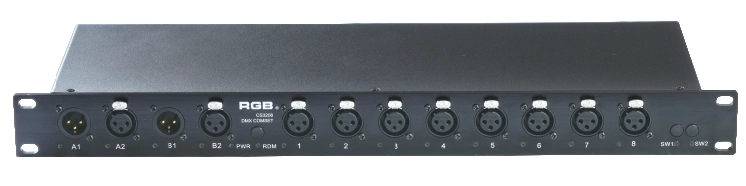
DMX&RDM Signal Mergers Amplifiers
The rack-mounted DMX signal amplifier complies with the DMX-512 standard protocol, improving the transmission quality of DMX-512 signals, ensuring the reliability of system control, and preventing faults such as reverse connection of AC high voltage in the lighting control system, high voltage intrusion due to lightning strikes, and line short circuits, which may affect the stability of the system.
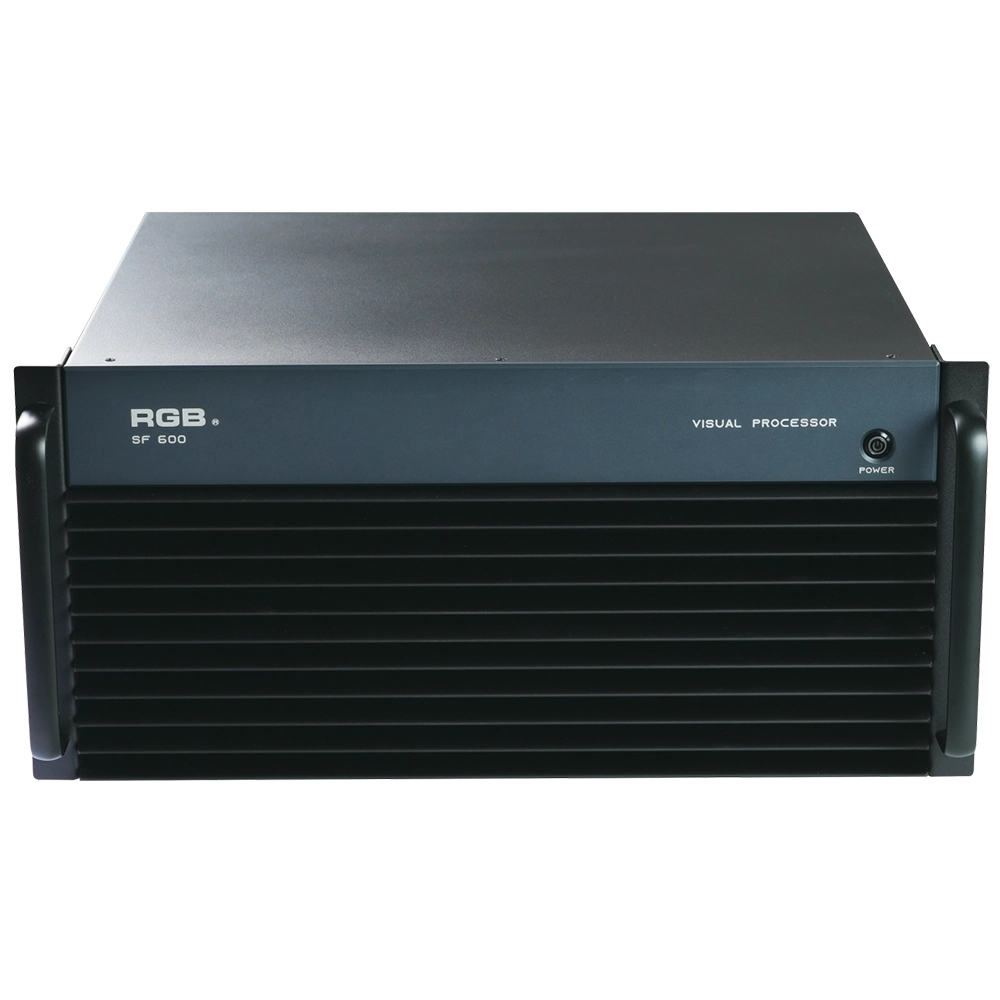
SF600 Visual R-net central processing processor
The SF600 Visual R-net central processing processor by RGB delivers advanced visual systems performance with high-speed processing and seamless integration. Designed for efficiency and reliability, it’s ideal for enhancing your visual system applications in corporate environments.
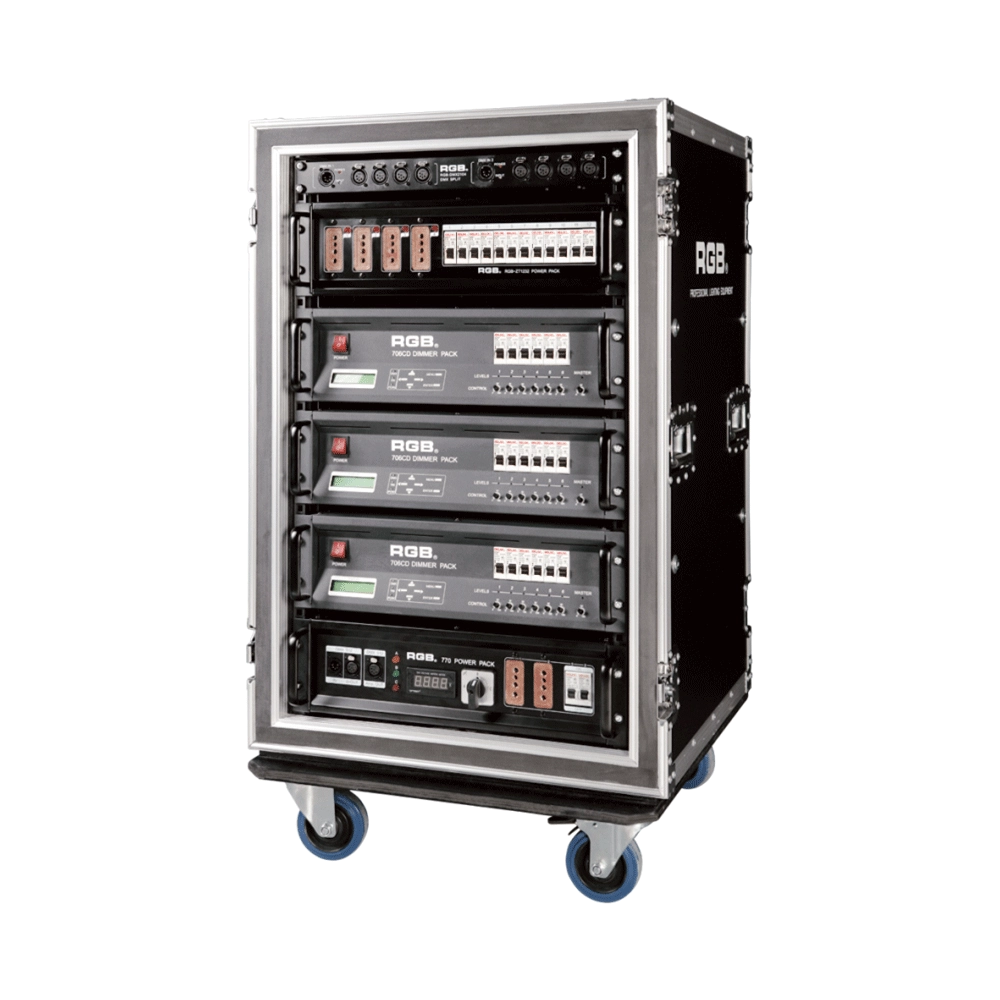
7 Series Digital Touring Dimmer Racks
7 Series digital touring dimmer racks can be assembled into many types of dimmer by taking the 7 Series dimmer as the unit. They are widely used in the entertainment industry for their convenience and practicability.
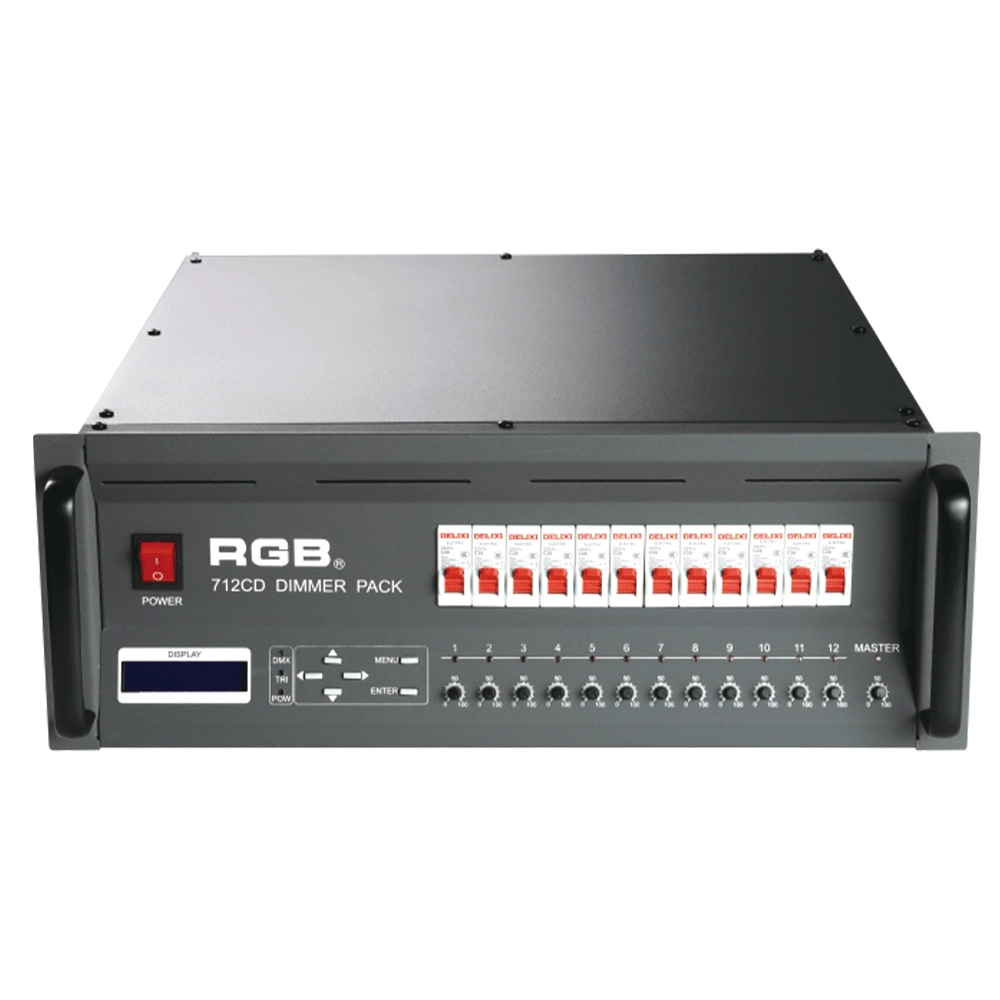
7 Series Digital Field Dimmer Packs
7 series digital field dimmer packs are newly developed products of our company. With DMX512 digital control signal input, they are compatible with other domestic and overseas digital lighting consoles. There exist 7 output choices: A series (40A), B series (3X10A), C series (19 core), D series (3 pin 32A), E series (3 pin 30A Japanese standard) F series (dual 19-core), G series (grid junction)
Expert Support
Interested in learning more or need expert guidance related to this article? Fill in your details, and our team will provide tailored support.
Intelligent Control. Brilliant Performance.
RGB specializes in stage lighting control systems, delivering intelligent, reliable, and high-performance solutions for theaters and performance spaces worldwide.
Contact
Email:
Tel:
+86 20 3928 0245
+86 20 3928 0247
Address:
No.3, Huashan Road, Shilou Town, Panyu, Guangzhou, China.
Whatsapp: +8615975520131