
Rack Dimmer Buying Guide: Choosing the Right Unit for Your Venue
- Power, Load and Electrical Safety
- Understanding Load Type and Calculations
- Channel Amperage, Diversity and Cable Sizing
- Thermal Management, Ventilation and Power Derating
- Types of Rack Dimmers and Technology Choices
- Thyristor/SCR Dimmer Racks
- Relay, Solid-State Relay (SSR) and Contactor Racks
- Hybrid and Intelligent Networked Dimmers
- Integration: Control Protocols, Monitoring and Compatibility
- Control Protocols: DMX, RDM, Art-Net and sACN
- Per-Channel Monitoring and Protection
- LED Compatibility and Dimming Curves
- Physical, Reliability and Procurement Considerations
- Channel Density vs. Serviceability
- Testing, Certifications and Quality Management
- Warranty, Spare Parts and Support
- Comparative Table: Choosing by Venue Type
- Vendor Selection and Lifecycle Value
- Evaluate Manufacturer Technical Depth
- Case Studies, References and Project History
- Cost of Ownership: Efficiency, Service and Upgrades
- About RGB — Manufacturer Profile and Competitive Advantages
- Checklist: What to Ask Before You Buy
- FAQ
- 1. What is a rack dimmer and when should I use one?
- 2. How do I size a rack dimmer for my venue?
- 3. Are all dimmers compatible with LED fixtures?
- 4. What control protocol should I choose?
- 5. How important is manufacturer support and certification?
- 6. Can I mix relay-switched circuits and dimmed circuits in one rack?
- 7. What are typical maintenance tasks for rack dimmers?
Rack Dimmer Buying Guide: Choosing the Right Unit for Your Venue
This guide is optimized for indexing and practical discovery: it summarizes essential technical and procurement criteria for selecting a rack dimmer for theaters, studios, houses of worship, and touring rigs. We cover electrical fundamentals, dimmer technologies, control integration, reliability and maintenance, and procurement checklist items that real-world venues and system integrators need to evaluate before purchase.
Power, Load and Electrical Safety
Understanding Load Type and Calculations
Before comparing units, identify the load types you will dim: incandescent/halogen resistive loads, leading/trailing-edge LED loads, electronic low-voltage transformers (ELV), magnetic transformers, and motorized fixtures. Each requires different dimming methods or compatibility. For example, traditional SCR (thyristor) dimmers are appropriate for resistive loads but can cause flicker or damage with many LED drivers unless specifically designed for LED compatibility. See the general overview of dimming technologies on Wikipedia for technical context.
Channel Amperage, Diversity and Cable Sizing
Calculate the required current per channel and total rack load. Use: Current (A) = Power (W) / Voltage (V). For 120 V circuits, a 1000 W lamp draws 8.33 A. Apply diversity factors when not all channels will be at full load simultaneously — but be conservative for fixed lighting rigs. Ensure each channel and the rack busbar are rated above expected continuous current with appropriate breaker protection (NEC recommends 125% for continuous loads in the U.S.). For international code references, consult the local electrical standard; a useful reference for quality management of electrical products is ISO 9001 (ISO).
Thermal Management, Ventilation and Power Derating
Rack dimmers convert and dissipate substantial heat. Check published thermal dissipation (W lost as heat), recommended rack spacing, and whether the unit has forced-air cooling or conduction cooling. Installations in enclosed relay racks may require additional ventilation or dedicated fans and should account for ambient temperature: many dimmers derate at 40°C and above. Failure to follow derating guidelines reduces reliability and can void warranties.
Types of Rack Dimmers and Technology Choices
Thyristor/SCR Dimmer Racks
SCR dimmers use phase-control to chop AC to vary RMS voltage. They are widely used for theatrical incandescent loads for their responsiveness and low cost. Pros: smooth control with incandescent loads, compact channel density. Cons: less suited for electronic loads and many LED fixtures. Refer to technical background on SCR and phase control at Wikipedia - Thyristor.
Relay, Solid-State Relay (SSR) and Contactor Racks
Relay or contactor racks switch entire phases on/off and are suitable for non-dimmable HID loads, large motor loads, or as switched power for circuits where dimming is undesirable. SSRs can offer silent switching and longer life. Use relays for circuits requiring exact on/off states or when dimming is not needed.
Hybrid and Intelligent Networked Dimmers
Hybrid dimmers combine SCR/thyristor control with electronic switching to support a wider range of loads including many LED drivers and low-voltage electronic transformers. Intelligent networked dimmers include embedded processors and support DMX512, RDM, Art-Net, sACN/E1.31, and networked monitoring for per-channel current sensing, load protection and remote firmware updates. These are best for modern venues where integration, monitoring and remote diagnostics matter. See DMX512 background at Wikipedia - DMX512.
Integration: Control Protocols, Monitoring and Compatibility
Control Protocols: DMX, RDM, Art-Net and sACN
Confirm the dimmer supports your control protocol: DMX512 remains ubiquitous, while Art-Net and sACN are commonly used for Ethernet-based control. RDM adds device discovery and configuration over DMX. If you plan distributed control or integration with show control systems, verify network latency, multicast behavior, and VLAN support.
Per-Channel Monitoring and Protection
Look for units with per-channel current sensing, thermal trip behavior, and fault isolation to prevent a single failure from bringing down an entire rig. Intelligent dimmers can report real-time load, cumulative operating hours and alert on overcurrent or short conditions — useful for preventative maintenance and audit trails.
LED Compatibility and Dimming Curves
LED fixtures often require specific dimming curves (linear, logarithmic) or protocols (0-10V, DALI, or digital control). Verify the dimmer vendor provides LED-mode settings and test the exact fixtures and drivers you intend to use. The general challenges of LED dimming are discussed at Wikipedia - LED Dimming.
Physical, Reliability and Procurement Considerations
Channel Density vs. Serviceability
Higher channel density (more channels per 19 rack) saves rack space but can complicate cooling and service. Consider modular designs with hot-swappable modules or easy field replacement for faster MTTR (mean time to repair). For touring rigs, ruggedized and shock-mounted modules improve durability.
Testing, Certifications and Quality Management
Check certifications such as CE, RoHS, EMC, CQC and manufacturer quality systems (ISO9001). These certificates indicate compliance with safety, emissions, and manufacturing standards. For example, ISO9001 provides a recognized framework for quality management practices (ISO 9001).
Warranty, Spare Parts and Support
Evaluate vendor warranty terms, availability of spare modules, and remote diagnostic options. On-site service contracts or the ability to ship replacement modules quickly reduces downtime for high-profile venues.
Comparative Table: Choosing by Venue Type
Below is a practical comparison to match dimmer technologies to common venue requirements. Data values are typical ranges and should be validated against manufacturer datasheets for precise selection.
| Venue / Use | Recommended Dimmer Type | Channel Amps (typ.) | Key Considerations |
|---|---|---|---|
| Theater / Broadway | Intelligent networked/hybrid dimmer racks | 10 A – 20 A per channel | DMX/RDM, per-channel monitoring, LED modes, redundancy |
| TV Studio / Broadcast | Hybrid dimmers or SSR + centralized power | 10 A – 32 A | Low-noise cooling, fast flicker-free response, remote control |
| Concert Touring | Ruggedized hybrid or relay racks | 16 A – 63 A | Shock-proof, modular, fast swap, high inrush handling |
| House of Worship / Multi-use Halls | Hybrid dimmers with mixed switching | 6 A – 16 A | Mix of dimmable loads and switched circuits, simple UI |
| Large Arenas / Venue Power Cabinets | Relay racks + power cabinets for stage circuits | 63 A and above | High-power switching, segregation of lighting and non-lighting loads |
Vendor Selection and Lifecycle Value
Evaluate Manufacturer Technical Depth
Prefer vendors with demonstrable R&D, software development and field-proven deployments. Look for product release notes, firmware update policies, and the ability to integrate into third-party control systems.
Case Studies, References and Project History
Ask for references and case studies for projects similar in size and profile to yours. Large national projects and events are a strong indicator of reliability in mission-critical contexts.
Cost of Ownership: Efficiency, Service and Upgrades
Assess not just purchase price but operating costs (fan power, losses), spare module pricing, software license fees, and the ease of upgrading firmware or expanding channels.
About RGB — Manufacturer Profile and Competitive Advantages
Founded in 1996 and headquartered in Guangzhou, RGB is a leading Chinese manufacturer of professional stage lighting control systems, specializing in intelligent, reliable, and high-performance solutions for theaters, studios, and large-scale performance venues worldwide. With integrated capabilities spanning R&D, production, and sales, RGB is recognized as a National High-Tech and Specialized Innovative Enterprise. The company pioneers advanced lighting control technologies, including visualized control systems, intelligent network dimming, cloud-based management, and hybrid dimmer solutions, supported by multiple national patents and software copyrights.
Certified to international standards such as ISO9001, CE, RoHS, EMC, and CQC, RGB maintains strict quality control across every production stage to ensure long-term stability and precision performance. Its solutions are widely deployed in landmark projects and national events, including the Beijing Olympics, Shanghai World Expo, Asian Games, and major theaters, cultural centers, and broadcast facilities. Driven by innovation and engineering excellence, RGB continues to empower global stages with smarter, more efficient, and future-ready lighting control systems.
RGB's core products include stage light control system, stage light controller, stage lighting dimmer, relay rack, and power cabinet. The company's competitive strengths are deep engineering expertise in dimming electronics, integrated software-driven monitoring, global certification compliance, extensive project delivery history, and after-sales support including spare module availability and firmware lifecycle management — all critical to minimizing downtime and maximizing lifetime value for venues.
Checklist: What to Ask Before You Buy
- What load types are supported and is there a published LED compatibility list?
- What are per-channel continuous amperage ratings and thermal derating curves?
- Which control protocols and network topologies are supported (DMX/RDM, Art-Net, sACN)?
- Is per-channel monitoring and remote diagnostics included?
- What certifications and test reports are provided (CE, RoHS, EMC, ISO9001, CQC)?
- Are spare modules hot-swappable and available through local distribution?
- What is the warranty, firmware update policy and expected product lifecycle?
FAQ
1. What is a rack dimmer and when should I use one?
A rack dimmer is a rack-mounted device that varies electrical power to lighting circuits, enabling smooth intensity control. Use one when you need centralized, professional, and high-channel-count dimming for stages, studios, and fixed venue installations. For a general explanation of dimming concepts, see Wikipedia.
2. How do I size a rack dimmer for my venue?
List all fixtures and their wattages, calculate per-channel current (W/V), account for continuous load safety factors (e.g., 125% in many jurisdictions), and apply diversity only if you have data to justify it. Consider peak inrush currents (e.g., for discharge lamps) and derating at elevated ambient temperatures.
3. Are all dimmers compatible with LED fixtures?
No. Many legacy SCR dimmers are not fully compatible with LED drivers. Choose hybrid or LED-compatible dimmers and test your specific fixtures. Look for vendors that publish fixture compatibility lists and provide adjustable dimming curves.
4. What control protocol should I choose?
DMX512 is standard for theatrical control; Art-Net or sACN are common for Ethernet distribution. If you need device management, choose RDM-capable hardware. The best choice depends on your control network architecture and integration needs.
5. How important is manufacturer support and certification?
Very important. Certifications (CE, RoHS, EMC, CQC, ISO9001) indicate compliance with safety and manufacturing standards. Strong manufacturer support ensures spare parts, timely firmware updates, and technical assistance — all critical to minimize downtime in venues.
6. Can I mix relay-switched circuits and dimmed circuits in one rack?
Yes, many modern racks support mixed module configurations (dimmer channels and relay modules). Ensure the rack’s bus and cooling are sized for the combined load and that the control system supports proper addressing and fail-safe behaviors.
7. What are typical maintenance tasks for rack dimmers?
Routine tasks include cleaning ventilation paths, verifying channel load readings, updating firmware, testing protective trips, and replacing worn modules or fans. Keep spare modules if uptime is mission-critical.
If you'd like personalized advice for your venue, system design assistance, or a quote on RGB stage dimming solutions and integrated control systems, contact our technical sales team or view product details and datasheets on the RGB site. For more in-depth standards and protocol references, consult the DMX512 documentation (DMX512) and ISO quality information (ISO 9001).
Contact us to discuss rack dimmer selection, staging layouts, and product demos — or request a tailored specification sheet and price proposal for your venue.
Rack Dimmer vs LED Drivers: Compatibility and Best Practices
Top 10 Dimmer & Relay Racks Manufacturers and Supplier Brands
Top Stage Lighting Consoles for Theaters, Tours & Events
Modular Theatre Dimmer Racks: Scalability for Growing Venues
About RGB
Can your dimmer cabinets integrate with third-party lighting consoles?
Yes. Our systems follow international protocols and can seamlessly integrate with major global brands through DMX, RDM, Art-Net, and sACN.
What after-sales support do you provide?
We offer technical guidance, remote diagnostics, installation assistance, system upgrades, and global support services.
Distributors
What is the minimum order quantity for cooperation?
Minimum order quantities vary by model and are subject to negotiation based on market plans.
Can distributors request customized products?
RGB primarily offers standardized products. Customization requests are rare and evaluated on a project-by-project basis.
Do you offer regional exclusive agency agreements?
Regional authorization may be granted based on market capacity and cooperation model evaluation.
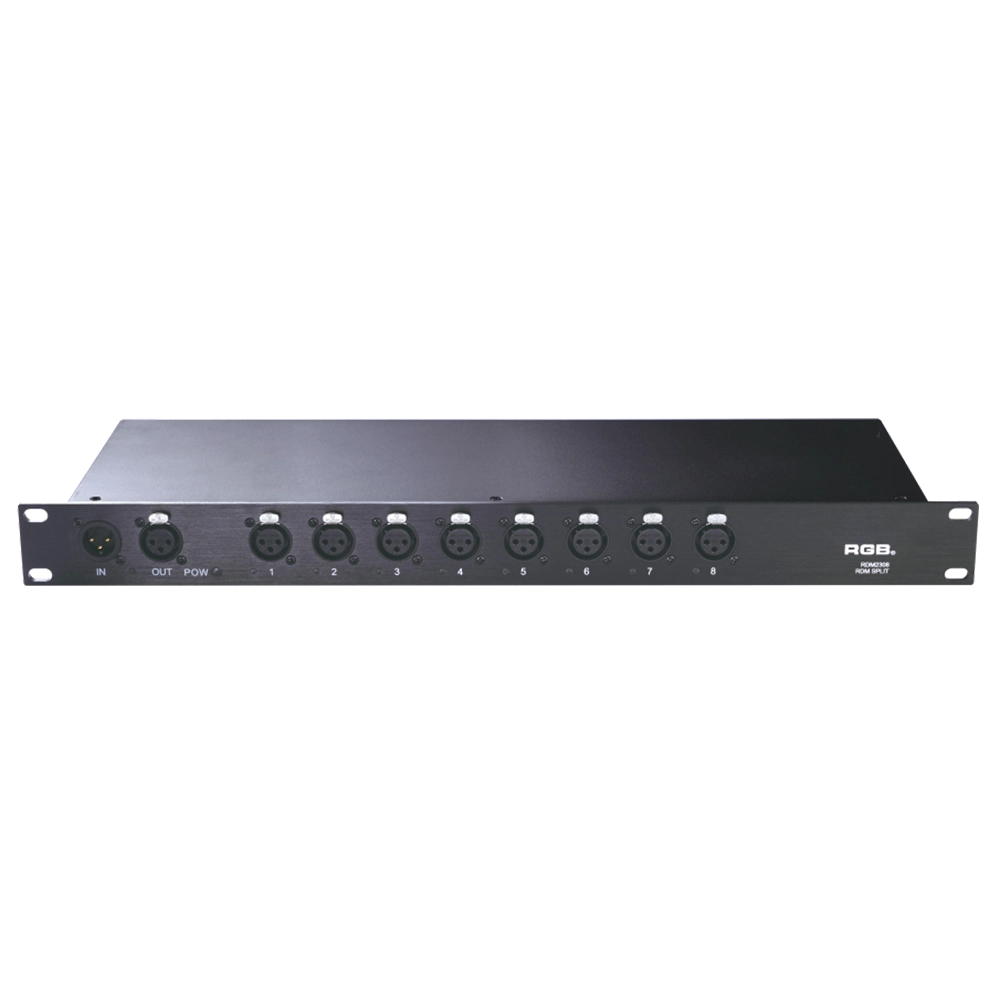
RDM Series Signal Amplifie
RDM2304, RDM2308, RDM2310, RDM2312 rack-mounted The RDM signal amplifier improves the quality of bidirectional RDM signal transmission, ensures the reliability of system control, and prevents faults such as AC high-voltage reverse series lighting control system, lightning high-voltage series entry, and line short circuit, which may affect system stability.
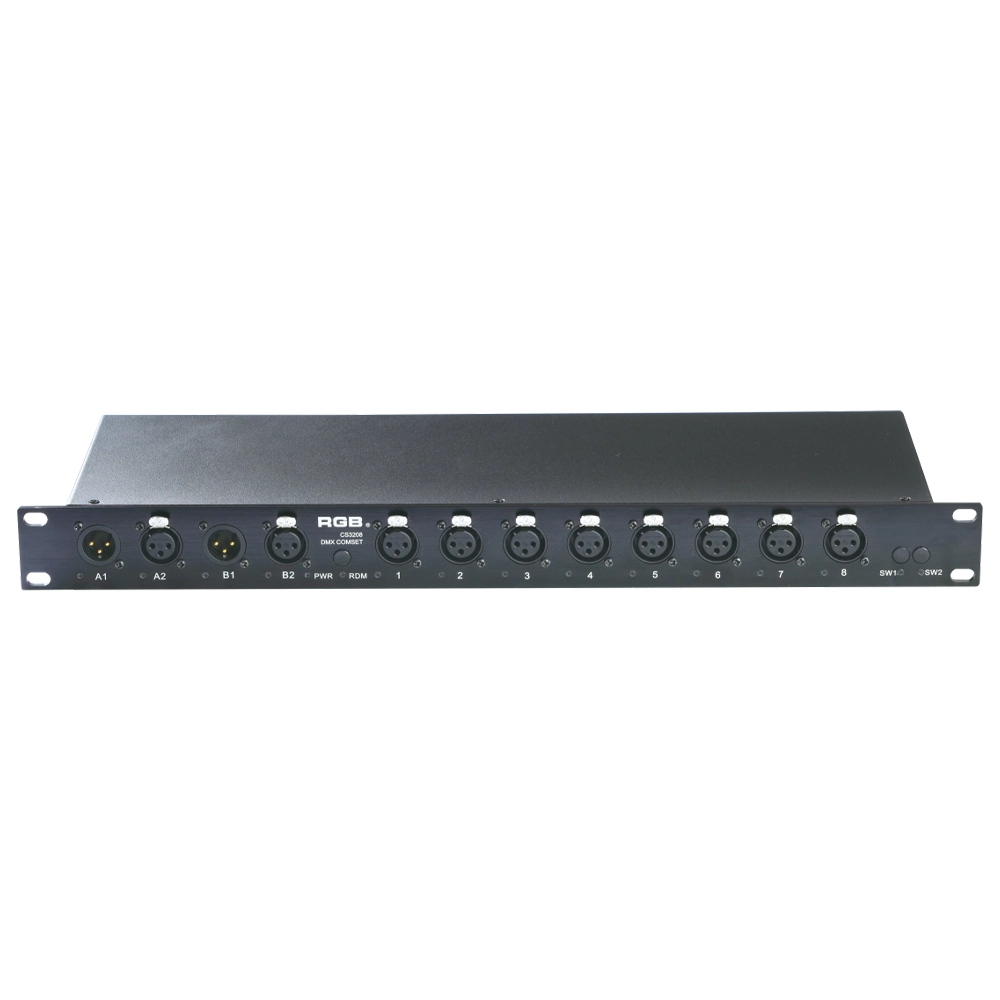
Multifunctional signal supercharger
The rack-mounted DMX signal amplifier complies with the DMX-512 standard protocol, improving DMX-512 signal transmission quality and ensuring reliable system control. It helps prevent issues such as AC high-voltage backflow into lighting control systems, lightning-induced surges, and signal interference caused by short circuits, thereby enhancing overall system stability.
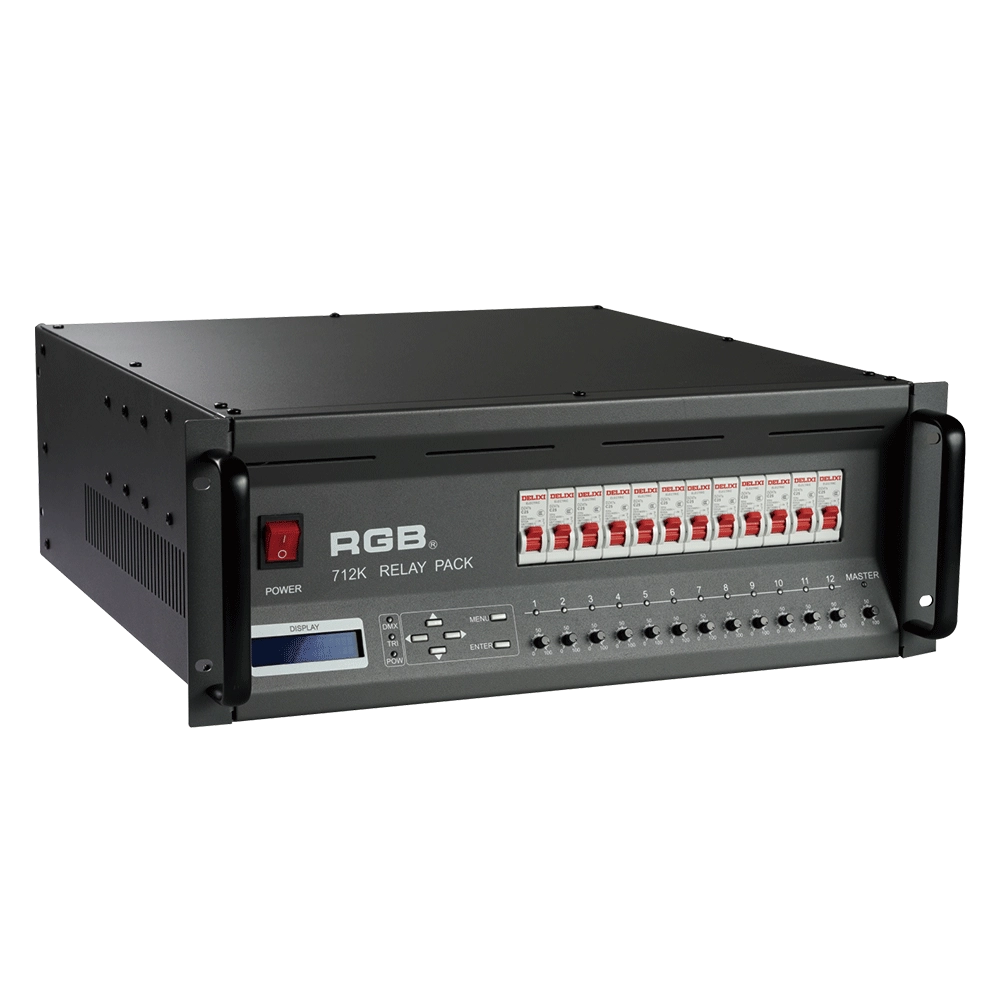
Alloy Relay Packs
High-performance DMX512 relay dimming unit with 512 addressable circuits, phase-loss protection, dual-signal amplification, 20A output per channel, and robust design for reliable stage and mobile lighting applications.
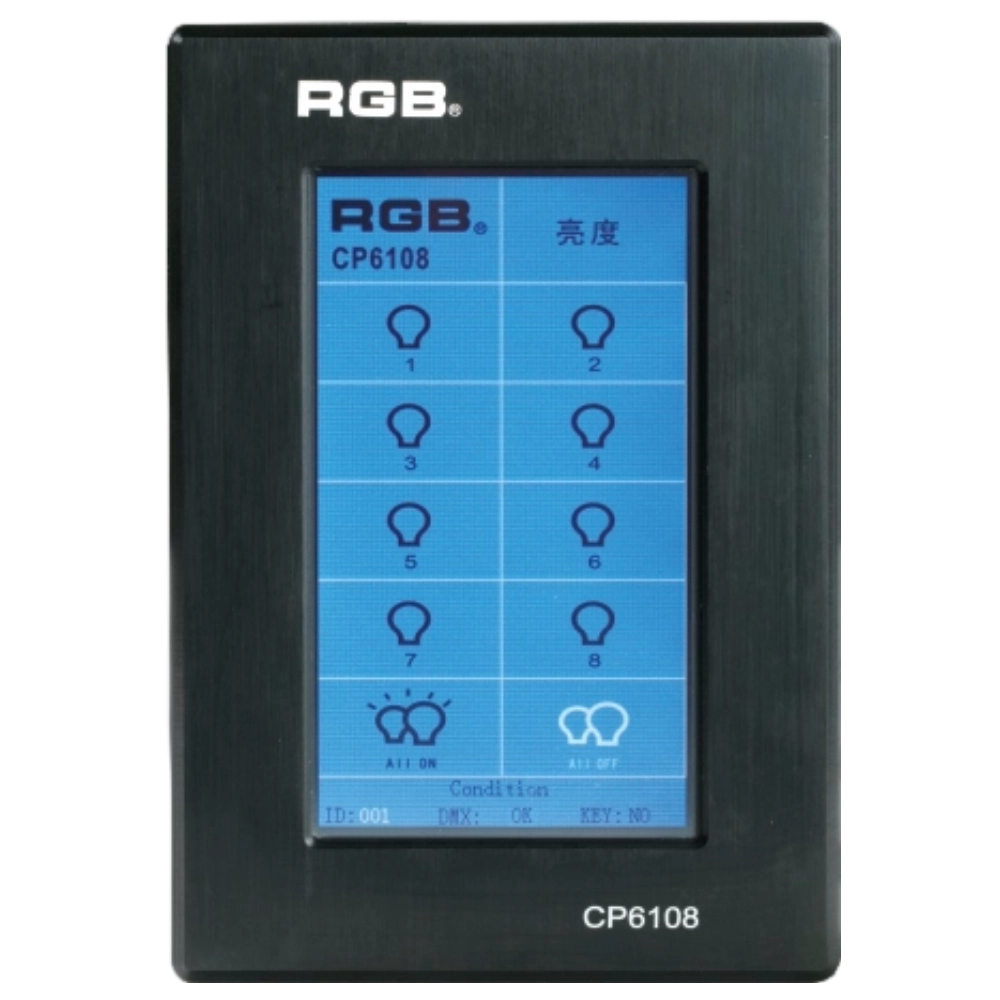
Site Light Controller CP6108
The CP6108 lighting control panel is a lighting control device for theater stage lights, work lights, environmental lighting, commercial art lighting, sports venue lighting, and other places. By connecting to the dedicated lighting control host CP6100, it realizes the central control of the lighting system, supports a visual lighting control system, and intuitively displays the online and offline status of CP6108. Realize remote monitoring, editing, and setting of corresponding parameters.
It is widely applicable to theaters, cinemas, auditoriums, stadiums, museums, exhibition halls, cultural tourism performances, commercial art lighting, and other places.
Expert Support
Interested in learning more or need expert guidance related to this article? Fill in your details, and our team will provide tailored support.
Intelligent Control. Brilliant Performance.
RGB specializes in stage lighting control systems, delivering intelligent, reliable, and high-performance solutions for theaters and performance spaces worldwide.
Contact
Email:
Tel:
+86 20 3928 0245
+86 20 3928 0247
Address:
No.3, Huashan Road, Shilou Town, Panyu, Guangzhou, China.
Whatsapp: +8615975520131