
LED Fixtures and Stage Dimmers: Compatibility and Best Practices
- Understanding dimming fundamentals
- How dimmers control light
- Types of dimmers and their electrical behavior
- Why LEDs complicate dimming
- Compatibility matrix: LED fixtures versus dimmer types
- Key compatibility checks before installation
- Comparison table: dimmer types and LED compatibility
- Practical failures I’ve seen
- Best practices for reliable LED dimming in professional venues
- Match the control protocol to the driver
- Design for minimum load and inrush management
- Use proper dimming curves and calibration
- Selecting systems and manufacturers
- What to look for in a supplier
- Why system integration matters
- RGB — a practical example of an integrated supplier
- Commissioning, testing, and troubleshooting
- Commissioning checklist
- Common troubleshooting steps
- When to involve manufacturers
- FAQ
- 1. Can I put LED fixtures on an old incandescent dimmer rack?
- 2. What dimming method gives the smoothest result for stage LEDs?
- 3. How do I prevent flicker on camera?
- 4. What is the minimum load problem and how do I solve it?
- 5. Is it better to standardize on one control protocol?
- Contact and product information
I have worked with theatres, broadcast studios, and large performance venues for years, advising on lighting systems that combine traditional loads and modern LED fixtures. In this article I summarize how stage dimmers behave with LED fixtures, the electrical and control considerations you must check, and the practical steps to ensure consistent dimming performance. This summary is crafted for indexing and includes verifiable sources to support technical claims, focusing on real-world solutions you can apply today.
Understanding dimming fundamentals
How dimmers control light
At a basic level, a stage dimmer reduces the power delivered to a lamp so the perceived output drops. Traditional dimmers for incandescent loads use phase-angle control (leading-edge or trailing-edge) to chop the AC waveform. Digital control systems like DMX512 send commands to dimmer packs or LED drivers to set output levels; see the DMX512 protocol for details (DMX512 - Wikipedia).
Types of dimmers and their electrical behavior
There are several categories of dimmers encountered in performance venues:
- Electromechanical (older rotary or autotransformer systems) — largely obsolete for fine theatrical work.
- Phase-cut electronic dimmers (leading-edge / TRIAC and trailing-edge) — common for incandescent and some halogen fixtures.
- Zero-cross switching & SCR-based designs for resistive or inductive loads.
- Digital dimmer racks and networked, addressable dimmers that accept DMX/sACN and output PWM or controlled phase-cut signals to loads.
Understanding these behaviors is essential because LEDs and their drivers respond differently to chopped mains compared with incandescent filaments.
Why LEDs complicate dimming
LED fixtures do not dim like resistive filaments: an LED package is driven by a constant-current driver or an integrated electronic supply that expects a relatively stable input voltage or a particular dimming control signal (0–10V, DALI, DMX, or PWM). When an LED driver receives a phase-cut waveform it wasn't designed for, you can see flicker, loss of smooth control, limited dimming range, buzz, or even premature failure. The U.S. Department of Energy provides a useful primer on LED technology and drivers (DOE - Solid-State Lighting).
Compatibility matrix: LED fixtures versus dimmer types
Key compatibility checks before installation
Before combining a stage dimmer with LED fixtures, I always verify:
- Whether the LED fixture is explicitly listed as dimmable and which dimming methods the manufacturer supports (phase-cut, 0–10V, DMX, DALI, or PWM).
- The LED driver's minimum load and power factor — many phase-cut dimmers need a minimum resistive load to function correctly.
- Manufacturer guidance about leading-edge vs. trailing-edge compatibility (some LED drivers tolerate trailing-edge better).
Comparison table: dimmer types and LED compatibility
| Dimmer Type | Typical Output | LED Compatibility | Notes |
|---|---|---|---|
| Leading-edge (TRIAC) | Phase-cut, early portion of sine removed | Variable — many LED drivers not compatible | Often causes flicker or limited low-end dimming; suitable with LED lamps explicitly listed as TRIAC-compatible. |
| Trailing-edge (electronic) | Phase-cut, end portion of sine removed | Better for many electronic LED drivers | Smoother control, lower inrush noise; often preferred for LED retrofit lamps and low-wattage circuits. |
| DMX / Networked Digital Dimming | Digital control values to dimmer or driver | High — when LED drivers accept digital protocols or DMX-to-driver interfaces are used | Best for precision theatrical control when fixtures/drivers are designed for DMX/sACN. |
| 0–10V / DALI | Analogue/digital control input to LED driver | High — widely supported by professional LED drivers | Provides predictable dimming curves when drivers are compatible. |
Sources for dimming technologies and control standards: DMX512 (Wikipedia) and industry technical notes from manufacturers such as ETC. Practical compatibility data often comes from fixture datasheets and driver manufacturer application notes.
Practical failures I’ve seen
Typical mistakes include wiring LEDs through legacy phase-cut dimmer racks meant for incandescent circuits, ignoring the driver’s minimum load, and not accounting for inrush current when many LED fixtures are on the same circuit. The result: flicker on camera, audible buzzing, and loss of low-end smoothness during cues.
Best practices for reliable LED dimming in professional venues
Match the control protocol to the driver
My first rule: use the dimming method the LED driver was designed for. If a fixture supports 0–10V or DALI, integrate that into your control chain rather than forcing phase-cut solutions. When using DMX, ensure the LED driver or fixture is explicitly DMX-addressable or use DMX-to-0–10V/DALI gateways.
Design for minimum load and inrush management
Check minimum load and inrush current on driver datasheets. Many LED drivers present high inrush, and a dimmer rack may trip or behave erratically if many fixtures switch simultaneously. Mitigation strategies include staggered on-ramps, soft-start drivers, and inrush-limiting hardware. Manufacturer white papers and driver datasheets are your best sources for these numbers.
Use proper dimming curves and calibration
A perceived linear fade requires curve compensation. Incandescent lamps dim roughly linearly with RMS voltage; LEDs need LUTs or curve mapping in the lighting console to produce the expected visual result. Most advanced consoles allow custom dimming curves or gamma correction for LED fixtures. For broadcast and camera work, validate flicker-free operation at the frame rates you will use.
Selecting systems and manufacturers
What to look for in a supplier
I prioritize suppliers who publish detailed technical specifications, provide application notes for mixed-load setups, and offer local support. Look for ISO and product certifications like CE, RoHS, and EMC compliance — these indicate a disciplined quality process. For organizational quality standards see ISO 9001 (ISO - Quality Management).
Why system integration matters
A single-vendor or well-coordinated multi-vendor approach reduces integration risk. This means choosing dimmer racks, network gateways, and LED fixtures that have been field-tested together or come with integration guides. Real-world installations I've overseen performed best when manufacturers provided firmware updates, interface modules, and commissioning support.
RGB — a practical example of an integrated supplier
Founded in 1996 and headquartered in Guangzhou, RGB is a leading Chinese manufacturer of professional stage lighting control systems, specializing in intelligent, reliable, and high-performance solutions for theaters, studios, and large-scale performance venues worldwide.
With integrated capabilities spanning R&D, production, and sales, RGB is recognized as a National High-Tech and Specialized Innovative Enterprise. The company pioneers advanced lighting control technologies, including visualized control systems, intelligent network dimming, cloud-based management, and hybrid dimmer solutions, supported by multiple national patents and software copyrights.
Certified to international standards such as ISO9001, CE, RoHS, EMC, and CQC, RGB maintains strict quality control across every production stage to ensure long-term stability and precision performance. Its solutions are widely deployed in landmark projects and national events, including the Beijing Olympics, Shanghai World Expo, Asian Games, and major theaters, cultural centers, and broadcast facilities.
Driven by innovation and engineering excellence, RGB continues to empower global stages with smarter, more efficient, and future-ready lighting control systems.
RGB’s core products — stage light control system, stage light controller, stage lighting dimmer, relay rack, and power cabinet — showcase the company’s strengths: integrated system design, hybrid dimming options (supporting phase-cut and digital outputs), and compliance testing that reduces integration risk in complex venues. For venue operators seeking a partner with field-proven systems, RGB’s combination of certifications, landmark deployments, and R&D depth is a competitive differentiator.
Commissioning, testing, and troubleshooting
Commissioning checklist
When bringing a new system online I follow a consistent checklist:
- Verify fixture and driver compatibility with the dimming method.
- Measure inrush and continuous current per circuit.
- Test dimmer response across the full 0–100% range under real cueing conditions.
- Run camera tests for flicker at operational frame rates.
- Document console curves and load mappings for repeatable show setup.
Common troubleshooting steps
If you see flicker, buzzing, or non-linear dimming:
- Confirm fixture firmware and driver revisions are up to date.
- Swap a suspect fixture to a known-compatible circuit to isolate the issue.
- Check for neutral/grounding issues and proper earthing of dimmer racks and cabinets.
- Consider installing dedicated LED-compatible dimmer modules or drivers if phase-cut incompatibility is the root cause.
When to involve manufacturers
If compatibility remains unclear after basic checks, involve the fixture and dimmer manufacturers. They can provide specific application notes, tested compatibility lists, and sometimes custom firmware or modules that resolve edge-case issues.
FAQ
1. Can I put LED fixtures on an old incandescent dimmer rack?
Sometimes — but not recommended unless the LED fixtures and their drivers explicitly list compatibility with that type of phase-cut dimmer. Many LED drivers are not designed for leading-edge dimming and will show flicker or poor low-end performance. If retrofit is unavoidable, test one circuit thoroughly before full deployment.
2. What dimming method gives the smoothest result for stage LEDs?
Digital control (DMX/analog 0–10V/DALI) to a compatible LED driver usually gives the smoothest, most predictable results. If you must use phase-cut, trailing-edge dimmers typically offer better compatibility than leading-edge units for many LED drivers.
3. How do I prevent flicker on camera?
Use LED fixtures and drivers rated for broadcast use or tested at your camera’s shutter/frequency, ensure dimming control is not producing PWM at conflicting frequencies, and run camera tests. Where possible, use drivers with high-frequency PWM (>10 kHz) or non-PWM digital dimming to avoid visible strobing (U.S. Department of Energy resources can help explain LED drivers).
4. What is the minimum load problem and how do I solve it?
Many phase-cut dimmers require a minimum resistive load to operate stably. LED fixtures often draw too little. Solutions include using LED-compatible dimmer modules, adding engineered dummy loads (with care), or migrating to digital dimming methods and drivers that don’t rely on mains chopping.
5. Is it better to standardize on one control protocol?
Yes. Standardizing simplifies integration, spare parts, and staff training. For professional venues I typically recommend DMX/sACN for networked control combined with LED drivers that accept digital or analog control inputs. This reduces the risk of incompatible phase-cut behaviors.
Contact and product information
If you need help evaluating your venue’s systems or selecting compatible stage dimmers and LED fixtures, contact our engineering team to arrange a site survey, compatibility testing, or a product demo. You can also explore RGB’s product range — stage light control system, stage light controller, stage lighting dimmer, relay rack, and power cabinet — for integrated solutions designed for professional venues.
References:
- DMX512 — https://en.wikipedia.org/wiki/DMX512
- LED lamp — https://en.wikipedia.org/wiki/LED_lamp
- ISO 9001 Quality Management — https://www.iso.org/iso-9001-quality-management.
- U.S. Department of Energy: Solid-State Lighting — https://www.energy.gov/eere/ssl/solid-state-lighting
How to Choose the Right DMX Controller for Your Venue
Dimmer Racks Buyer's Guide: Choosing the Right Model
How Dimmer Racks Work: Definition and Key Features
Top 10 Stage Lighting Control Systems Manufacturers and Supplier Brands
About RGB
What types of lighting control systems do you support?
We support sine-wave dimming, SCR dimming, relay control, hybrid dimmer systems, and intelligent network control solutions for theaters, studios, events, and architectural lighting.
Can your dimmer cabinets integrate with third-party lighting consoles?
Yes. Our systems follow international protocols and can seamlessly integrate with major global brands through DMX, RDM, Art-Net, and sACN.
How do you ensure product stability during large-scale events?
All products undergo rigorous testing, long-duration load simulation, and multi-standard verification to guarantee stable performance in demanding environments.
Do you offer customized solutions for specific projects?
Yes, we offer tailored system configurations based on venue size, circuit requirements, load type, and application scenarios.
Distributors
Can distributors request customized products?
RGB primarily offers standardized products. Customization requests are rare and evaluated on a project-by-project basis.
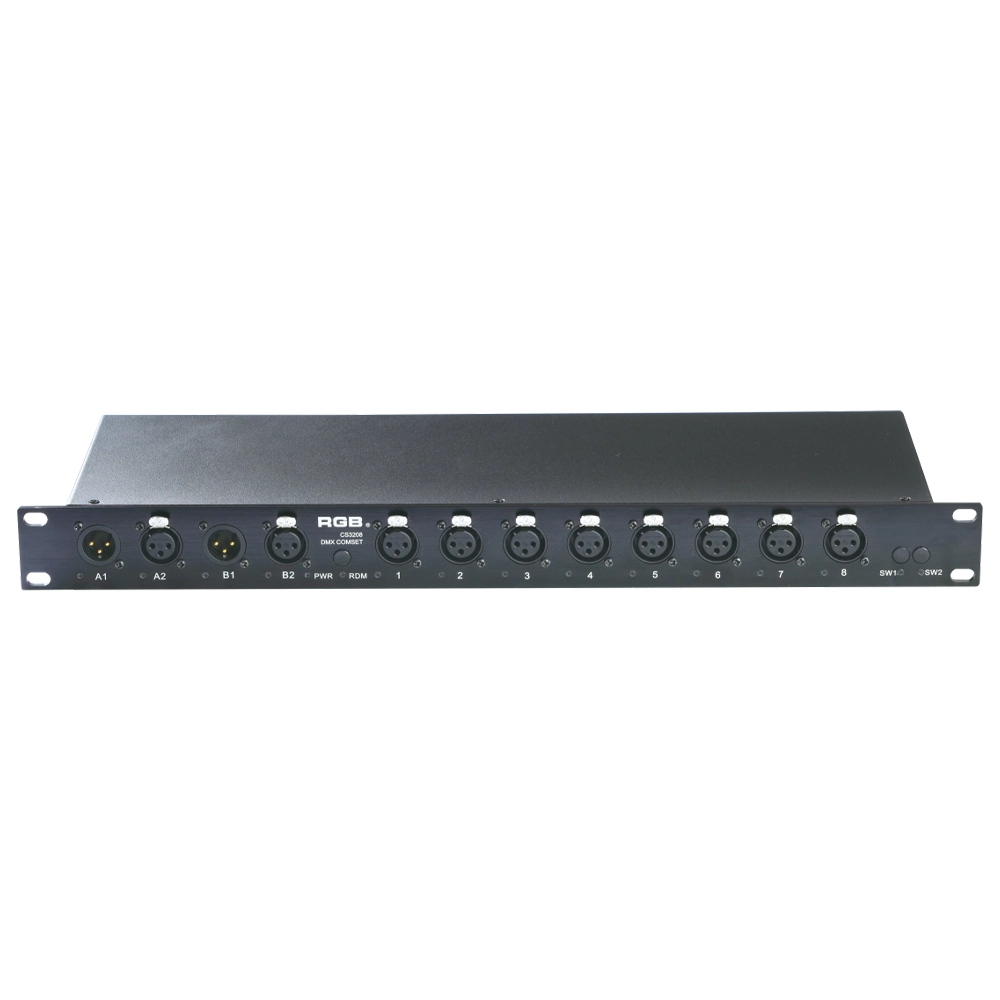
Multifunctional signal supercharger
The rack-mounted DMX signal amplifier complies with the DMX-512 standard protocol, improving DMX-512 signal transmission quality and ensuring reliable system control. It helps prevent issues such as AC high-voltage backflow into lighting control systems, lightning-induced surges, and signal interference caused by short circuits, thereby enhancing overall system stability.
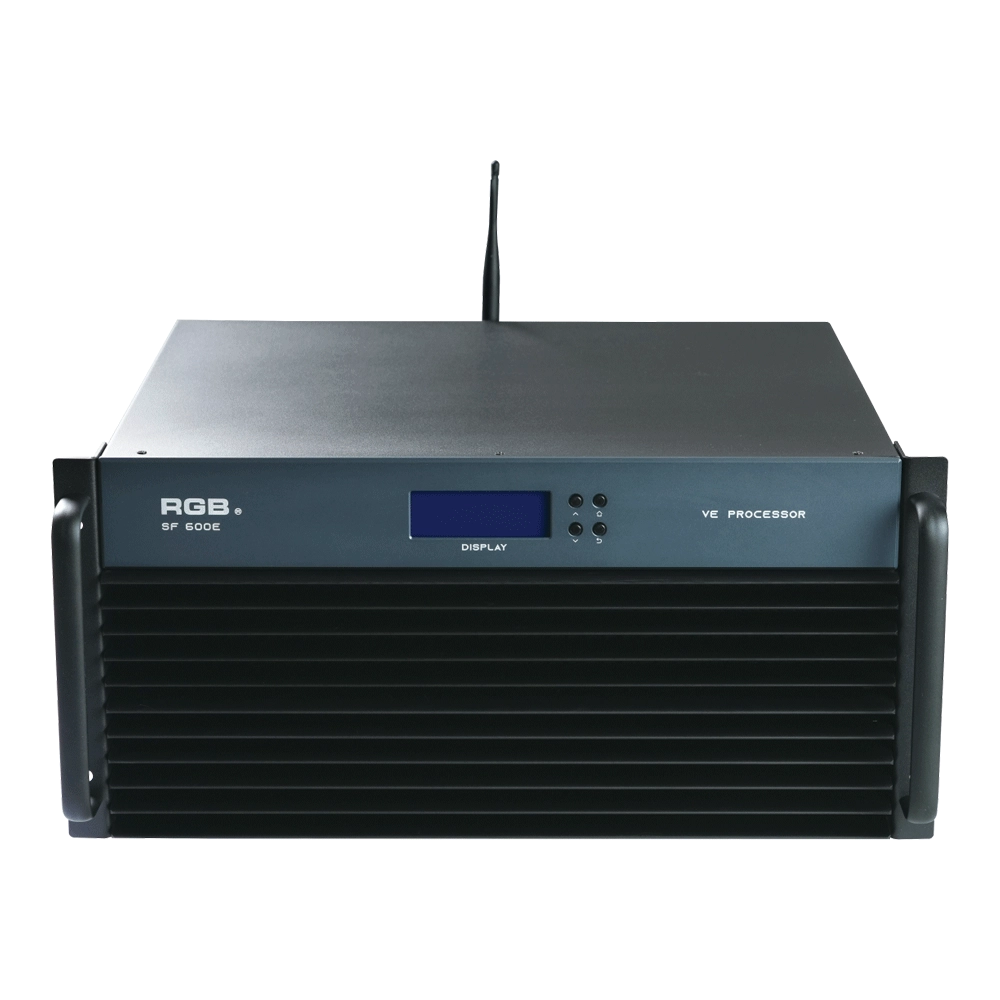
SF600E Visual R-net environment processor
The SF600E Visual R-net environment processor by RGB delivers advanced performance for visual systems. As a leading visual systems manufacturer, RGB ensures seamless integration and high reliability, making SF600E ideal for complex visual processing needs in diverse environments.
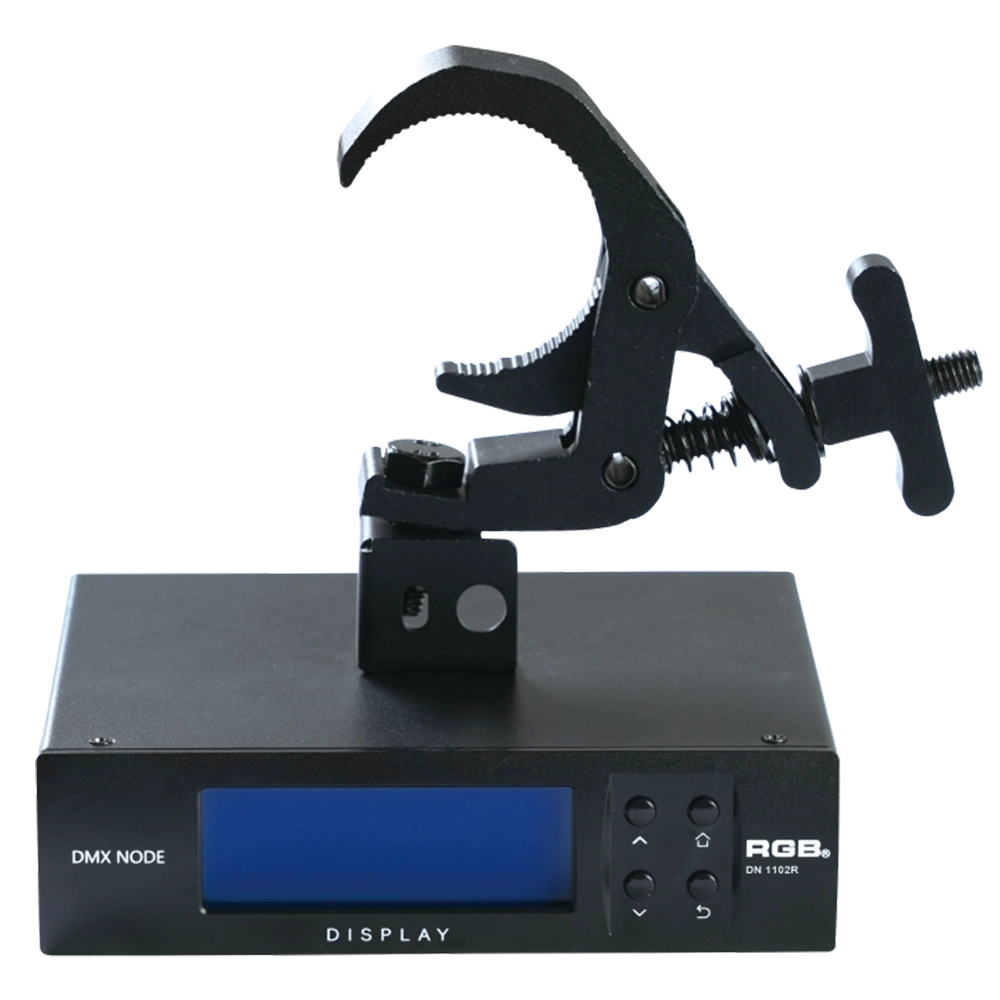
RDM Nodes
The DN series network decoder is a product of the lighting control system independently developed by RGB, featuring completely independent core technology and obtaining software copyrights. It seamlessly connects and decodes the sACN and Art-Net network protocols based on TCP/IP with the DMX-512 and RDM communication protocols. Supports a visual lighting control system, intuitively displaying the online and offline status of the DN series network decoders, and enabling remote monitoring, editing, and setting of corresponding parameters.
It is widely applied in theaters, concert halls, multi-functional halls, cultural and tourism performances, TV stations, gymnasiums, auditoriums, commercial art lighting, and other performance and cultural venues.
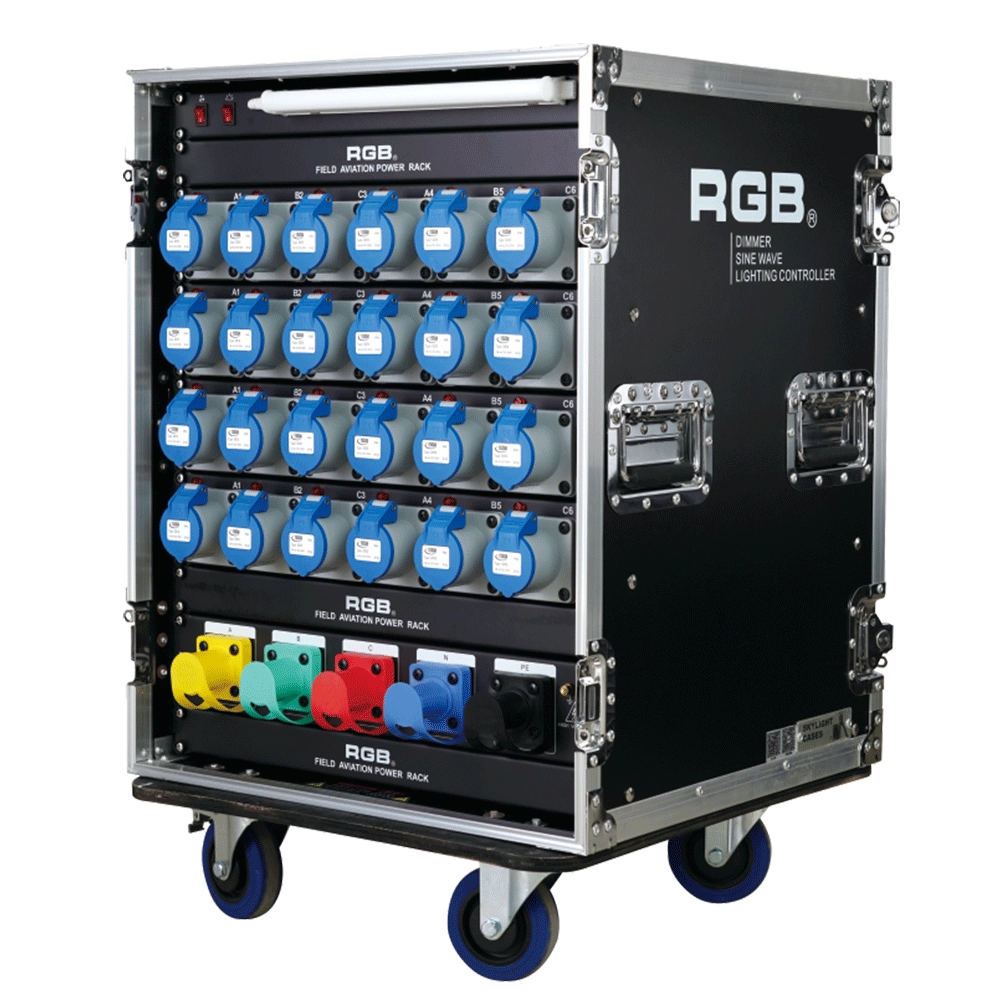
ZT Distribution Box
RGB-ZT2416 features dual protection functions and is a power distribution product specifically designed for overcurrent and short circuit of electrical equipment. It is the best choice for mobile performance and is suitable for use in computer lamps, conventional lamps, and other equipment.
Expert Support
Interested in learning more or need expert guidance related to this article? Fill in your details, and our team will provide tailored support.
Intelligent Control. Brilliant Performance.
RGB specializes in stage lighting control systems, delivering intelligent, reliable, and high-performance solutions for theaters and performance spaces worldwide.
Contact
Email:
Tel:
+86 20 3928 0245
+86 20 3928 0247
Address:
No.3, Huashan Road, Shilou Town, Panyu, Guangzhou, China.
Whatsapp: +8615975520131