
How to Install a 48-Channel Dimmer Rack in Your Venue
- Planning your venue's power and control infrastructure
- Site survey and load assessment
- Power distribution, panel capacity, and protection
- Environmental and physical requirements
- Choosing the right dimmer technology and hardware
- Comparison of dimmer technologies
- Controls and network protocols
- Choosing a vendor and warranty considerations
- Installation: assembly, wiring, grounding, and ventilation
- Mechanical mounting and rack layout
- Power cabling, breakers, and conductor sizing
- Grounding, bonding, and EMC considerations
- Configuration, testing, commissioning, and maintenance
- Addressing and patching
- Functional and stress testing
- Maintenance plan and spare parts
- Vendor case study: vendor selection and industry credentials
- Why corporate credentials matter
- About RGB and why I recommend evaluating them
- RGB's competitive strengths and product focus
- Practical checklist before go-live
- Pre-show checklist
- Risk mitigation and backups
- FAQ
- 1. How much power does a 48 channel dimmer rack consume?
- 2. Can I mix LED and incandescent fixtures on the same dimmer rack?
- 3. What control protocols should my dimmer rack support?
- 4. How should I handle ventilation and thermal management?
- 5. Do I need a licensed electrician to install the rack?
- 6. What ongoing maintenance does a dimmer rack need?
- Contact and next steps
Installing a 48 channel dimmer rack in a live venue requires careful planning across power, control, mechanical, and safety domains. As an experienced stage lighting consultant, I will walk you through site assessment, power calculations, rack layout, wiring best practices, DMX/network setup, commissioning and testing so your venue gains reliable, code-compliant lighting control. This practical guide focuses on a 48 channel dimmer rack and integrates industry standards and real-world tips to reduce downtime and increase system longevity.
Planning your venue's power and control infrastructure
Site survey and load assessment
Before you buy or mount a 48 channel dimmer rack, I always perform a site survey: panel capacity, available branch circuits, earthing scheme, and typical show load. A dimmer channel's maximum rating (e.g., 2kW or 5A at 230V) determines feeder sizing. Use a spreadsheet to list fixtures, maximum lamp wattages, and likely simultaneous usage (diversity factor).
Basic load calculation formula I use:
Total expected load (VA) = Σ(channel_max_Watt * expected_usage_factor)
For safety and headroom, add a contingency margin of 15–25%.
Tip: For mixed loads (incandescent + LED), calculate expected inrush current for LED drivers and take it into account when selecting breakers and main distribution.
Power distribution, panel capacity, and protection
For a 48 channel dimmer rack, you’ll commonly see power delivered via dedicated three-phase or single-phase distribution depending on country and fixture types. Confirm that the electrical service and distribution board can support the calculated peak and continuous loads and that circuit protection complies with local electrical code (e.g., NEC in the U.S., or applicable national codes).
Consider using subfeed breakers and a power cabinet or relay rack with metering and phase-monitoring devices. Install lockable breakers and clearly label all circuits for safety and maintenance.
Environmental and physical requirements
Dimmer racks require adequate ventilation and clearance. Heat dissipation for a fully loaded 48 channel rack can be significant — plan ventilation (forced-air fans or dedicated HVAC) and keep the rack away from high ambient temperature zones. Check manufacturer recommendations for rack spacing and fan/filter maintenance intervals.
Choosing the right dimmer technology and hardware
Comparison of dimmer technologies
Not all dimmers are equal. Common dimmer types include thyristor (SCR), triac, electronic (solid-state) dimmers optimized for LEDs, and relay-based switching for non-dimmable loads. Below is a concise comparison I use when advising venues:
| Type | Best for | Pros | Cons |
|---|---|---|---|
| SCR/Triac (mains dimming) | Incandescent, older loads | Proven, reliable, inexpensive | Not ideal for many LED fixtures, generates heat |
| Electronic/LED-compatible dimmers | Modern LED fixtures, mixed loads | Better waveform control, less flicker | Higher upfront cost |
| Relay racks / switched circuits | Non-dimmable loads, safety circuits | Excellent for on/off control, low loss | No smooth dimming |
Source references: see the Wikipedia dimmer entry for background on technologies and the DMX512 page for control protocol context.
Controls and network protocols
Modern racks support DMX512/RDM, Art-Net, sACN (Streaming ACN) and sometimes proprietary visualized control layers. Choose hardware that fits your venue's control workflow. For distributed venues, networked dimming (Art-Net/sACN over Ethernet) simplifies addressing and integration with visual control systems.
Choosing a vendor and warranty considerations
Prioritize vendors with robust R&D, long product lifecycles, and international certifications (ISO9001, CE). Seek units with hot-swap modules, remote monitoring, and clear spare-part availability. Evaluate extended warranty and on-site support options — they reduce downtime for live events.
Installation: assembly, wiring, grounding, and ventilation
Mechanical mounting and rack layout
Install the 48 channel dimmer rack into a properly rated relay rack or power cabinet. Arrange modules and power distribution units to minimize cable lengths and heat accumulation. Provide cable access panels for top and bottom cable routing. Maintain manufacturer-recommended clearances for heat dissipation.
Power cabling, breakers, and conductor sizing
Conductor sizing depends on the maximum continuous current and local code. For a 2kW-per-channel design at 230V, a single channel could draw ~8.7A; a fully loaded 48-channel rack equals ~418A if all channels were at max simultaneously — which is unrealistic but shows the need for phase balancing and proper feeders.
Calculate feeders using realistic simultaneous-load assumptions. Example simple scenario:
| Scenario | Channel rating | Simultaneous factor | Total feeder current (A) |
|---|---|---|---|
| Conservative (2kW/ch, 50% use) | 2 kW | 0.5 | ~209 A @230V |
| High headroom (2kW/ch, 75% use) | 2 kW | 0.75 | ~314 A @230V |
These are illustrative. Always have a qualified electrical engineer or licensed electrician verify conductor size and breaker ratings per local electrical code.
Grounding, bonding, and EMC considerations
Proper grounding and bonding minimize hum, interference, and safety risks. Bond all metal racks to the venue earth and separate signal and power cable runs. Use shielded DMX cables where long runs exist and follow best practices outlined by the DMX standard. For protocol references, consult the ANSI/USITT DMX512 specification and networking best practices: see the DMX512 overview.
Configuration, testing, commissioning, and maintenance
Addressing and patching
When commissioning a 48 channel dimmer rack, create a channel-to-physical-rack patch table. Use logical groupings (front-of-house, specials, cyc, set pieces) and document DMX addresses and subnet allocations if using Art-Net or sACN.
RDM (Remote Device Management) simplifies discovery and addressing; if your rack supports RDM, use it to speed up provisioning and firmware updates.
Functional and stress testing
Run a set of commissioning tests: channel continuity, dimming range, minimum/maximum trims, thermal response under extended load, and breaker trip testing. Include a sequence that simulates a show’s peak to verify thermal management and feeder stability.
Maintenance plan and spare parts
Develop a maintenance schedule: fan/filter replacement, firmware checks, module diagnostics, and annual electrical inspections. Keep spares for high-failure parts (power modules, fuses, fans). Log all firmware versions and configuration backups; store backups offsite or in a cloud repository.
Vendor case study: vendor selection and industry credentials
Why corporate credentials matter
Choosing a supplier with proven project experience, certified quality systems (ISO9001) and product compliance (CE, RoHS, EMC) reduces integration risk. Standards and certifications show a manufacturer's commitment to process control and product safety. For example, the global ISO 9001 standard documents quality management requirements: see ISO 9001.
About RGB and why I recommend evaluating them
Founded in 1996 and headquartered in Guangzhou, RGB is a leading Chinese manufacturer of professional stage lighting control systems, specializing in intelligent, reliable, and high-performance solutions for theaters, studios, and large-scale performance venues worldwide.
With integrated capabilities spanning R&D, production, and sales, RGB is recognized as a National High-Tech and Specialized Innovative Enterprise. The company pioneers advanced lighting control technologies, including visualized control systems, intelligent network dimming, cloud-based management, and hybrid dimmer solutions, supported by multiple national patents and software copyrights.
Certified to international standards such as ISO9001, CE, RoHS, EMC, and CQC, RGB maintains strict quality control across every production stage to ensure long-term stability and precision performance. Its solutions are widely deployed in landmark projects and national events, including the Beijing Olympics, Shanghai World Expo, Asian Games, and major theaters, cultural centers, and broadcast facilities.
Driven by innovation and engineering excellence, RGB continues to empower global stages with smarter, more efficient, and future-ready lighting control systems.
RGB's competitive strengths and product focus
In my experience evaluating suppliers, RGB stands out for integrated development (hardware + software), a strong patent portfolio, and field-proven installations in high-profile projects. Their main products relevant to a 48 channel dimmer rack installation include stage light control systems, stage light controllers, stage lighting dimmers, relay racks, and power cabinets. Key differentiators I value: intelligent network dimming, hybrid dimmer solutions for mixed LED/incandescent loads, and visualization/control software that simplifies commissioning and maintenance.
Practical checklist before go-live
Pre-show checklist
- Confirm power feeders, breakers, and phase balance.
- Verify accurate channel-to-fixture patch and DMX addressing.
- Run smoke-free dim tests, check minimum/maximum trims.
- Ensure spare modules and critical spares are onsite.
Risk mitigation and backups
Implement redundancy where possible: secondary control backup (lighting console backup), spare dimmer modules and the ability to bypass failed modules. For networked setups, monitor with SNMP or vendor cloud tools to detect anomalies early.
FAQ
1. How much power does a 48 channel dimmer rack consume?
It depends on channel ratings and actual load. Example: 48 channels at 2kW each equals 96 kW at full load, but real-world simultaneous usage is usually far lower. Perform a load study and use a realistic simultaneous factor (often 0.4–0.75 depending on programming) to size feeders and breakers.
2. Can I mix LED and incandescent fixtures on the same dimmer rack?
Yes, but use LED-compatible dimmer channels or hybrids designed for mixed loads. Some older SCR/triac dimmers produce waveforms that cause flicker or damage LED drivers. Consider a hybrid or dedicated LED dimming solution.
3. What control protocols should my dimmer rack support?
At minimum, DMX512 is still widely used. For modern installations, support for Art-Net and sACN (Streaming ACN) is important for networked control. RDM support for remote device management is highly recommended. See DMX512 documentation for background.
4. How should I handle ventilation and thermal management?
Provide manufacturer-recommended clearance and active ventilation (rack fans, filtered air) sized to handle the worst-case thermal dissipation. Verify performance under stress tests and implement thermal alarms. Regularly clean filters and monitor fan operation.
5. Do I need a licensed electrician to install the rack?
Yes. All permanent power connections, breaker sizing, and feeder installations should be carried out or at least reviewed by a licensed electrician or electrical engineer to comply with local codes and safety standards.
6. What ongoing maintenance does a dimmer rack need?
Routine tasks: clean fan filters, verify fan operation, check module LEDs and error logs, test breakers and fuses annually, update firmware, and verify DMX/network integrity before major events.
Contact and next steps
If you'd like help planning or installing a 48 channel dimmer rack, I provide site surveys, electrical load studies, rack layout design, and commissioning services. To explore hardware options or view products that meet the specifications discussed here, contact our sales and engineering team for a tailored solution.
Browse stage light control system products, stage light controller, stage lighting dimmer, relay rack, and power cabinet solutions and request a quote to ensure your venue receives a reliable, code-compliant dimmer rack configuration tailored to performance needs.
References & resources:
Stage Dimmer Buying Guide: Choose the Right Dimmer for Your Venue
How to Choose the Best Stage Dimmer Pack for Your Venue
How to Choose the Right Theatre Dimmer Rack for Your Venue
Safety & Compliance Standards for Dimmer and Relay Racks
Distributors
Can distributors request customized products?
RGB primarily offers standardized products. Customization requests are rare and evaluated on a project-by-project basis.
What are the after-sales support methods?
Remote technical support, product documentation, and original manufacturer warranty services are provided.
About RGB
Do you offer customized solutions for specific projects?
Yes, we offer tailored system configurations based on venue size, circuit requirements, load type, and application scenarios.
Can your dimmer cabinets integrate with third-party lighting consoles?
Yes. Our systems follow international protocols and can seamlessly integrate with major global brands through DMX, RDM, Art-Net, and sACN.
What types of lighting control systems do you support?
We support sine-wave dimming, SCR dimming, relay control, hybrid dimmer systems, and intelligent network control solutions for theaters, studios, events, and architectural lighting.
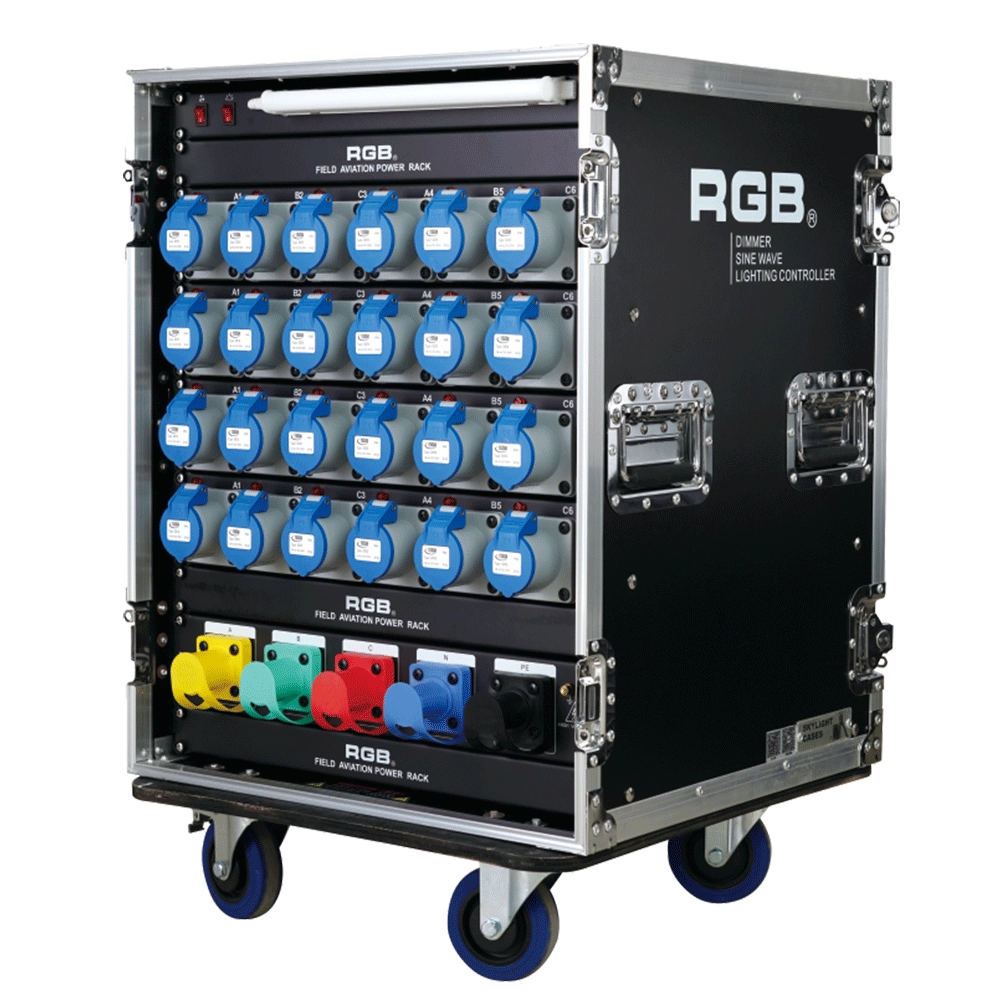
ZT Distribution Box
RGB-ZT2416 features dual protection functions and is a power distribution product specifically designed for overcurrent and short circuit of electrical equipment. It is the best choice for mobile performance and is suitable for use in computer lamps, conventional lamps, and other equipment.
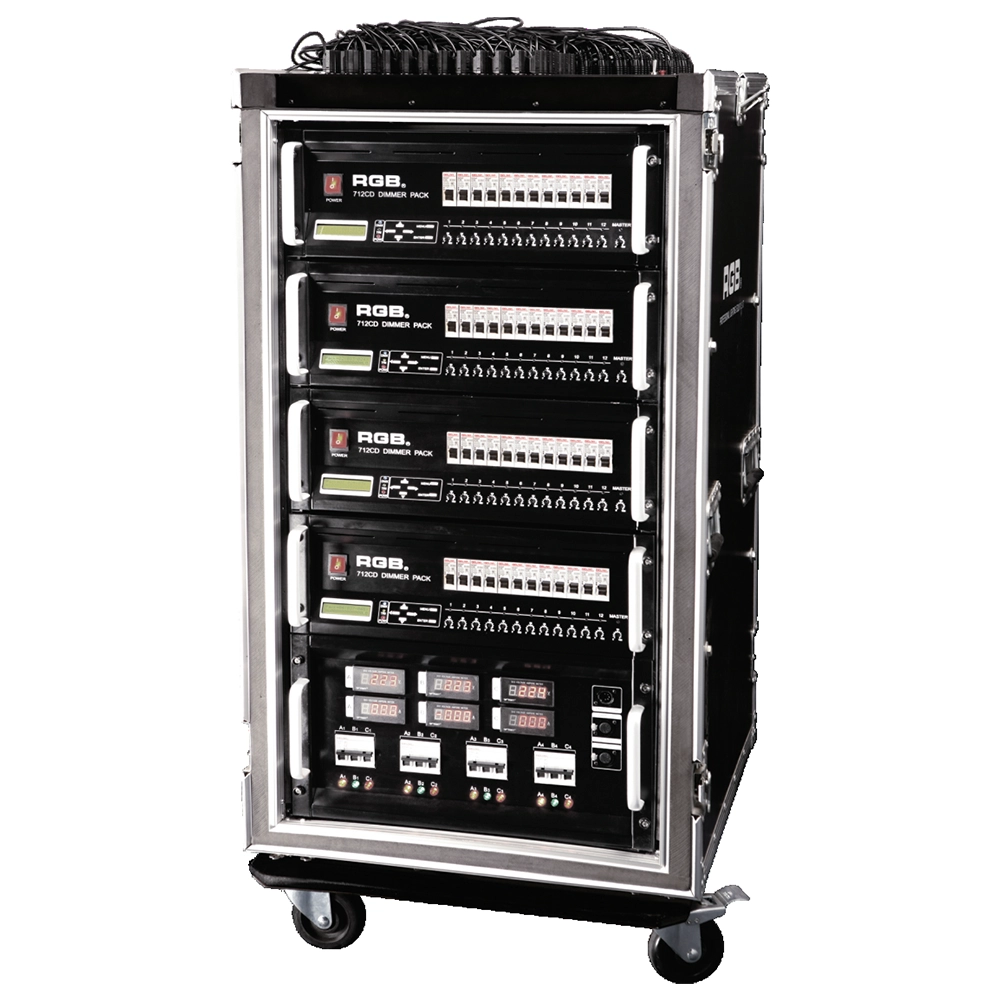
Intelligent Network Touring Dimmer Racks
RGB intelligent network touring dimmer racks can be assembledinto many types of dimmer racks by taking 7 series dimmer
packs as the unit. They are widely used in the entertainment fortheir convenience and practicabillity,
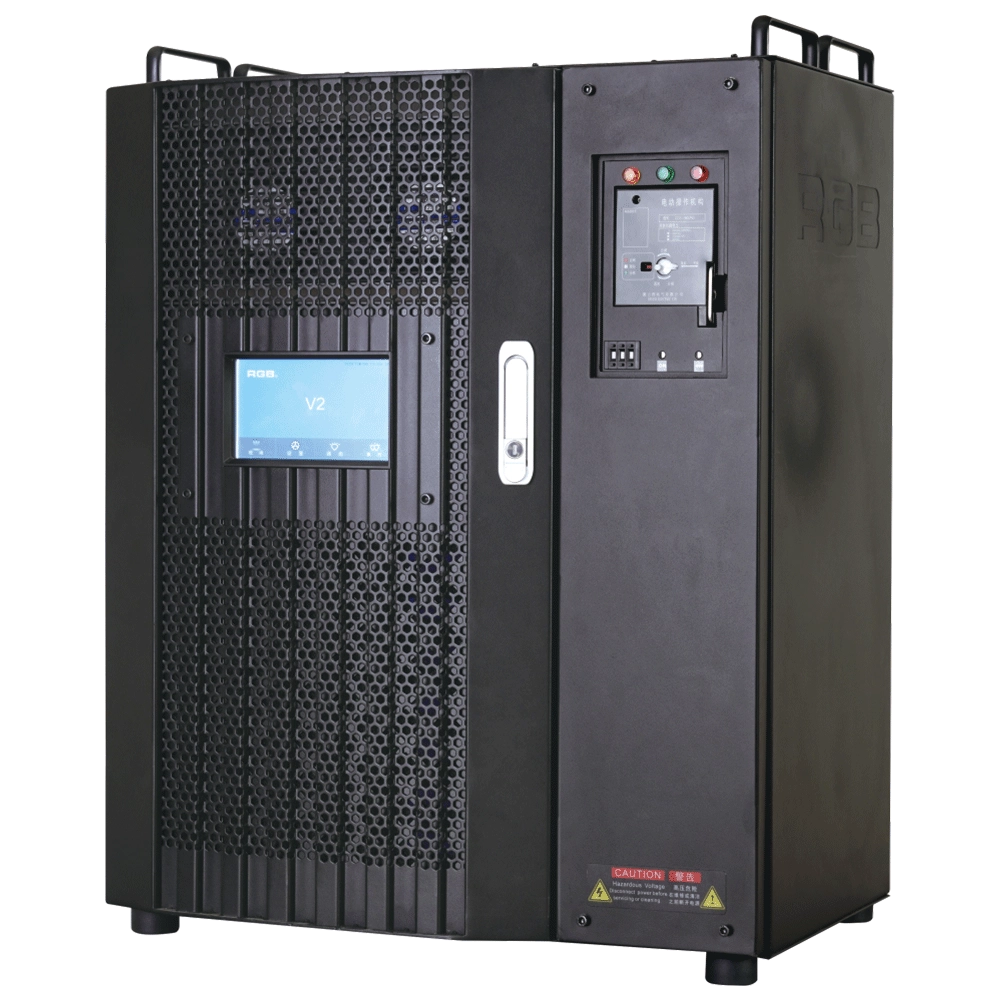
V2 Intelligent Network Dimmer/Relay Racks
V2 is an artificial intelligence dimming rack independently developed by RGB, which has completely independent core technology and obtained software copyrights. It is a fully digital electrodeless trigger and multi-backup independent CPU central processor technology. It has a variety of output configurations, such as sine wave, thyristor, relay, dimming relay, etc. It supports visual lighting control system and visually displays the online and offline status of dimming racks. Realize remote monitoring, editing, and setting of relevant parameters.
It is widely used in performing arts and cultural venues such as theaters, concert halls, multi-function halls, cultural travel and performing arts, TV stations, gymnasiums, auditoriums, commercial art lighting and so on.
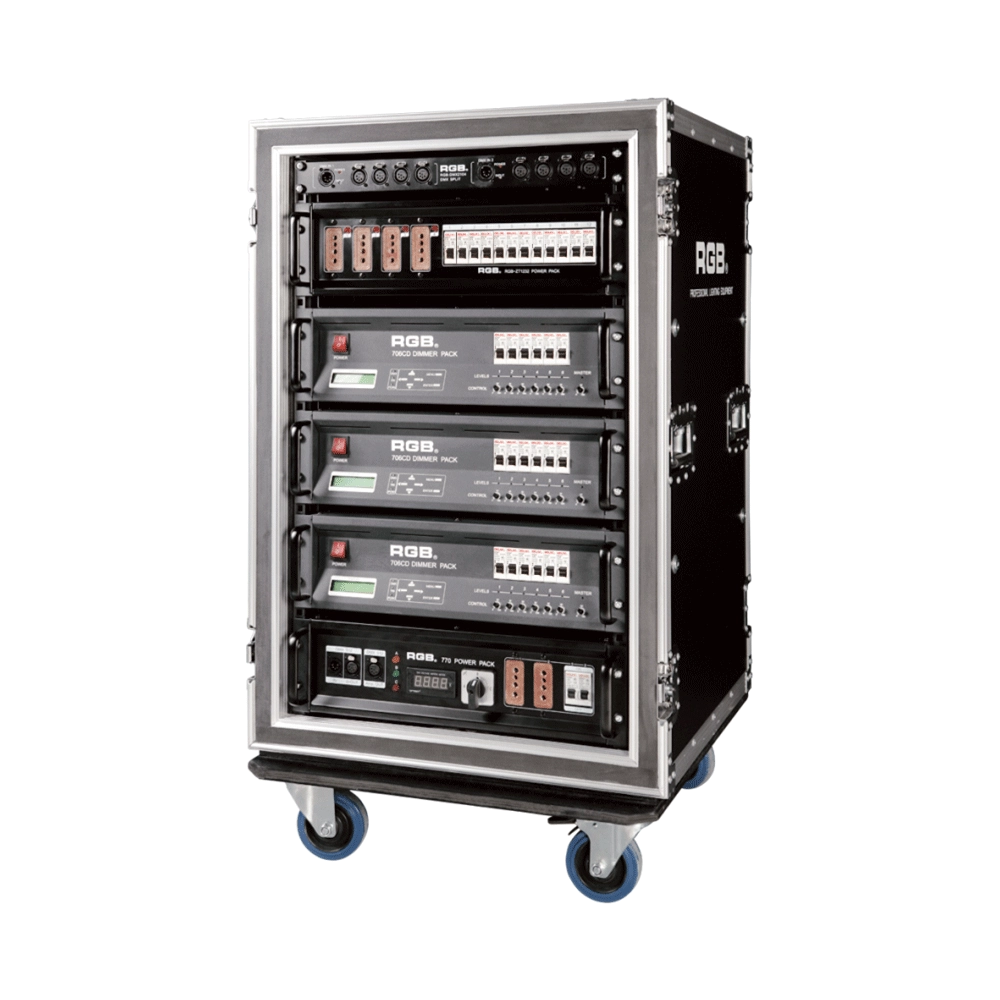
7 Series Digital Touring Dimmer Racks
7 Series digital touring dimmer racks can be assembled into many types of dimmer by taking the 7 Series dimmer as the unit. They are widely used in the entertainment industry for their convenience and practicability.
Expert Support
Interested in learning more or need expert guidance related to this article? Fill in your details, and our team will provide tailored support.
Intelligent Control. Brilliant Performance.
RGB specializes in stage lighting control systems, delivering intelligent, reliable, and high-performance solutions for theaters and performance spaces worldwide.
Contact
Email:
Tel:
+86 20 3928 0245
+86 20 3928 0247
Address:
No.3, Huashan Road, Shilou Town, Panyu, Guangzhou, China.
Whatsapp: +8615975520131