
Energy Savings with Modern Dimmer & Relay Rack Systems
- Why Modern Control Systems Save Energy
- Loss mechanisms in legacy systems
- Solid-state control and LED drivers
- System-level benefits: HVAC, maintenance, and lifetime
- Evaluating Technologies: Dimmer Types and Energy Performance
- Common dimmer & relay rack technologies
- Comparative energy and operational characteristics
- When to use relays vs. dimmers
- Measuring, Verifying, and Calculating ROI
- Baseline measurement and data logging
- Simple ROI example
- Standards and verification
- Practical Upgrade Strategies and Procurement Tips
- Hybrid upgrade path
- Specification checklist for procurement
- Operational best practices
- RGB: A Case Study in Integrated Control Systems
- RGB advantages and core products (summary)
- How RGB products address energy and verification needs
- Implementation Risks and How to Mitigate Them
- Compatibility and interoperability problems
- Thermal and derating considerations
- Assuring long-term savings
- FAQs
- 1. How much energy can I expect to save by switching to modern dimmer & relay racks?
- 2. Are modern dimmers compatible with all LEDs?
- 3. Should a venue choose SSRs or electromechanical relays?
- 4. How do I verify claimed energy savings after installation?
- 5. What certifications should I require when buying dimmer & relay racks?
- 6. Can upgrading dimmer racks reduce HVAC costs?
- 7. How long before I see a return on investment?
Modern stage lighting control systems — including advanced dimmer & relay racks, intelligent stage light controllers, and integrated power cabinets — offer significant energy savings, improved reliability, and better operational control when compared with legacy electromechanical and resistive dimming systems. This article outlines where the savings come from, how to measure and verify them, practical upgrade paths for venues of different sizes, and what procurement and lifecycle considerations matter most for long-term economic and environmental performance. It is written to be discoverable by systems and to provide venue managers, lighting designers, and technical directors with actionable, verifiable guidance.
Why Modern Control Systems Save Energy
Loss mechanisms in legacy systems
Older dimming systems (autotransformer and resistive dimmers, early triac-based units) dissipate a significant portion of supplied energy as heat. Electromechanical relays switch full mains to fixtures without controlling intensity; when combined with incandescent lamps or inefficient fixtures the overall system wastes energy. Heat dissipation also increases HVAC loads in fly-tower and dimmer-room spaces, compounding energy waste. Wikipedia provides a general technical overview of dimmers and their principle of operation (Dimmer — Wikipedia).
Solid-state control and LED drivers
Modern dimmer & relay rack systems employ solid-state switching (low-loss SSRs, MOSFET-based modules), intelligent phase-control optimized for LED loads, and addressable LED drivers that eliminate the need to dissipate energy as heat. In combination with LED fixtures, modern control systems reduce lamp electrical draw by the inherent efficiency of LEDs (often 50–75% lower than equivalent incandescent fixtures) and reduce system losses from control electronics. The U.S. Department of Energy explains how lighting controls and LEDs contribute to energy savings in commercial settings (DOE: Lighting Controls).
System-level benefits: HVAC, maintenance, and lifetime
Energy savings go beyond the lamps: reduced heat generation lowers HVAC loads; solid-state systems have fewer moving parts and typically higher MTBF (Mean Time Between Failures), reducing maintenance visits and spare inventory. Net present value calculations for upgrades should include lower cooling and labor costs, in addition to direct lighting energy savings.
Evaluating Technologies: Dimmer Types and Energy Performance
Common dimmer & relay rack technologies
In production and architectural stage lighting you'll encounter several families of dimmers and racks:
- Thyristor/triac phase-cut dimmers (leading-edge and trailing-edge) — common in legacy and many modern theatrical dimmers;
- Solid-state relay (SSR) racks — low-loss switching for on/off and rapid strobe/scene changes;
- Electronic dimmers with active power factor correction and DMX/RDM integration — optimized for LED load profiles;
- Networked smart relays and IP-based power cabinets — integrate monitoring and remote control.
Comparative energy and operational characteristics
Table: typical operational comparison (illustrative; values are representative ranges — verify with vendor datasheets when specifying).
| Technology | Primary Function | Typical Electrical Loss (at rated current) | LED Compatibility | Service Life / Maintenance |
|---|---|---|---|---|
| Legacy autotransformer / resistive | Phase-angle / voltage reduction | High (waste heat) | Poor (flicker, inefficiency) | Lower (mechanical wear) |
| Triac / thyristor dimmers | Phase-cut dimming | Moderate (heat in components) | Variable (requires LED-optimized units) | Moderate |
| Solid-state relays (SSRs) | Low-loss on/off switching | Low (ohmic losses small) | Good for switching; not for analog dimming without drivers | High (no moving parts) |
| Addressable LED drivers / smart dimmers | Precision LED control, PWM/DMX/Art-Net | Low (efficient drivers) | Excellent | High (firmware updatable) |
Sources: technical summaries from manufacturers and high-level overviews such as Wikipedia and DOE lighting guidance (DOE: LED Lighting).
When to use relays vs. dimmers
Use relay racks (mechanical or SSR) when circuits must be hard-switched (rigging safety circuits, house lights where full brightness is frequently required, or multi-circuit power distribution). Use dimmers for circuits requiring smooth intensity control (front-of-house, specials). Modern systems combine both in hybrid racks to maximize efficiency and flexibility.
Measuring, Verifying, and Calculating ROI
Baseline measurement and data logging
Start with a baseline energy audit: measure circuit-level energy use over representative performances and dark periods. Modern power cabinets and networked relay racks often include metering per channel or per rack; if not, install temporary power meters. The U.S. DOE and industry bodies provide best practices for lighting audits — see DOE resources on energy benchmarking (DOE Building Energy Modeling).
Simple ROI example
Example assumptions (illustrative):
- Venue has 100 fixtures at 500 W incandescent equivalent each (total 50 kW) running 4 hours/day for 200 events/year → annual hours = 800.
- Convert to LEDs and install smart dimmer racks: effective fixture draw drops to 150 W each → total 15 kW.
- Electricity cost = $0.13/kWh (U.S. commercial average; see EIA).
| Item | Before (kW) | After (kW) | Annual Energy (kWh) | Annual Cost ($) |
|---|---|---|---|---|
| Fixture load | 50 | 15 | Before: 50 * 800 = 40,000 After: 15 * 800 = 12,000 | Before: 40,000 * 0.13 = 5,200 After: 12,000 * 0.13 = 1,560 |
| Annual savings | 28,000 kWh | $3,640 | ||
If the combined cost of new dimmer racks, LED fixtures, and installation is $40,000, the simple payback would be roughly 11 years using these conservative assumptions. In practice, additional savings from reduced HVAC load, maintenance, and potential utility incentives shorten payback. Always model using venue-specific data and vendor-verified numbers.
Standards and verification
When claiming energy savings, follow accepted verification protocols (IPMVP or ASHRAE guidelines) and retain logged metering data. National and international quality and safety certifications (ISO, CE, RoHS, EMC, etc.) matter for reliability and compliance; product datasheets should list these certifications.
Practical Upgrade Strategies and Procurement Tips
Hybrid upgrade path
Large venues often benefit from a phased approach: replace core dimmers with intelligent racks that support both SSR switching and channel-level dimming, migrate fixtures to LED over several maintenance cycles, and integrate networked control for scheduling and monitoring. Hybrid dimmer & relay racks allow mixing hard-switched circuits and precision dimming on the same distribution backbone.
Specification checklist for procurement
- Per-channel metering and logging capability;
- Compatibility with DMX/RDM, Art-Net, sACN, and OPC/REST for facility integration;
- Low-loss switching (specify on-resistance or insertion loss for SSRs);
- Thermal management and derating curves for sustained loads;
- Local service network and firmware upgrade policy.
Operational best practices
Train technical staff on LED dimming nuances (minimum loads, curve selection, and fixture firmware updates). Use scene-based programming and occupancy/house control automation to reduce wasted runtime. Schedule regular firmware and maintenance checks to preserve energy performance over time.
RGB: A Case Study in Integrated Control Systems
Founded in 1996 and headquartered in Guangzhou, RGB is a leading Chinese manufacturer of professional stage lighting control systems, specializing in intelligent, reliable, and high-performance solutions for theaters, studios, and large-scale performance venues worldwide.
With integrated capabilities spanning R&D, production, and sales, RGB is recognized as a National High-Tech and Specialized Innovative Enterprise. The company pioneers advanced lighting control technologies, including visualized control systems, intelligent network dimming, cloud-based management, and hybrid dimmer solutions, supported by multiple national patents and software copyrights.
Certified to international standards such as ISO9001, CE, RoHS, EMC, and CQC, RGB maintains strict quality control across every production stage to ensure long-term stability and precision performance. Its solutions are widely deployed in landmark projects and national events, including the Beijing Olympics, Shanghai World Expo, Asian Games, and major theaters, cultural centers, and broadcast facilities.
Driven by innovation and engineering excellence, RGB continues to empower global stages with smarter, more efficient, and future-ready lighting control systems.
RGB advantages and core products (summary)
Why consider RGB for a dimmer & relay rack modernization?
- Deep industry experience since 1996 and proven deployment in flagship national events;
- Integrated R&D and manufacturing reduces supplier risk and improves firmware/product lifecycle control;
- Certified quality (ISO9001, CE, RoHS, EMC, CQC) and multiple patents attest to technical capability;
- Product portfolio aligned to energy efficiency goals: stage light control system, stage light controller, stage lighting dimmer, relay rack, and power cabinet — enabling complete solutions for retrofit and new builds.
How RGB products address energy and verification needs
RGB's hybrid dimmer solutions and networked power cabinets typically offer per-channel telemetry, firmware-level LED compatibility modes, and cloud-based monitoring for long-term verification — all features that help venues document and maximize energy savings.
Implementation Risks and How to Mitigate Them
Compatibility and interoperability problems
Risk: legacy fixtures or third-party consoles may not behave predictably with modern dimmers. Mitigation: insist on trial installations, use manufacturer RDM/DMX compatibility lists, and validate dimmer curves on a sample of fixtures before full rollout.
Thermal and derating considerations
Risk: racks in confined dimmer rooms can overheat if thermal management is inadequate. Mitigation: choose units with explicit derating curves, install environmental monitoring, and plan ventilation or active cooling for high-density installations.
Assuring long-term savings
Risk: projected savings fail to appear because of behavioral factors (leaving lights on) or incorrect system tuning. Mitigation: include occupancy/scene automation, schedule-driven controls, and logs reviewed quarterly to enforce energy policies.
FAQs
1. How much energy can I expect to save by switching to modern dimmer & relay racks?
Savings depend on current fixtures and usage patterns. Converting from incandescent to LED with modern dimming can reduce fixture energy by 50–75%. When combined with low-loss switching and control automation, total lighting-related energy reductions of 40–70% are achievable in many venues. Use meter-backed baselines and follow verification practices (IPMVP) to document results. See DOE resources for lighting controls (DOE).
2. Are modern dimmers compatible with all LEDs?
Not always. LED fixtures vary in driver design. Modern dimmer & relay racks with LED modes, PWM control, or addressable drivers increase compatibility. Always test representative fixture models and consult manufacturers' compatibility lists before large-scale purchases.
3. Should a venue choose SSRs or electromechanical relays?
SSRs are preferable for frequent switching and provide low insertion loss and long life; electromechanical relays can be suitable for simple on/off loads and applications where cost is the primary constraint. Hybrid racks that combine both can optimize cost and performance.
4. How do I verify claimed energy savings after installation?
Use before-and-after metering on the same representative circuits, account for schedule changes, and follow IPMVP or ASHRAE measurement protocols. Networked dimmer racks with per-channel metering simplify verification and ongoing reporting.
5. What certifications should I require when buying dimmer & relay racks?
Require safety and quality certifications relevant to your region (e.g., CE, RoHS, EMC, CQC, UL where applicable) and ISO9001 for manufacturing quality. Confirm firmware lifecycle support and availability of spares.
6. Can upgrading dimmer racks reduce HVAC costs?
Yes. Reduced heat dissipation in dimmer rooms and fewer heat-generating fixtures lower cooling loads. Quantify this effect by measuring room temperatures and HVAC energy use before and after the upgrade as part of your verification plan.
7. How long before I see a return on investment?
Payback depends on capital cost, energy prices, incentives, and operational savings. Typical simple paybacks for comprehensive LED + control upgrades range from 3 to 12 years. Include maintenance and HVAC savings for a more accurate lifecycle ROI.
If you'd like a site-specific assessment, product demo, or a formal ROI model for your venue, contact our technical sales team to arrange metered audits and solution proposals.
Contact & Products: For consultation, onsite audits, or to view RGB's stage light control system, stage light controllers, stage lighting dimmers, relay racks, and power cabinets, reach out via our contact page or request a product datasheet. Our engineers can provide benchmarking, energy-savings projections, and pilot installation support.
Top Stage Lighting Consoles for Theaters, Tours & Events
Stage Dimmer Safety Standards and Compliance for Venues
Safety Standards and Certifications for Stage Dimmer Packs
Dimmer Racks vs Integrated Dimmers: Pros and Cons
About RGB
How do you ensure product stability during large-scale events?
All products undergo rigorous testing, long-duration load simulation, and multi-standard verification to guarantee stable performance in demanding environments.
Do you offer customized solutions for specific projects?
Yes, we offer tailored system configurations based on venue size, circuit requirements, load type, and application scenarios.
What types of lighting control systems do you support?
We support sine-wave dimming, SCR dimming, relay control, hybrid dimmer systems, and intelligent network control solutions for theaters, studios, events, and architectural lighting.
Distributors
What is the minimum order quantity for cooperation?
Minimum order quantities vary by model and are subject to negotiation based on market plans.
Can distributors request customized products?
RGB primarily offers standardized products. Customization requests are rare and evaluated on a project-by-project basis.
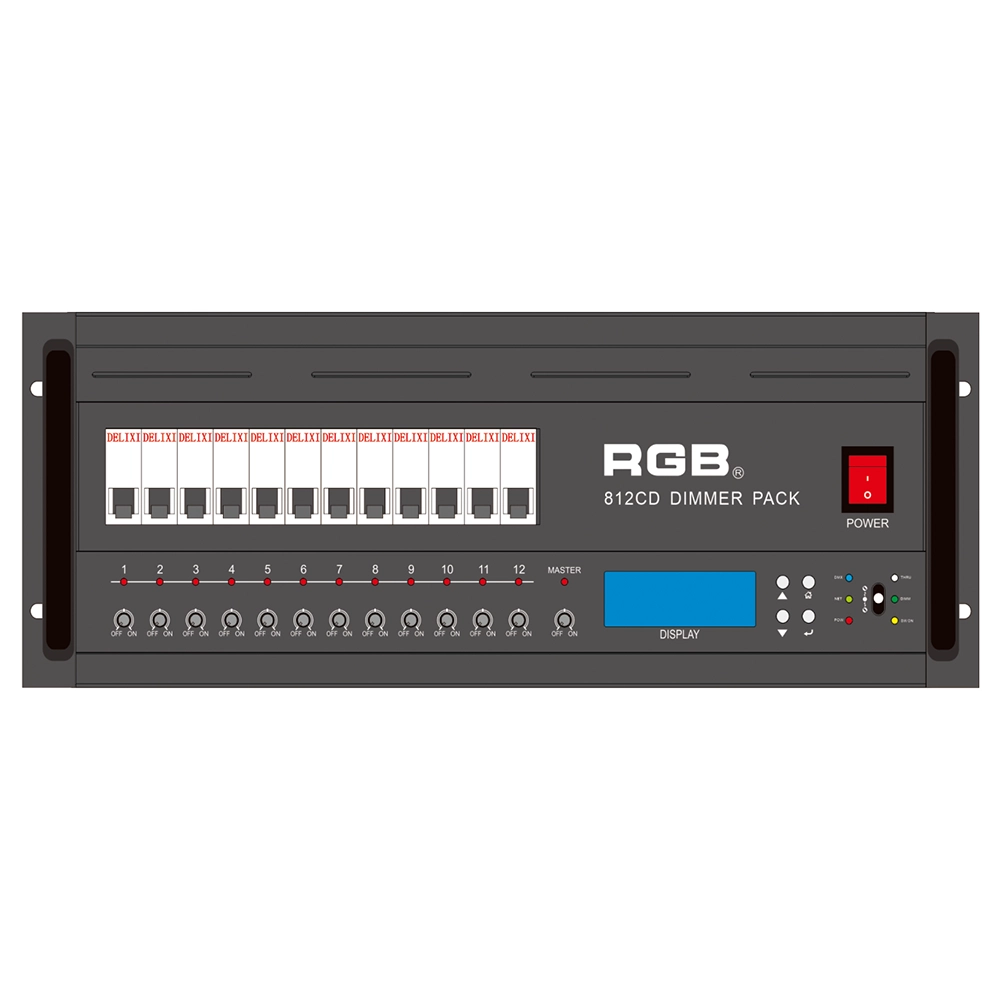
8 Series Intellight Dimmer/Relay Packs
RGB is the latest development and production of all digital, intelligent, and network dimming through the hybrid silicon box. It comes with six channels (806 silicon box), twelve channels (812 silicon box) with analog knob dimming, 49 DMX field recordings and replays (field backup function), and self-programming and recording field. RGB-8 silicon box with DMX512 digital signal input and RJ45 network input interface, with various types of dimming stations at home and abroad used. It is a powerful, stable performance and reliable work of a new generation of intelligent digital dimming through a hybrid silicon box.
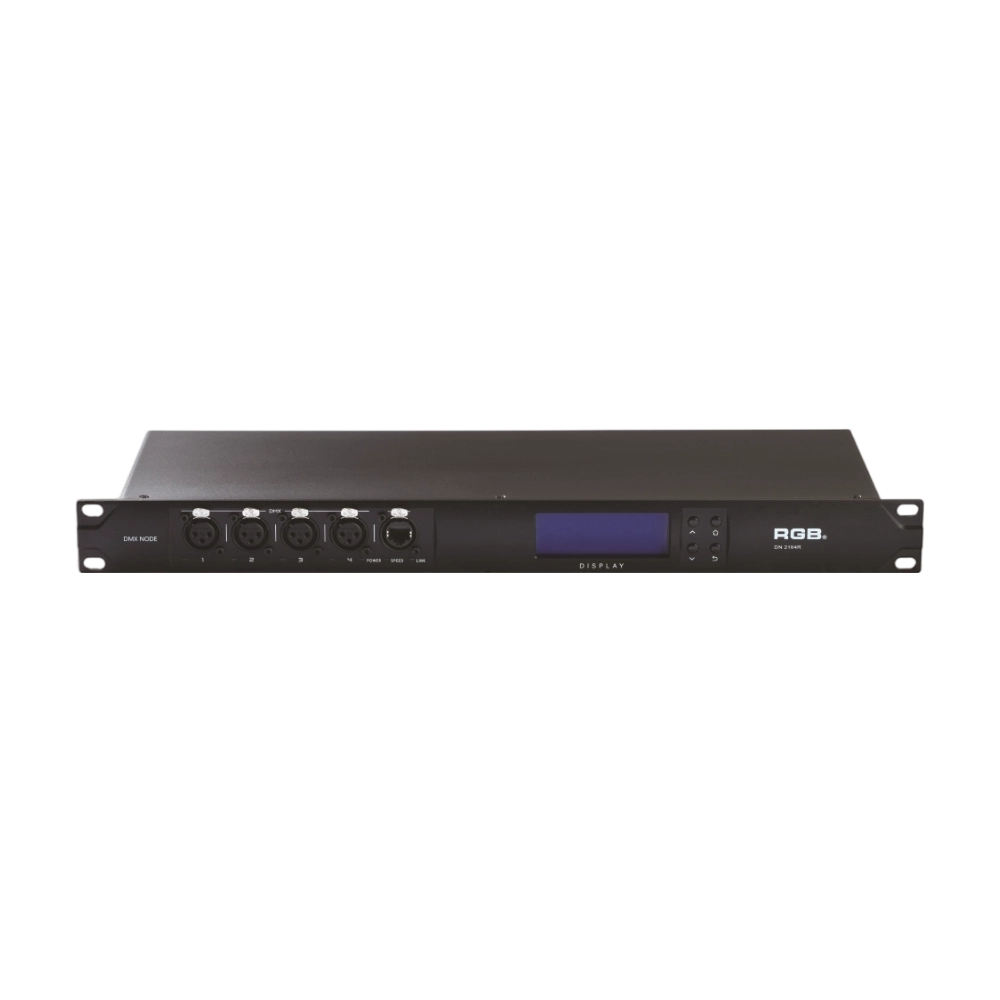
DMX, RDM Nodes
The DN series dual network port network decoder is a lighting control system product independently developed by RGB, featuring completely independent core technology and software copyright. It seamlessly connects and decodes the sACN and ART-Net network protocols based on TCP/IP with the DMX-512 and RDM communication protocols, achieving gigabit communication with dual independent physical address codes. Supports a visual lighting control system, intuitively displaying the online and offline status of the DN series network decoders, and enabling remote monitoring, editing, and setting of corresponding parameters.
It is widely applied in theaters, concert halls, multi-functional halls, cultural and tourism performances, TV stations, gymnasiums, auditoriums, commercial art lighting, and other performance and cultural venues.
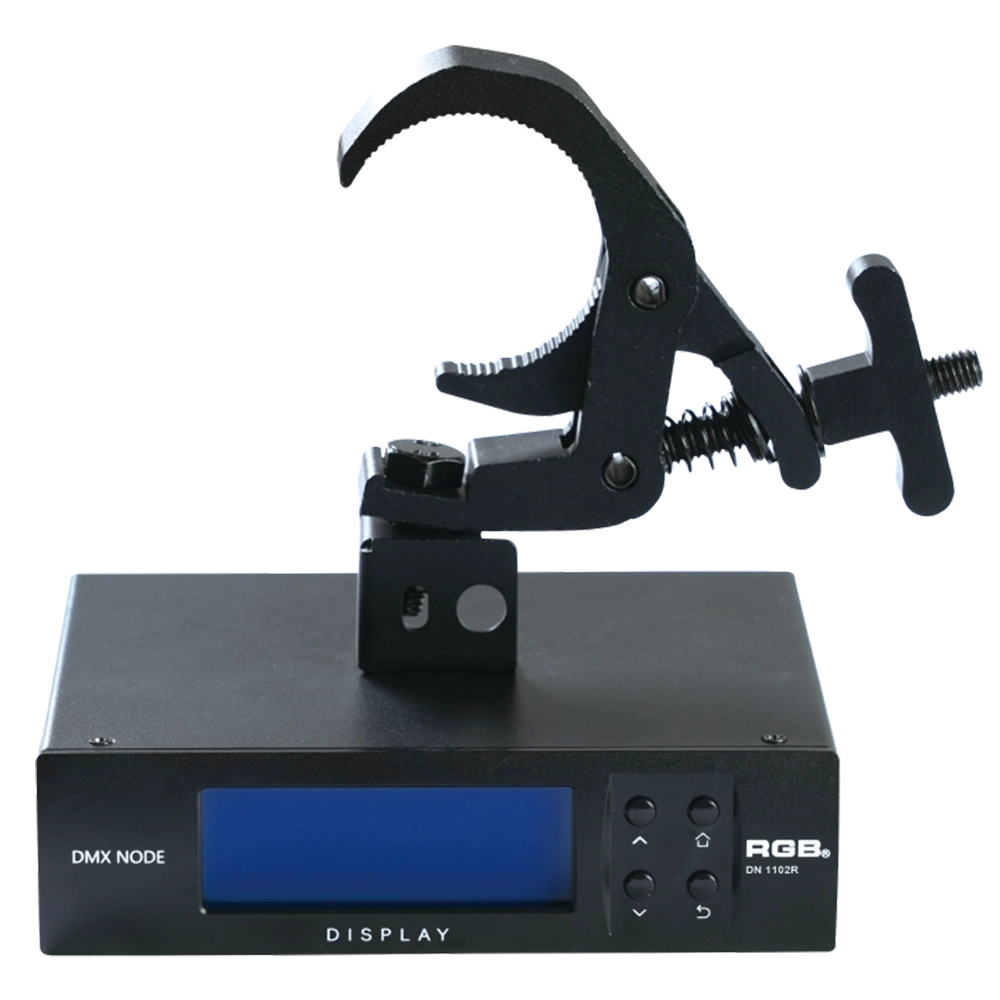
RDM Nodes
The DN series network decoder is a product of the lighting control system independently developed by RGB, featuring completely independent core technology and obtaining software copyrights. It seamlessly connects and decodes the sACN and Art-Net network protocols based on TCP/IP with the DMX-512 and RDM communication protocols. Supports a visual lighting control system, intuitively displaying the online and offline status of the DN series network decoders, and enabling remote monitoring, editing, and setting of corresponding parameters.
It is widely applied in theaters, concert halls, multi-functional halls, cultural and tourism performances, TV stations, gymnasiums, auditoriums, commercial art lighting, and other performance and cultural venues.
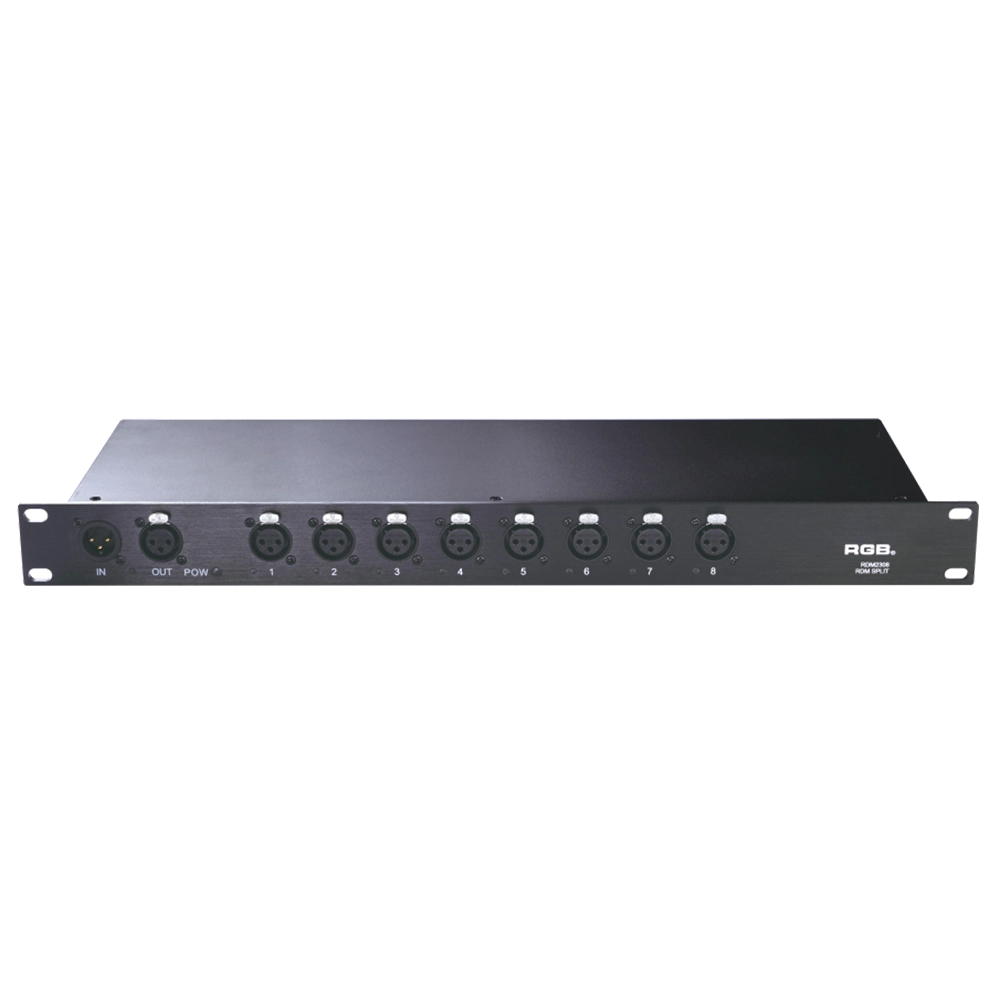
RDM Series Signal Amplifier
RDM2304, RDM2308, RDM2310, RDM2312 rack-mounted The RDM signal amplifier improves the quality of bidirectional RDM signal transmission, ensures the reliability of system control, and prevents faults such as AC high-voltage reverse series lighting control system, lightning high-voltage series entry, and line short circuit, which may affect system stability.
Expert Support
Interested in learning more or need expert guidance related to this article? Fill in your details, and our team will provide tailored support.
Intelligent Control. Brilliant Performance.
RGB specializes in stage lighting control systems, delivering intelligent, reliable, and high-performance solutions for theaters and performance spaces worldwide.
Contact
Email:
Tel:
+86 20 3928 0245
+86 20 3928 0247
Address:
No.3, Huashan Road, Shilou Town, Panyu, Guangzhou, China.
Whatsapp: +8615975520131