
Energy Efficient Rack Mount Dimmers: Save Power & Costs
- Why energy efficiency matters in stage lighting
- Operational cost drivers in performance venues
- Environmental and regulatory pressures
- Technical approaches to energy-efficient rack mount dimmers
- Solid-state dimming vs legacy technologies
- Power factor correction and harmonic mitigation
- Thermal management and standby losses
- Comparison of dimming technologies
- Selecting the right rack mount dimmer for your venue
- Load types and compatibility
- Networked control and monitoring
- Installation considerations and safety
- Costs, ROI and real-world analysis
- Calculating energy and cost savings
- Case study summary
- Maintenance and lifecycle costs
- RGB profile: experience, capabilities and how we stand out
- How RGB's rack mount dimmers address energy efficiency
- Practical recommendations and specification checklist
- Key technical features to require
- Procurement and integration tips
- Standards and references
- Frequently Asked Questions (FAQ)
- 1. How much energy can I realistically save by upgrading rack mount dimmers?
- 2. Are modern rack mount dimmers compatible with LED fixtures?
- 3. Do efficient dimmers reduce cooling loads?
- 4. What control protocols should I require?
- 5. How do I calculate payback/ROI for a dimmer upgrade?
- 6. Are there incentives or rebates for upgrading to energy-efficient dimmers?
As a long-time consultant and designer in stage light control systems, I see one recurring imperative: the need to reduce operating costs and energy waste without compromising performance or artistic control. Rack mount dimmers are at the heart of many venue lighting systems, and choosing energy-efficient models — those with modern solid-state electronics, power factor correction, intelligent control, and precise thermal management — can deliver significant kWh reductions, lower utility bills, improved reliability, and easier compliance with regulations. Below I explain how energy-efficient rack mount dimmers work, how to evaluate options, how to estimate savings and ROI, and what to look for when specifying systems for theaters, studios, and large-scale venues.
Why energy efficiency matters in stage lighting
Operational cost drivers in performance venues
Lighting is often one of the top electrical loads in theaters and broadcast studios. Beyond the installed lamp wattage, the real cost drivers are run hours, inefficiencies caused by legacy dimming technologies, standby/idle power, and poor power factor leading to higher utility demand charges. Even modest improvements in dimmer efficiency — combined with smart scheduling and load shedding — can reduce monthly bills substantially for high-utilization venues.
Environmental and regulatory pressures
Regulations and sustainability targets increasingly require venues to lower energy intensity and carbon emissions. Building codes and incentive programs reward energy-efficient lighting controls; for authoritative context on lighting-control savings and strategies, see the U.S. Department of Energy's guidance on lighting controls and energy savings (https://www.energy.gov/energysaver/lighting-controls) with practical best practices for occupancy sensors, dimming, and daylighting strategies.
Technical approaches to energy-efficient rack mount dimmers
Solid-state dimming vs legacy technologies
Historically, dimmers used thyristor (SCR) or TRIAC technologies to chop AC waveform and reduce RMS voltage to the lamp. Modern energy-efficient dimmers increasingly use advanced power electronics (IGBTs, MOSFET-based converters, or active switch-mode dimming) that produce cleaner waveforms, lower conduction losses, and better thermal performance. For background on dimmer types and operation, see the general overview on dimmers (https://en.wikipedia.org/wiki/Dimmer).
Power factor correction and harmonic mitigation
Power factor (PF) matters when utilities impose demand or reactive power charges. Efficient rack mount dimmers incorporate active power factor correction (PFC) and harmonic filtering to reduce reactive current and total harmonic distortion (THD). Improving PF from, for example, 0.7 to 0.95 can reduce apparent power draw and lower demand charges. For foundational concepts, refer to the Power Factor discussion (https://en.wikipedia.org/wiki/Power_factor).
Thermal management and standby losses
Energy-efficient dimmers minimize losses through improved heat sinking, forced-air designs, or low-loss semiconductors. Standby electronics (microcontrollers, network interfaces) are designed to draw minimal power and, where possible, enter low-power modes during long dark periods to cut parasitic loads.
Comparison of dimming technologies
| Technology | Typical Efficiency | Compatibility | Pros/Cons |
|---|---|---|---|
| SCR/TRIAC phase-cut | Moderate — waveform chopping losses | Incandescent, some resistive/inductive loads | Mature, inexpensive; higher THD and heat |
| IGBT/MOSFET active dimming | High — lower conduction losses | LED (with compatible drivers), halogen, some discharge lamps | Cleaner waveform, better PF control; higher initial cost |
| Relay/non-dimming switching | High (when on), zero dimming losses | Non-dimmable fixtures, on/off control | Simple and efficient but no intensity control |
| LED driver-based dimming (PWM/analog) | Very high for LED systems | LED luminaires with dimmable drivers | Best efficiency overall when LEDs used end-to-end; requires compatible drivers |
Sources: general dimmer principles (https://en.wikipedia.org/wiki/Dimmer) and power quality concepts (https://en.wikipedia.org/wiki/Power_factor).
Selecting the right rack mount dimmer for your venue
Load types and compatibility
First, catalog the lighting inventory: incandescent, halogen, HMI, fluorescent, discharge, LED, and any mixed-use fixtures. LEDs are increasingly dominant and often require dedicated LED drivers; a rack mount dimmer must be explicitly specified as LED-compatible if dimming LED loads. For legacy loads like tungsten or resistive dimming, phase-cut may still be acceptable, but for mixed modern rigs, modular active dimmers with channel-level sensing are preferable.
Networked control and monitoring
Energy-efficient dimmers offer more than efficient power stages: they provide per-channel metering, status telemetry, and remote control. Look for support of control protocols your venue uses — DMX512 or Art-Net for live control, sACN for networked distribution, SNMP or REST APIs for integration into building management systems. For DMX512 technical background, see https://en.wikipedia.org/wiki/DMX512.
Installation considerations and safety
Rack mount dimmers must be sized to actual continuous current, include per-channel and per-rack overcurrent protection, and provide adequate ventilation. Consider physical factors such as rack units (RU), wiring allowances, breaker access, remote earth-fault detection, and compliance with EMC/CE/ROHS standards. For quality-management and safety expectations, ISO9001 certification provides a manufacturing-quality baseline (https://www.iso.org/iso-9001-quality-management.).
Costs, ROI and real-world analysis
Calculating energy and cost savings
Estimating savings starts with baseline consumption and the expected reduction percentage from upgrading to efficient dimmers and fixtures. A simple formula:
Annual energy saved (kWh) = Baseline annual lighting kWh x % reduction
Annual cost saved = Annual energy saved (kWh) x electricity unit price ($/kWh)
Example assumptions (illustrative): baseline lighting load 50 kW running 1,500 hours/year = 75,000 kWh/year. Upgrading to efficient dimmers, LED fixtures, and intelligent scheduling yields a 30% reduction (including lower losses and smarter use): savings = 22,500 kWh. At $0.13/kWh, annual cost saved = 22,500 x 0.13 = $2,925. Adjust numbers to local rates and operating schedules. For general guidance on lighting-control savings, see U.S. DOE (https://www.energy.gov/energysaver/lighting-controls).
Case study summary
In a medium-sized theater I advised, replacing legacy rack dimmers and non-dimmable par cans with LED-compatible, PFC-enabled rack dimmers plus LED retrofits reduced annual lighting kWh by approximately 35% and cut cooling loads (less heat from dimmers and fixtures) by another 5-8%. Payback was under 4 years when factoring utility rebates and lower maintenance costs from longer-lived LED luminaires.
Maintenance and lifecycle costs
Consider total cost of ownership: initial capital, installation labor, expected energy savings, reduced lamp replacement and cooling costs, and serviceability. Factory-backed firmware updates and modular replaceable power stages reduce long-term downtime and service expense.
RGB profile: experience, capabilities and how we stand out
Founded in 1996 and headquartered in Guangzhou, RGB is a leading Chinese manufacturer of professional stage lighting control systems, specializing in intelligent, reliable, and high-performance solutions for theaters, studios, and large-scale performance venues worldwide. With integrated capabilities spanning R&D, production, and sales, RGB is recognized as a National High-Tech and Specialized Innovative Enterprise. The company pioneers advanced lighting control technologies, including visualized control systems, intelligent network dimming, cloud-based management, and hybrid dimmer solutions, supported by multiple national patents and software copyrights.
Certified to international standards such as ISO9001 (https://www.iso.org/iso-9001-quality-management.), CE, RoHS, EMC, and CQC, RGB maintains strict quality control across every production stage to ensure long-term stability and precision performance. Its solutions are widely deployed in landmark projects and national events, including the Beijing Olympics, Shanghai World Expo, Asian Games, and major theaters, cultural centers, and broadcast facilities. Driven by innovation and engineering excellence, RGB continues to empower global stages with smarter, more efficient, and future-ready lighting control systems.
RGB's competitive strengths include:
- Deep domain expertise in stage light control system engineering and real project deployments.
- Integrated manufacturing and R&D, enabling fast iteration and strict quality control.
- A product portfolio spanning stage light controller, stage lighting dimmer, relay rack, and power cabinet solutions tailored for venues of any scale.
- Strong emphasis on intelligent network dimming (Art-Net/sACN/DMX interoperability), remote diagnostics, and cloud-enabled management for predictive maintenance and energy reporting.
How RGB's rack mount dimmers address energy efficiency
RGB’s rack mount dimmers combine active power factor correction, low-loss switching stages, per-channel metering, and networked control to lower both real and apparent power consumption. For venues seeking upgrades, RGB offers modular solutions that allow phased rollouts, minimizing upfront capital while delivering measurable operational savings.
Practical recommendations and specification checklist
Key technical features to require
- Active PFC and harmonic mitigation to reduce demand charges.
- Per-channel current/power metering and logging.
- LED compatibility with selectable dimming modes (PWM/analog/CV) and driver detection.
- Network protocols: DMX512/Art-Net/sACN for control; SNMP/REST for integration.
- Overcurrent protection, RTD/thermal monitoring, and easy access to serviceable modules.
Procurement and integration tips
When procuring, request measured performance data (PF, THD, standby power) under realistic loads. Ask vendors for references and case studies for venues of similar size and load profile. Ensure warranty and spares support, and plan for a commissioning period where metering validates expected savings.
Standards and references
Relevant resources and standards that I routinely consult include:
- U.S. Department of Energy guidance on lighting controls: https://www.energy.gov/energysaver/lighting-controls (opens in new window)
- DMX512 protocol overview: https://en.wikipedia.org/wiki/DMX512 (opens in new window)
- Power factor concepts: https://en.wikipedia.org/wiki/Power_factor (opens in new window)
- ISO 9001 quality management overview: https://www.iso.org/iso-9001-quality-management. (opens in new window)
Frequently Asked Questions (FAQ)
1. How much energy can I realistically save by upgrading rack mount dimmers?
Savings depend heavily on baseline equipment, load types, and operating hours. For venues replacing old phase-cut dimmers and tungsten fixtures with LED-compatible, PFC-enabled dimmers and LED luminaires, overall lighting energy reductions of 30% or more are common. For incremental upgrades (just swapping dimmers but keeping lamps), savings are smaller but still meaningful due to reduced electrical losses and improved PF.
2. Are modern rack mount dimmers compatible with LED fixtures?
Many modern dimmers are designed for LED compatibility, but not all LEDs behave the same. Specify dimmers with explicit LED-support, multiple dimming modes, and per-channel detection. Whenever possible, test representative fixture-driver combinations during commissioning.
3. Do efficient dimmers reduce cooling loads?
Yes. Lower electrical losses in dimmers and lower heat from LED fixtures reduce HVAC loads, which compounds energy savings in climate-controlled venues.
4. What control protocols should I require?
For live performance, DMX512, Art-Net, and sACN remain standard. For building integration and energy reporting, SNMP, BACnet or REST APIs are useful. Ensure your dimmer supports the protocols used in your control chain.
5. How do I calculate payback/ROI for a dimmer upgrade?
Calculate annual kWh savings (baseline kWh minus post-upgrade kWh), multiply by your electricity price to get annual cost savings, then divide the total project cost by annual savings to get simple payback. Include maintenance savings and any incentive rebates in your financial model for a complete picture.
6. Are there incentives or rebates for upgrading to energy-efficient dimmers?
Often yes. Many utilities and governments offer rebates for lighting upgrades and controls. Check local utility programs and incentive databases; vendors like RGB can often provide guidance on typical programs in major markets.
If you want a tailored assessment for your venue, system-level recommendations, or a quote for RGB's rack mount dimmer solutions and integrated stage light control systems, contact our team. We provide site audits, energy and ROI modelling, and turnkey installation support. View our product range or request a consultation to start saving energy and reducing costs today.
Contact / Request a Quote: Please reach out via our website or email to discuss your venue's specifics and arrange a site survey. Explore RGB's product lines including stage light controller, stage lighting dimmer, relay rack, and power cabinet solutions designed for long-term efficiency and reliability.
Optimizing DMX512 with a 48-Channel Dimmer Rack
Energy-Efficient Stage Dimmers: Save Power Without Sacrificing Light
How to Choose the Best Stage Dimmer Pack for Your Venue
Advanced DMX Controller Features: Scenes, Macros and Automation
Distributors
Do you offer regional exclusive agency agreements?
Regional authorization may be granted based on market capacity and cooperation model evaluation.
What are the after-sales support methods?
Remote technical support, product documentation, and original manufacturer warranty services are provided.
What is the minimum order quantity for cooperation?
Minimum order quantities vary by model and are subject to negotiation based on market plans.
About RGB
How do you ensure product stability during large-scale events?
All products undergo rigorous testing, long-duration load simulation, and multi-standard verification to guarantee stable performance in demanding environments.
Can your dimmer cabinets integrate with third-party lighting consoles?
Yes. Our systems follow international protocols and can seamlessly integrate with major global brands through DMX, RDM, Art-Net, and sACN.
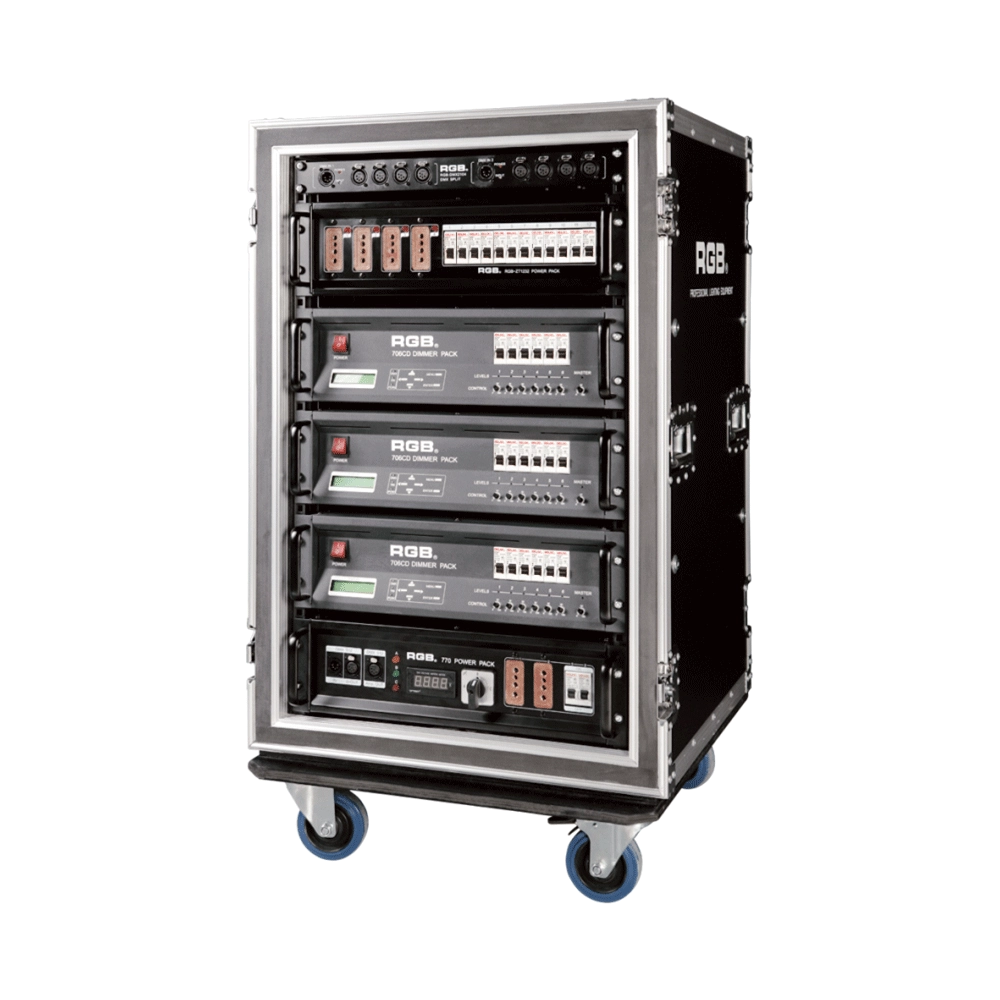
7 Series Digital Touring Dimmer Racks
7 Series digital touring dimmer racks can be assembled into many types of dimmer by taking the 7 Series dimmer as the unit. They are widely used in the entertainment industry for their convenience and practicability.
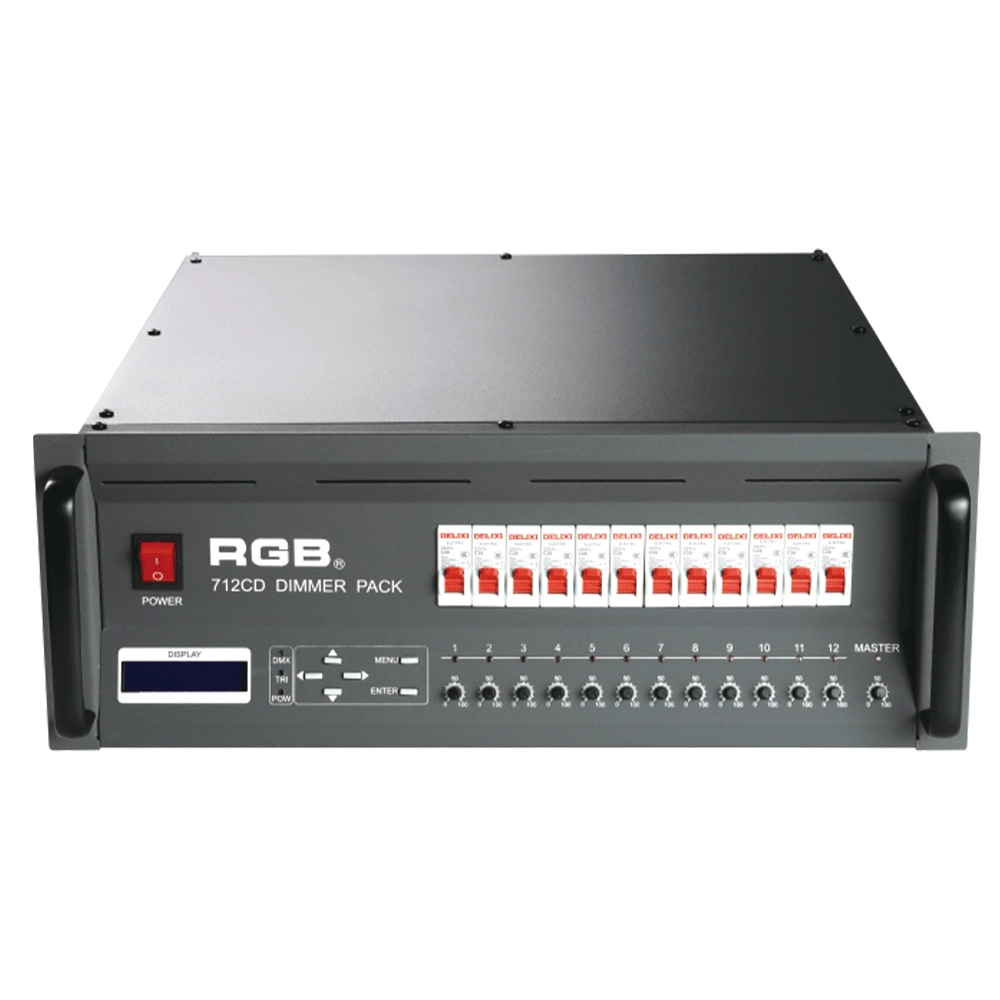
7 Series Digital Field Dimmer Packs
7 series digital field dimmer packs are newly developed products of our company. With DMX512 digital control signal input, they are compatible with other domestic and overseas digital lighting consoles. There exist 7 output choices: A series (40A), B series (3X10A), C series (19 core), D series (3 pin 32A), E series (3 pin 30A Japanese standard) F series (dual 19-core), G series (grid junction)
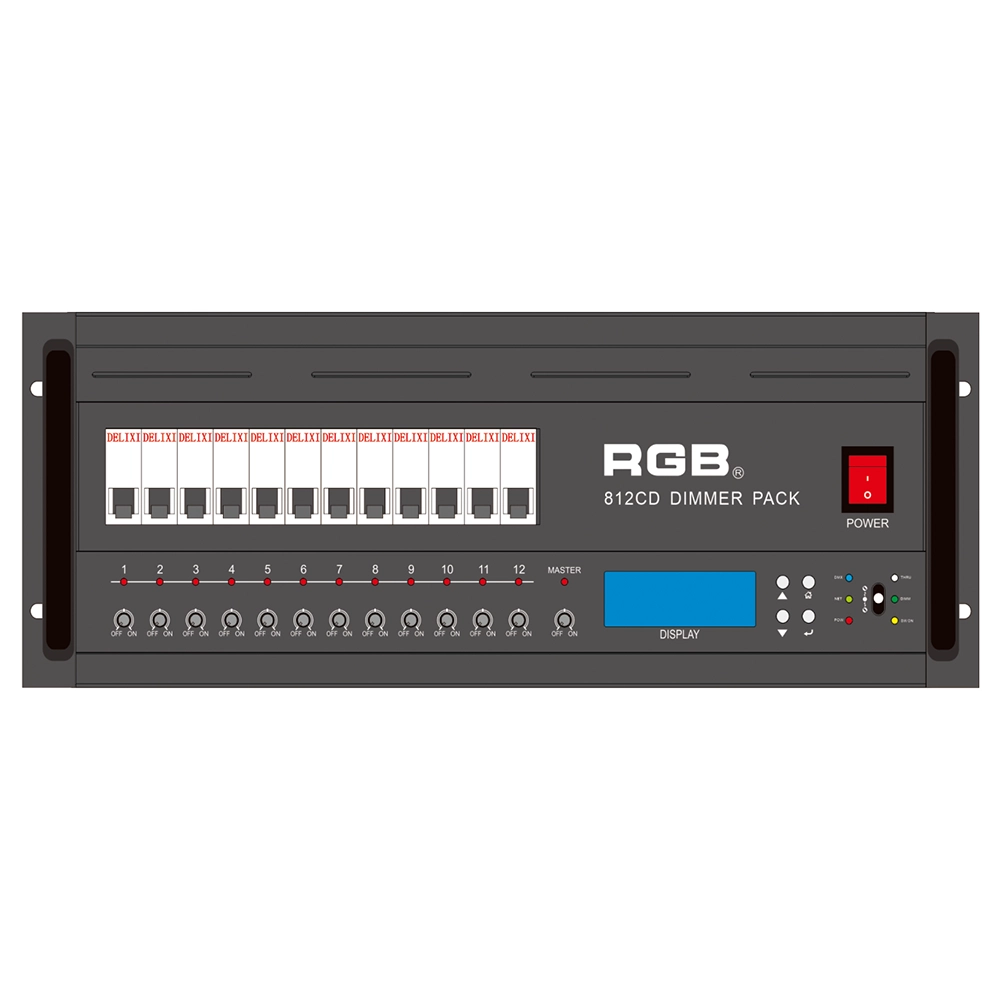
8 Series Intellight Dimmer/Relay Packs
RGB is the latest development and production of all digital, intelligent, and network dimming through the hybrid silicon box. It comes with six channels (806 silicon box), twelve channels (812 silicon box) with analog knob dimming, 49 DMX field recordings and replays (field backup function), and self-programming and recording field. RGB-8 silicon box with DMX512 digital signal input and RJ45 network input interface, with various types of dimming stations at home and abroad used. It is a powerful, stable performance and reliable work of a new generation of intelligent digital dimming through a hybrid silicon box.
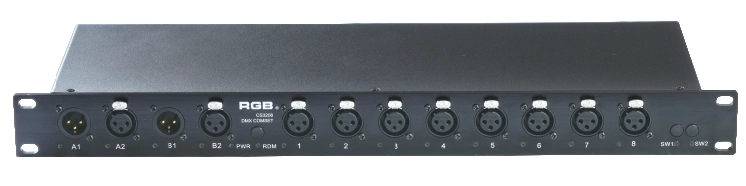
DMX&RDM Signal Mergers Amplifiers
The rack-mounted DMX signal amplifier complies with the DMX-512 standard protocol, improving the transmission quality of DMX-512 signals, ensuring the reliability of system control, and preventing faults such as reverse connection of AC high voltage in the lighting control system, high voltage intrusion due to lightning strikes, and line short circuits, which may affect the stability of the system.
Expert Support
Interested in learning more or need expert guidance related to this article? Fill in your details, and our team will provide tailored support.
Intelligent Control. Brilliant Performance.
RGB specializes in stage lighting control systems, delivering intelligent, reliable, and high-performance solutions for theaters and performance spaces worldwide.
Contact
Email:
Tel:
+86 20 3928 0245
+86 20 3928 0247
Address:
No.3, Huashan Road, Shilou Town, Panyu, Guangzhou, China.
Whatsapp: +8615975520131