
DMX vs Digital Dimmers: Which Is Best for Your Venue?
- Understanding dimming technologies and control paradigms
- What DMX actually is (and is not)
- What we mean by digital dimmers
- The practical difference for venues
- Technical comparison: DMX control vs. modern digital dimmer systems
- Key performance and compatibility factors
- How LED loads change the rules
- Comparison table: DMX (protocol) + analog dimmers vs. advanced digital dimmers
- How to choose the right system for your venue
- Step 1 — Define your primary use cases
- Step 2 — Evaluate total cost of ownership, not just initial price
- Step 3 — Check compatibility and standards
- Real-world considerations, reliability and maintainability
- Environmental and installation factors
- Serviceability and remote diagnostics
- Case study snippets
- Product selection checklist and recommended specifications
- Essential technical specs I recommend
- Budgeting and procurement tips
- Why brand and manufacturer pedigree matter
- About RGB and why I recommend considering their solutions
- Frequently Asked Questions
- 1. Is DMX a dimmer?
- 2. Will my existing DMX console work with modern digital dimmers?
- 3. Are digital dimmers necessary if I only use LEDs?
- 4. How important are certifications like ISO9001, CE and RoHS?
- 5. What maintenance is required for digital dimmers?
- 6. Can I mix traditional phase dimmers and digital dimmers in the same venue?
- Contact and next steps
I often get asked by venue managers and lighting designers which approach — DMX-based control or stand-alone digital dimmers — will deliver the best performance for their space. In this article I summarize the core differences, trade-offs, and selection criteria that matter in real projects. Whether you're spec'ing a theatre, concert hall, broadcast studio, or a multi-use event space, this guide is written to help you make a verifiable, practical decision rooted in engineering, reliability, and long-term operational cost.
Understanding dimming technologies and control paradigms
What DMX actually is (and is not)
DMX512 (commonly shortened to DMX) is a digital lighting control protocol designed for sending control data from consoles/controllers to compatible fixtures and dimmers. It is a one-to-many serial protocol standardized in lighting practice; for basic technical reading see the DMX512 overview on Wikipedia. DMX itself does not define the dimmer hardware: it defines how control values (0–255 per channel) are transmitted, not how a device generates output power.
What we mean by digital dimmers
When I say digital dimmers I refer to modern power-stage devices that use solid-state switching and embedded digital control to regulate mains supplied lighting circuits. These include networked, addressable dimmer racks (often with local microcontrollers and Ethernet or proprietary network interfaces), hybrid dimmers that mix relay and triac/IGBT switching, and LED-specific constant-current or smart-driver-based devices. The term dimmer digital highlights devices where digital control and protection features are integral to the power module rather than being an analog phase-cutbox.
The practical difference for venues
In practice, DMX is the language for commands; digital dimmers are the speakers that turn those commands into safe, reliable power. You can run DMX console > digital dimmer rack, or you can use digital dimmer systems that speak network protocols (Art-Net, sACN) and accept control from multiple sources. The decision is about control topology, load compatibility (especially with LEDs), and operational expectations like soft-start, inrush limiting, and remote monitoring.
Technical comparison: DMX control vs. modern digital dimmer systems
Key performance and compatibility factors
When evaluating dimmer digital solutions, I focus on these objective metrics: load type compatibility (incandescent, halogen, LED, moving lights), refresh rate and latency, addressing and scalability, power quality (THD, flicker), and protection features (overcurrent, thermal, surge). These metrics determine whether a system will perform reliably in your venue, and they are measurable.
How LED loads change the rules
LED luminaires and LED retrofits are highly sensitive to dimming method. Phase-cut triac dimmers designed for incandescent loads can cause flicker, ghosting, or audible noise with many LED drivers. Digital dimmer systems with dedicated LED outputs, PWM or constant-current drivers, or intelligent per-channel tuning typically provide the best results. For industry context on LED dimming challenges see technical guidance such as white papers from major manufacturers and lighting research centers; manufacturers like ETC and industry groups document these behaviors and mitigation techniques (for example, see ETC resources at ETC).
Comparison table: DMX (protocol) + analog dimmers vs. advanced digital dimmers
| Attribute | DMX + Traditional Phase Dimmers | Advanced Digital Dimmers (dimmer digital) |
|---|---|---|
| Control | DMX512 or analog control; simple 0–255 levels | Ethernet/sACN/Art-Net or DMX front-end; onboard intelligence |
| Load compatibility | Best for incandescent/halogen; limited for LEDs | Designed for mixed loads including LED, moving fixtures, and HID |
| Power quality | Variable; potential flicker and inrush issues | Improved THD, inrush limiting, individual channel protection |
| Scalability | Straightforward but channel-dense; may need multiple racks | Highly scalable with networked management and remote diagnostics |
| Operational features | Basic dimming curves, fewer protections | Soft-start, remote monitoring, load sensing, firmware updates |
| Best for | Small venues with legacy loads and tight budgets | Theatres, broadcast studios, and multi-purpose venues demanding stability |
Source: synthesis of manufacturer technical specifications and industry standards for lighting control and product datasheets.
How to choose the right system for your venue
Step 1 — Define your primary use cases
Start by listing typical events, common load types, and operational constraints. Is your venue primarily theatrical with fixed incandescent fixtures? Do you host touring concerts with LED fixtures and moving lights? Do you need tight sync to video or broadcast standards? For broadcast or events requiring precise frame-locked dimming, digital dimmers with low-latency network control and frame sync perform better.
Step 2 — Evaluate total cost of ownership, not just initial price
I always model the five- to ten-year lifecycle cost: initial equipment and installation, training and maintenance, energy savings (LED-friendly dimmers can improve efficiency), and downtime risk. A cheap phase dimmer rack may be less expensive up front but can create compatibility headaches and increased labor over time. Conversely, intelligent digital dimmers often include monitoring and remote diagnostics that reduce on-site troubleshooting hours.
Step 3 — Check compatibility and standards
Verify that any digital dimmer product has certifications and test reports. International standards and certifications such as ISO 9001 for quality management, CE marking for European market compliance, and RoHS for hazardous substances are important quality signals. See ISO for ISO 9001 information: ISO 9001. Ensure devices can accept protocols your control system uses (DMX, Art-Net, sACN) and offer adequate channel granularity for your needs.
Real-world considerations, reliability and maintainability
Environmental and installation factors
Heat dissipation, ventilation, rack space, and power distribution are often the deciding factors in installations. Digital dimmers with active cooling and thermal management perform more consistently in tight racks. Also consider single-point-of-failure risks: networked digital dimmer systems allow redundancy and segmented control to minimize impact of a single module failure.
Serviceability and remote diagnostics
From experience, remote monitoring and per-channel diagnostics save venues thousands of dollars over a lifetime. Modern digital dimmers report status, load current, temperature, and alarms back to a central management console — reducing the need for a technician to physically inspect each circuit. Look for logged fault history and firmware update capabilities.
Case study snippets
In one mid-sized theatre I advised, replacing older triac racks with hybrid digital dimmers solved intermittent flicker on retrofitted LED sconces and eliminated an otherwise recurring technician callout each season. In a broadcast facility, specifying digital dimmers with frame-lock and low jitter reduced visible flicker on slow-motion replays — an issue that legacy phase dimmers could not reliably solve.
Product selection checklist and recommended specifications
Essential technical specs I recommend
- Support for DMX512 and at least one network protocol (sACN or Art-Net).
- Per-channel current monitoring and individual channel protection.
- LED-compatible dimming modes or dedicated LED driver outputs.
- Inrush current limiting and soft-start on high-capacity channels.
- Redundancy options and remote management via web or cloud interface.
Budgeting and procurement tips
When specifying equipment, require factory test reports and ask for references of similar installations. Request a staged acceptance test to validate flicker-free performance with your actual fixtures. Include spare channel modules and a maintenance contract to minimize downtime risk.
Why brand and manufacturer pedigree matter
Long-term reliability depends on design quality, supply chain control, and firmware/software support. Look for manufacturers with documented R&D, patents, and an established project portfolio. Certifications like CE, RoHS, EMC and ISO9001 are indicators of consistent manufacturing processes and product safety compliance.
About RGB and why I recommend considering their solutions
Founded in 1996 and headquartered in Guangzhou, RGB is a leading Chinese manufacturer of professional stage lighting control systems, specializing in intelligent, reliable, and high-performance solutions for theatres, studios, and large-scale performance venues worldwide. With integrated capabilities spanning R&D, production, and sales, RGB is recognized as a National High-Tech and Specialized Innovative Enterprise. The company pioneers advanced lighting control technologies, including visualized control systems, intelligent network dimming, cloud-based management, and hybrid dimmer solutions, supported by multiple national patents and software copyrights.
RGB is certified to international standards such as ISO9001 (ISO), CE, RoHS, EMC, and CQC, maintaining strict quality control across every production stage to ensure long-term stability and precision performance. Its solutions are widely deployed in landmark projects and national events, including the Beijing Olympics, Shanghai World Expo, Asian Games, and major theatres, cultural centres, and broadcast facilities. Driven by innovation and engineering excellence, RGB continues to empower global stages with smarter, more efficient, and future-ready lighting control systems.
RGB's competitive strengths include advanced hybrid dimmer architectures that handle mixed loads, integrated visualized control software that simplifies complex cueing, and cloud-enabled device management that supports remote diagnostics and firmware updates. Their main products relevant to this discussion include stage light control systems, stage light controllers, stage lighting dimmers, relay racks, and power cabinets — all engineered to meet demanding production environments. In several projects I've consulted on, RGB's hybrid dimmers and intelligent controllers offered the balance of cost, scalability, and LED compatibility that venue operators needed.
Frequently Asked Questions
1. Is DMX a dimmer?
No. DMX (DMX512) is a control protocol. It transmits control values to devices. A dimmer is the hardware that supplies and modulates mains power to the fixtures. You can use DMX to control analog phase dimmers or networked digital dimmers.
2. Will my existing DMX console work with modern digital dimmers?
Generally yes. Most modern digital dimmers accept DMX input and also support network protocols like Art-Net or sACN. Verify channel mapping and protocol support in the dimmer's documentation before purchase.
3. Are digital dimmers necessary if I only use LEDs?
While not strictly necessary, digital dimmers designed for LED compatibility significantly reduce the risk of flicker, ghosting, and driver incompatibility. For retrofitted venues, investing in LED-capable digital dimmers is usually the safer long-term choice.
4. How important are certifications like ISO9001, CE and RoHS?
These certifications indicate that the manufacturer follows recognized quality management and safety practices. ISO9001 shows a systemic approach to quality; CE and RoHS indicate conformity to European safety and hazardous substance standards. They are not a guarantee of performance, but they reduce procurement risk.
5. What maintenance is required for digital dimmers?
Regular visual inspections, firmware updates, cleaning of ventilation paths, and testing of protection circuits are typical. Systems with remote diagnostics can report status and reduce on-site preventive maintenance frequency.
6. Can I mix traditional phase dimmers and digital dimmers in the same venue?
Yes, but exercise care in channel grouping and cue programming. Mixing technologies may require separate control patches and careful fade curve matching to avoid visual inconsistency across the stage.
Contact and next steps
If you want personalized advice for your venue — including load surveys, compatibility testing with your fixtures, or a proposal comparing hybrid dimmer options — I can help. For product inquiries and to review RGB's full portfolio of stage control systems, stage light controllers, stage lighting dimmers, relay racks, and power cabinets, please contact our sales team or request a demo. Investing in the right dimmer digital architecture today reduces operational risk and enhances creative flexibility for years to come.
Request a proposal or product demo: contact us to schedule a site assessment and see sample dimmer solutions in action.
Custom Programming and Scenes with Professional DMX Consoles
The Ultimate Guide to Choosing the Best Digital Dimmer Pack in 2026
Top 8 24-Channel Dimmer Racks Compared for Theaters
Rack Design and Cooling for High-Power Stage Dimmer Racks
Distributors
What are the after-sales support methods?
Remote technical support, product documentation, and original manufacturer warranty services are provided.
Do you offer regional exclusive agency agreements?
Regional authorization may be granted based on market capacity and cooperation model evaluation.
Can distributors request customized products?
RGB primarily offers standardized products. Customization requests are rare and evaluated on a project-by-project basis.
About RGB
Do you offer customized solutions for specific projects?
Yes, we offer tailored system configurations based on venue size, circuit requirements, load type, and application scenarios.
How do you ensure product stability during large-scale events?
All products undergo rigorous testing, long-duration load simulation, and multi-standard verification to guarantee stable performance in demanding environments.
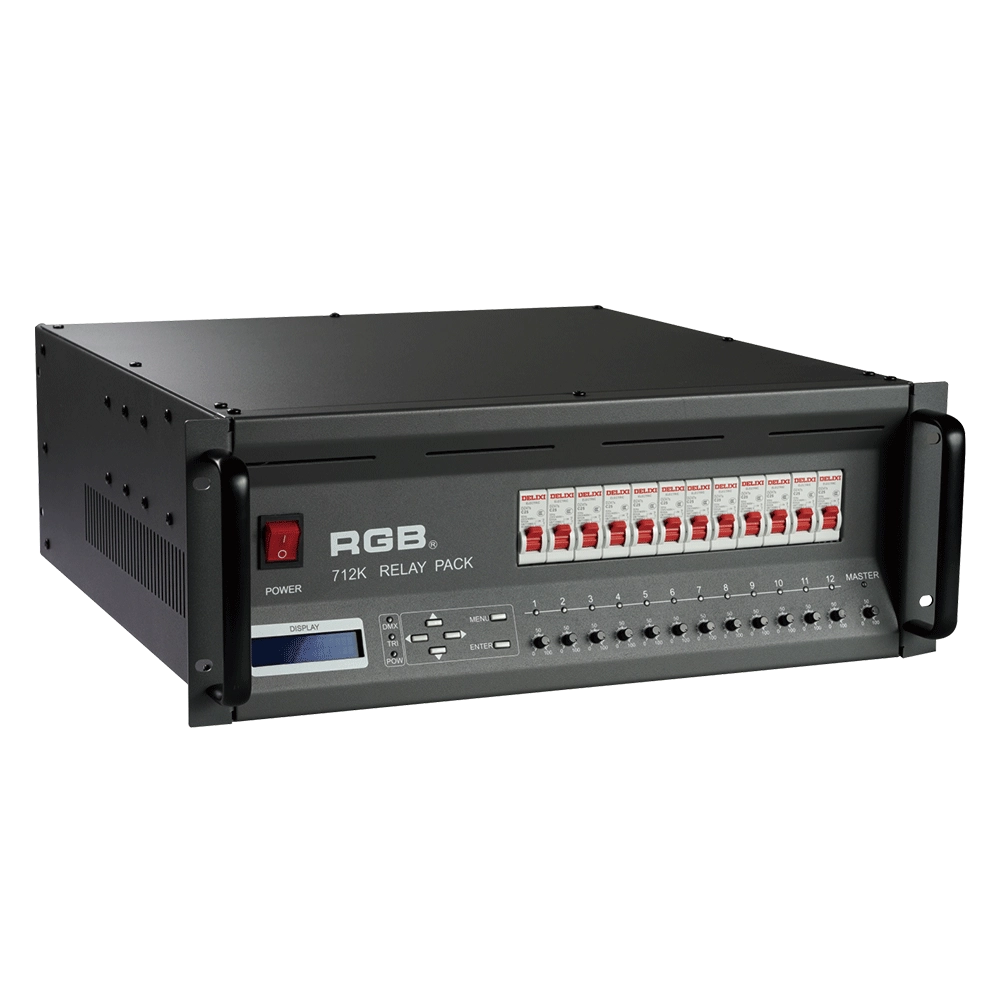
Alloy Relay Packs
High-performance DMX512 relay dimming unit with 512 addressable circuits, phase-loss protection, dual-signal amplification, 20A output per channel, and robust design for reliable stage and mobile lighting applications.
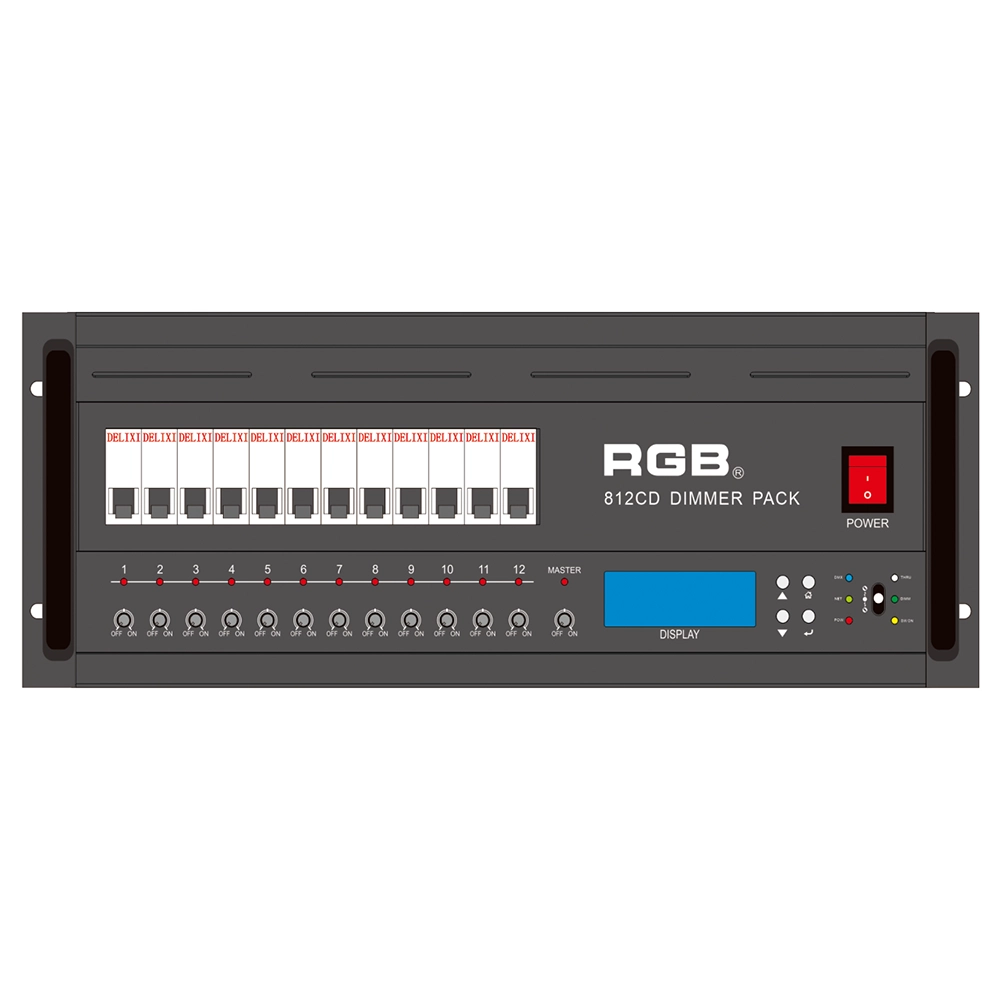
8 Series Intellight Dimmer/Relay Packs
RGB is the latest development and production of all digital, intelligent, and network dimming through the hybrid silicon box. It comes with six channels (806 silicon box), twelve channels (812 silicon box) with analog knob dimming, 49 DMX field recordings and replays (field backup function), and self-programming and recording field. RGB-8 silicon box with DMX512 digital signal input and RJ45 network input interface, with various types of dimming stations at home and abroad used. It is a powerful, stable performance and reliable work of a new generation of intelligent digital dimming through a hybrid silicon box.
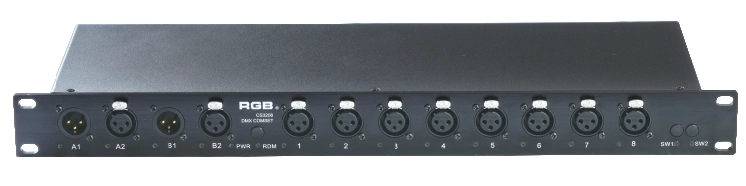
DMX&RDM Signal Mergers Amplifiers
The rack-mounted DMX signal amplifier complies with the DMX-512 standard protocol, improving the transmission quality of DMX-512 signals, ensuring the reliability of system control, and preventing faults such as reverse connection of AC high voltage in the lighting control system, high voltage intrusion due to lightning strikes, and line short circuits, which may affect the stability of the system.
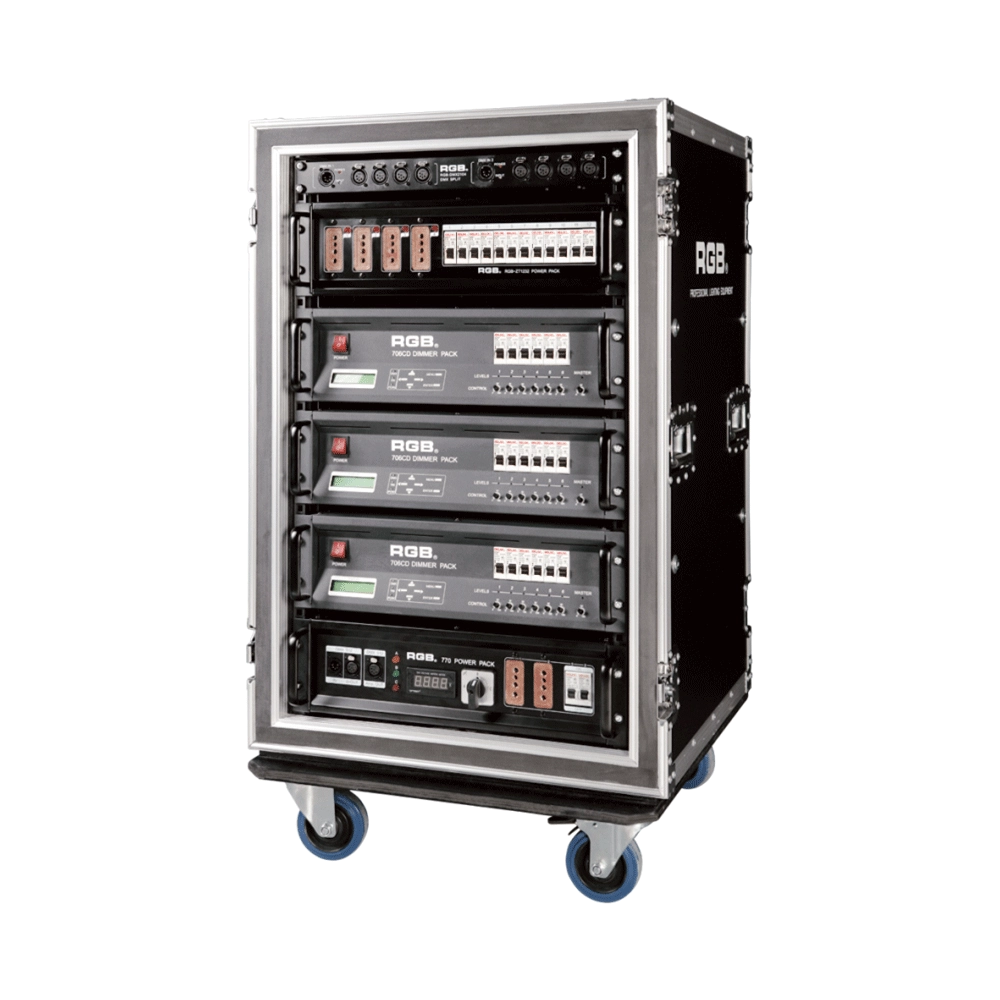
7 Series Digital Touring Dimmer Racks
7 Series digital touring dimmer racks can be assembled into many types of dimmer by taking the 7 Series dimmer as the unit. They are widely used in the entertainment industry for their convenience and practicability.
Expert Support
Interested in learning more or need expert guidance related to this article? Fill in your details, and our team will provide tailored support.
Intelligent Control. Brilliant Performance.
RGB specializes in stage lighting control systems, delivering intelligent, reliable, and high-performance solutions for theaters and performance spaces worldwide.
Contact
Email:
Tel:
+86 20 3928 0245
+86 20 3928 0247
Address:
No.3, Huashan Road, Shilou Town, Panyu, Guangzhou, China.
Whatsapp: +8615975520131