
Stage Dimmer Rack vs LED Drivers: Cost and Performance
- Understanding Power and Control in Stage Lighting
- How stage light controller, dimmer racks, and LED drivers relate
- Why the distinction matters for performance and cost
- Standards and references I use
- Technical Comparison: Dimmer Racks vs LED Drivers
- Electrical topology and compatibility
- Power efficiency, heat, and losses
- Control fidelity and flicker management
- Operational Costs and Lifecycle
- Upfront capital vs total cost of ownership (TCO)
- Maintenance, mean time between failures (MTBF), and serviceability
- Sample lifecycle cost model (illustrative)
- Design, Integration and Best Practices
- How I specify for mixed fleets
- Control protocols and smart driver features
- Electromagnetic compatibility and safety
- When to Choose Which: Practical Decision Matrix
- Use-cases favoring dimmer racks
- Use-cases favoring LED drivers/LED fixtures
- Practical recommendations I give clients
- About RGB — Industry Credentials and Offerings
- FAQs
- 1. Can I use a dimmer rack to control LED fixtures?
- 2. What is the typical payback period for switching to LEDs and proper drivers?
- 3. How does a stage light controller interact with hybrid dimmer/LED systems?
- 4. What certifications should I require for dimmers and drivers?
- 5. Are hybrid dimmer solutions a good compromise?
- 6. How should I plan upgrades to avoid disruptions during live seasons?
Quick summary for and readers: When choosing between traditional stage dimmer racks and dedicated LED drivers, the decision affects capital cost, energy efficiency, reliability, and how your stage light controller manages fixtures. I examine technical differences, lifecycle costs, integration and control strategies, and real-world considerations to help venues, rental companies, and lighting integrators make an informed choice.
Understanding Power and Control in Stage Lighting
How stage light controller, dimmer racks, and LED drivers relate
I often start system design by mapping the signal and power chain: a stage light controller sends control data (DMX/RDM/Art-Net/sACN) to a control interface that in turn instructs power-handling devices: either a dimmer rack (usually for resistive or inductive loads) or LED drivers (for solid-state luminaires). The controller’s role is to translate artistic intent into electrical control — but the downstream hardware determines waveform, power quality, and fixture compatibility.
Why the distinction matters for performance and cost
Dimmer racks and LED drivers operate on different electrical principles. Dimmer racks (thyristor/SCR or triac-based for stage use) modulate AC mains, often by phase-cutting. LED drivers provide regulated DC output (constant-current or constant-voltage) tailored to LED electronics. Those differences impact dimming smoothness, energy losses, flicker behavior, and harmonic distortion — all critical to both broadcast and live performance environments.
Standards and references I use
For technical grounding I reference standards and authoritative sources such as ISO quality standards (ISO9001) and background on LED drivers and dimmers (LED driver, Dimmer (lighting), Stage lighting) to validate electrical behavior and definitions.
Technical Comparison: Dimmer Racks vs LED Drivers
Electrical topology and compatibility
Dimmer racks typically use line-side switching (phase-cut) to control voltage supplied to a load. This works well with incandescent incandescent/halogen fixtures designed for resistive loads. LED luminaires, however, contain internal driver electronics that expect a stable DC supply; phase-cut can create undesirable behavior unless the fixture/driver explicitly supports it.
Power efficiency, heat, and losses
LED drivers are designed for high conversion efficiency (commonly 85–95%), minimizing wasted energy and heat. Older SCR dimmer racks can dissipate heat in the rack and produce higher standby losses, especially when dimming heavily. This affects HVAC considerations in fly towers and control rooms.
Control fidelity and flicker management
Control fidelity is critical for broadcast and high-frame-rate capture. Dedicated LED drivers with high-frequency PWM or constant-current regulation provide predictable dimming and reduced flicker. Phase-cut dimming can introduce temporal artifacts unless both driver and dimmer are designed for that mode.
| Characteristic | Stage Dimmer Rack | LED Driver |
|---|---|---|
| Primary method | AC phase-cut (SCR/triac) | DC regulated output (constant-current/voltage) |
| Best for | Incandescent, legacy fixtures | LED fixtures and modern luminaires |
| Energy efficiency | Lower (wasted heat) | High (85–95% typical) |
| Dimming smoothness | Can be smooth for resistive loads; problematic with LEDs | High when matched to fixture; predictable |
| EMI/Harmonics | Higher harmonics unless filtered | Lower, though switching noise exists |
| Typical lifecycle | 10–20 years (mechanical/electronic wear possible) | 5–15 years (depending on thermal management) |
| Control integration | Direct via analog/DMX-controlled rack controllers | Often integrated via protocol-capable drivers and intelligent fixtures |
Data sources: general device behavior summarized from technical overviews such as LED driver (Wikipedia) and industry literature on dimmers (Dimmer (lighting)).
Operational Costs and Lifecycle
Upfront capital vs total cost of ownership (TCO)
Upfront equipment cost favors traditional dimmer racks when your inventory is dominated by legacy fixtures; a basic multi-channel rack can be cost-effective for resistive loads. However, TCO shifts when you factor energy consumption, maintenance, retrofit costs, and fixture replacement. LEDs paired with proper drivers reduce electricity costs substantially over years of operation.
Maintenance, mean time between failures (MTBF), and serviceability
Dimmer racks are often modular and serviceable, making in-situ repairs straightforward. LED drivers are sometimes internal to fixtures; if a driver fails, replacing or repairing the fixture may be necessary. However, many modern LED fixtures use external, hot-swappable drivers to mitigate this.
Sample lifecycle cost model (illustrative)
Below is a simplified, realistic model comparing a 10-year TCO for a 48-circuit system. Numbers are illustrative and should be verified for specific projects.
| Item | Dimmer Rack (48ch) | LED + Drivers (48ch equivalent) |
|---|---|---|
| Initial hardware | $30,000 | $60,000 |
| Annual energy (kWh savings estimated) | $6,000 | $2,000 |
| 10-year energy | $60,000 | $20,000 |
| Maintenance & replacements | $8,000 | $12,000 |
| Estimated 10-year TCO | $98,000 | $92,000 |
Note: These estimates depend on usage patterns, electricity costs, cooling needs, and fixture lifetimes. For broadcast venues with high run-hours, the LED path typically yields faster payback.
Design, Integration and Best Practices
How I specify for mixed fleets
In many venues the reality is a mixed inventory: some legacy incandescent fixtures and a growing number of LED moving lights. I often recommend hybrid approaches: retain dimmer racks for theatrical tungsten where appropriate, but specify LED-compatible drivers or full LED fixtures for new procurement. Hybrid dimmer solutions and networked power distribution can be used to manage both types while keeping one stage light controller system.
Control protocols and smart driver features
Modern LED drivers increasingly support RDM or networked control, enabling two-way communication and monitoring. When selecting a stage light controller, ensure it supports the required protocols (DMX512-A, sACN, Art-Net) and can communicate with fixture-level drivers for calibration, firmware updates, and power monitoring.
Electromagnetic compatibility and safety
Both dimmers and drivers must comply with EMC and safety directives. For equipment deployed in international projects, I check certifications such as CE, RoHS, EMC directives (EU), and ISO9001 manufacturing quality management. See the EU CE guidance (CE marking) and RoHS overview (RoHS).
When to Choose Which: Practical Decision Matrix
Use-cases favoring dimmer racks
- Theatrical venues that still use many tungsten fixtures and prioritize established dimming curves.
- Rental houses needing rugged, serviceable racks with straightforward repairability.
- Short-term budgets where immediate capital limits outweigh long-term running costs.
Use-cases favoring LED drivers/LED fixtures
- Long-run venues (stadia, broadcast studios) where energy savings and low maintenance matter.
- Installations requiring advanced color control, pixel-mapping, and networked fixture intelligence.
- Projects where thermal management and HVAC load reduction are priorities.
Practical recommendations I give clients
- Audit your fixture inventory and run-hours. High-run-hour LEDs usually justify higher upfront cost.
- Specify LED drivers that explicitly support phase-cut dimming only if you must reuse a dimmer rack; otherwise prefer compatible protocols and direct DMX/RDM support.
- Consider hybrid dimmer and driver solutions with smart monitoring for preventive maintenance.
About RGB — Industry Credentials and Offerings
Founded in 1996 and headquartered in Guangzhou, RGB is a leading Chinese manufacturer of professional stage lighting control systems, specializing in intelligent, reliable, and high-performance solutions for theaters, studios, and large-scale performance venues worldwide. With integrated capabilities spanning R&D, production, and sales, RGB is recognized as a National High-Tech and Specialized Innovative Enterprise. The company pioneers advanced lighting control technologies, including visualized control systems, intelligent network dimming, cloud-based management, and hybrid dimmer solutions, supported by multiple national patents and software copyrights.
RGB’s manufacturing and quality systems adhere to international expectations, with certifications and compliance aligning to standards such as ISO9001, CE (CE), RoHS (RoHS), EMC (EMC), and CQC. RGB maintains strict quality control across every production stage to ensure long-term stability and precision performance. Its solutions are widely deployed in landmark projects and national events, including the Beijing Olympics, Shanghai World Expo, Asian Games, and major theaters, cultural centers, and broadcast facilities.
Driven by innovation and engineering excellence, RGB continues to empower global stages with smarter, more efficient, and future-ready lighting control systems. RGB’s primary products and strengths include:
- stage light control system
- stage light controller
- stage lighting dimmer (including hybrid dimmer racks)
- relay rack and power cabinet solutions
In projects where I have recommended RGB systems, their combination of visualized control, reliable network dimming, and hybrid solutions reduced installation complexity and improved long-term serviceability compared to ad-hoc mixed systems.
FAQs
1. Can I use a dimmer rack to control LED fixtures?
Sometimes, but it depends on the LED driver. Many LED fixtures are not designed for phase-cut dimming and can flicker, produce noise, or behave unpredictably. Use dimmers only with fixtures whose drivers explicitly support the chosen dimming method. For details on LED driver types, see LED driver (Wikipedia).
2. What is the typical payback period for switching to LEDs and proper drivers?
Payback depends on electricity cost, run-hours, and initial investment. For venues with high run-hours (e.g., broadcast studios, performance residencies), payback can be 2–5 years. Lower-run venues may take longer; performing a site-specific TCO analysis is essential.
3. How does a stage light controller interact with hybrid dimmer/LED systems?
A modern stage light controller communicates control data (DMX, sACN, Art-Net) and can manage both dimmer racks and intelligent LED drivers, given appropriate interfaces or gateways. Controllers with visualized mapping and fixture profiles simplify integration and ensure predictable dimming curves.
4. What certifications should I require for dimmers and drivers?
Require safety and EMC compliance for your deployment region (e.g., CE, RoHS, EMC for EU; local certifications for China such as CQC). ISO9001 manufacturing process certification is a good indicator of consistent quality. See ISO information at ISO9001.
5. Are hybrid dimmer solutions a good compromise?
Yes—hybrid dimmer systems that combine networked control, switching relays for non-dimmable loads, and dedicated LED driver outputs can simplify mixed-fleet management and extend the useful life of existing inventories during transition periods.
6. How should I plan upgrades to avoid disruptions during live seasons?
Plan upgrades during dark periods, prioritize high-run fixtures for replacement, and adopt a phased approach (control, infrastructure, then fixtures). Use temporary gateways if necessary to bridge legacy dimmers with new driver-based fixtures.
If you’d like help auditing your venue, modeling TCO, or specifying a hybrid stage lighting solution compatible with your stage light controller, contact our team for a tailored consultation or view our product catalog. For project inquiries and technical consultation, please contact us or visit our products page to explore stage light control systems, stage light controllers, stage lighting dimmers, relay racks, and power cabinets designed for professional venues.
Contact & Product Inquiry: For a custom quote, system design, or on-site audit, email sales@rgblighting.example or visit our product pages to request datasheets and case studies.
Scalable Stage Lighting Systems for Touring Productions
DMX Rack Dimmer Installation: Best Practices for Venues
Custom vs Off-the-Shelf Stage Dimmer Solutions for Buyers
Best Ethernet DMX Node Models for Stage Lighting Purchases
About RGB
Do you offer customized solutions for specific projects?
Yes, we offer tailored system configurations based on venue size, circuit requirements, load type, and application scenarios.
Can your dimmer cabinets integrate with third-party lighting consoles?
Yes. Our systems follow international protocols and can seamlessly integrate with major global brands through DMX, RDM, Art-Net, and sACN.
What types of lighting control systems do you support?
We support sine-wave dimming, SCR dimming, relay control, hybrid dimmer systems, and intelligent network control solutions for theaters, studios, events, and architectural lighting.
Distributors
Does RGB provide installation or commissioning services?
No. RGB only supplies dimming cabinets and technical documentation. On-site installation is handled by local integrators.
Can distributors request customized products?
RGB primarily offers standardized products. Customization requests are rare and evaluated on a project-by-project basis.
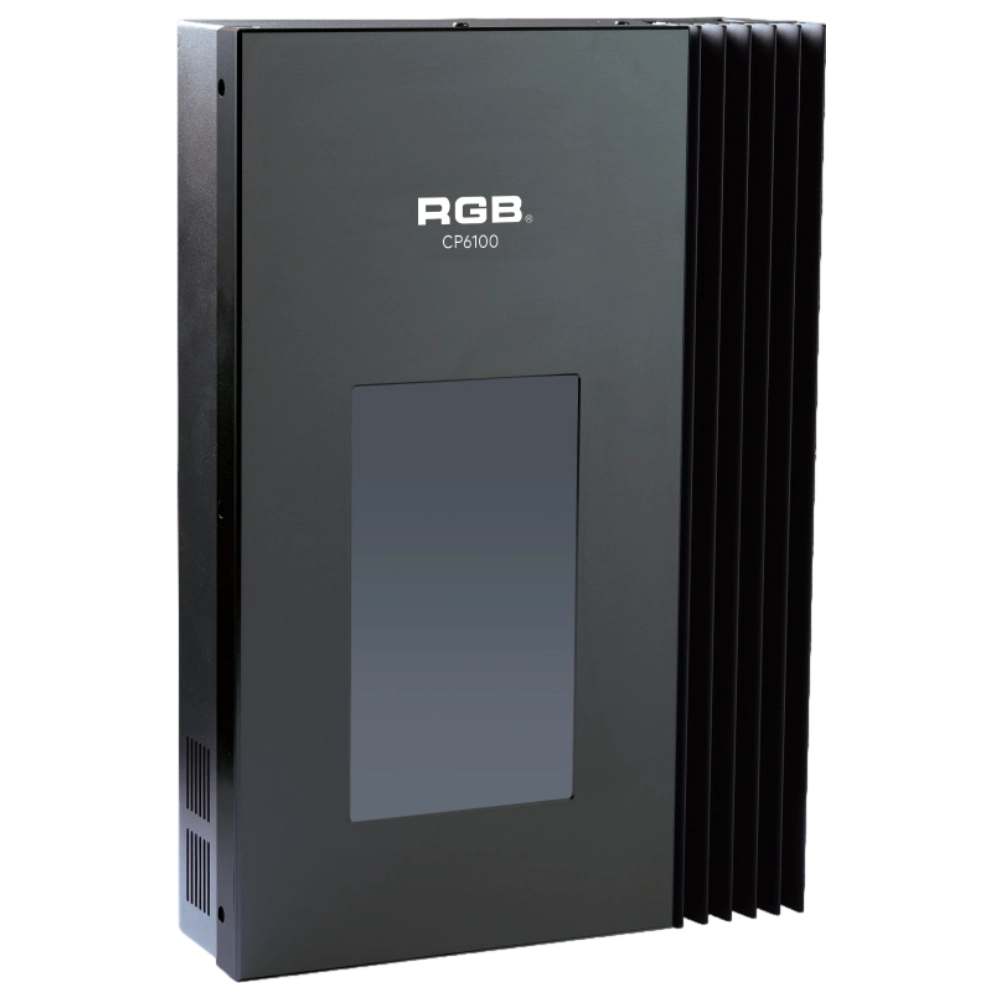
CP6100 Light Control System
The lighting control host is the main control device for theater stage lights, work lights, environmental lighting, commercial art lighting, sports venue lighting, and other places. By connecting the dedicated lighting control panels CP6104 and CP6108, it realizes the central control of the lighting system, supports a visual lighting control system, and intuitively displays the online and offline status of CP6100. Realize remote monitoring, editing, and setting of corresponding parameters.
It is widely applicable to theaters, cinemas, auditoriums, stadiums, museums, exhibition halls, cultural tourism performances, commercial art lighting, and other places.
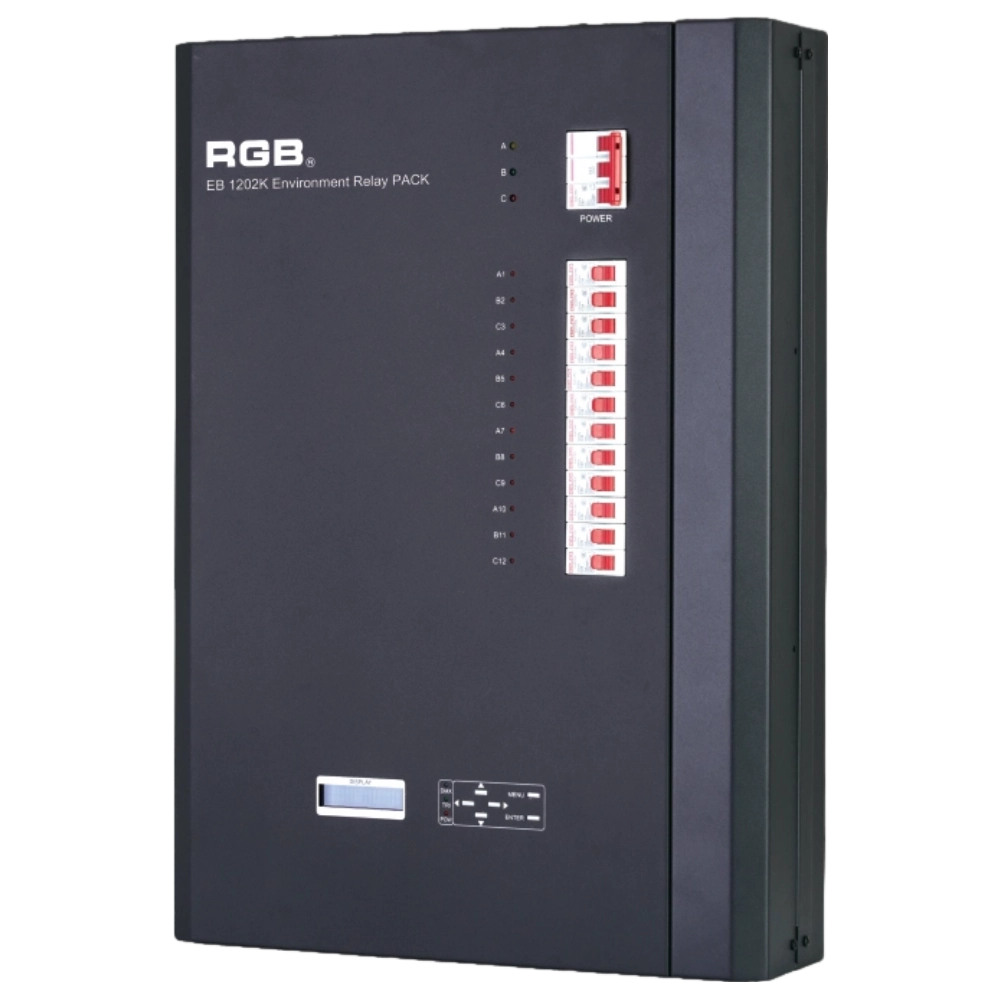
EB1202 Wall-Mounted Smart Site Light Control Series
Wall-mounted smart lighting controller with CE certification, DMX512 compatibility, flexible 12/24-channel output, scene backup, intelligent interface, and multiple dimming curves for precise professional lighting control.
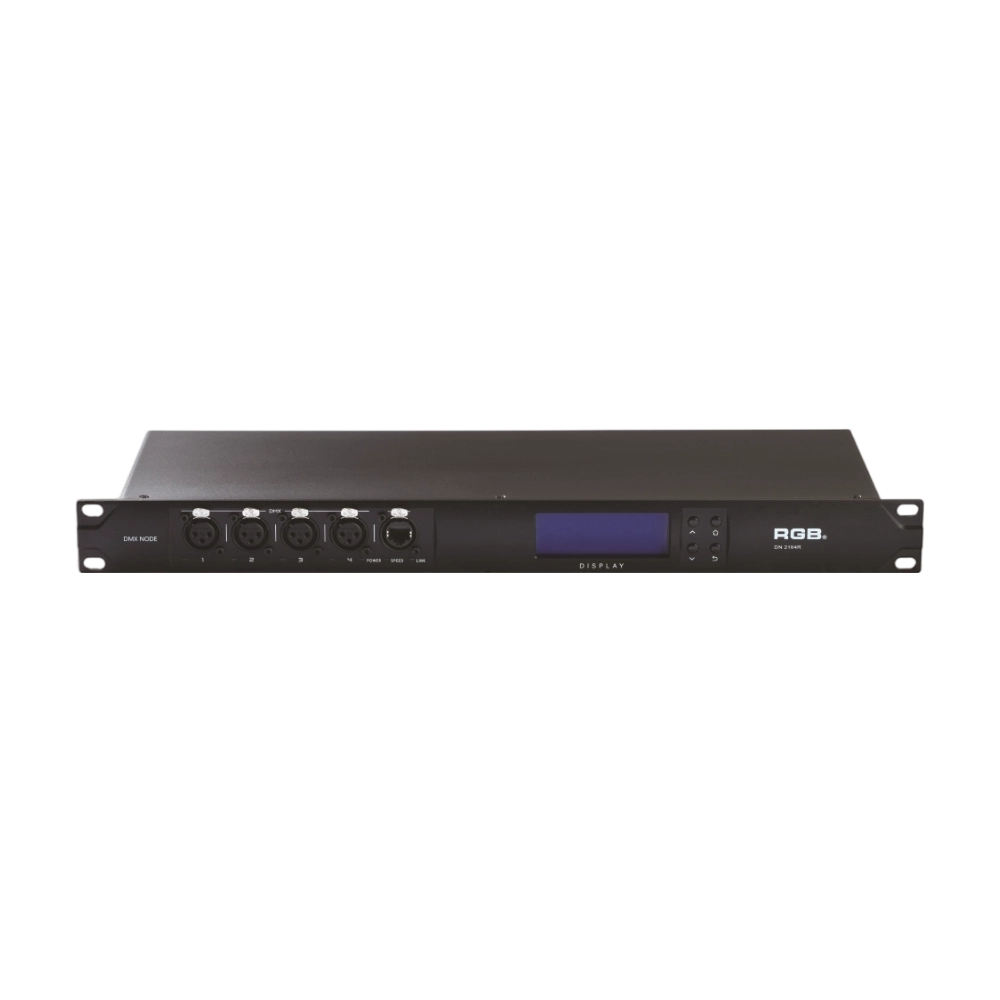
DMX, RDM Nodes
The DN series dual network port network decoder is a lighting control system product independently developed by RGB, featuring completely independent core technology and software copyright. It seamlessly connects and decodes the sACN and ART-Net network protocols based on TCP/IP with the DMX-512 and RDM communication protocols, achieving gigabit communication with dual independent physical address codes. Supports a visual lighting control system, intuitively displaying the online and offline status of the DN series network decoders, and enabling remote monitoring, editing, and setting of corresponding parameters.
It is widely applied in theaters, concert halls, multi-functional halls, cultural and tourism performances, TV stations, gymnasiums, auditoriums, commercial art lighting, and other performance and cultural venues.
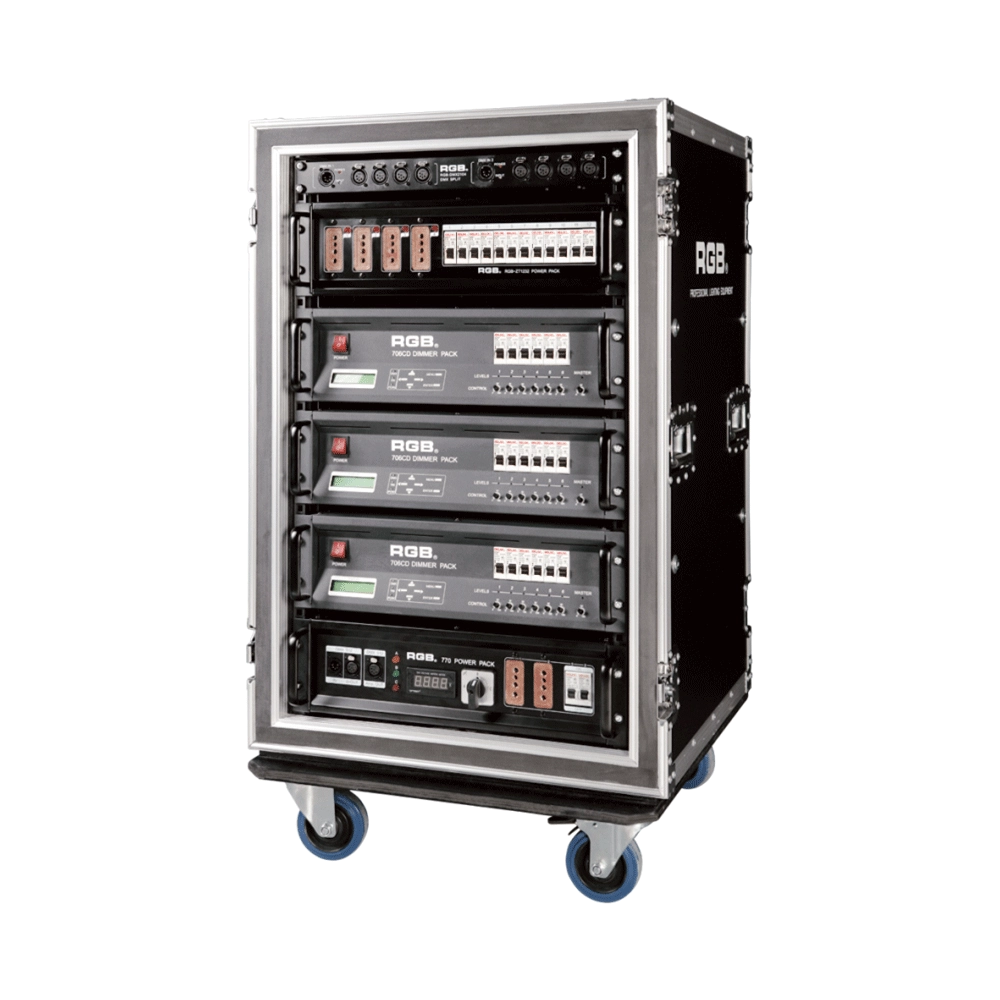
7 Series Digital Touring Dimmer Racks
7 Series digital touring dimmer racks can be assembled into many types of dimmer by taking the 7 Series dimmer as the unit. They are widely used in the entertainment industry for their convenience and practicability.
Expert Support
Interested in learning more or need expert guidance related to this article? Fill in your details, and our team will provide tailored support.
Intelligent Control. Brilliant Performance.
RGB specializes in stage lighting control systems, delivering intelligent, reliable, and high-performance solutions for theaters and performance spaces worldwide.
Contact
Email:
Tel:
+86 20 3928 0245
+86 20 3928 0247
Address:
No.3, Huashan Road, Shilou Town, Panyu, Guangzhou, China.
Whatsapp: +8615975520131