
How to Choose the Right DMX Controller for Your Venue
- Understanding your venue's lighting needs
- Define purpose and show complexity
- Estimate number of fixtures and channel count
- Evaluate operational staff and workflow
- Core features to look for in a DMX controller
- Protocol and network support: DMX512, Art-Net, sACN
- Channel capacity and universes
- User interface and programming workflow
- Integration, scalability, and reliability considerations
- Integration with existing systems and show control
- Network architecture, redundancy, and latency
- Power, rack space, and physical installation
- Comparing controller tiers and costs
- Entry-level vs mid-range vs high-end
- Total cost of ownership and serviceability
- Real-world testing and proof of concept
- Vendor selection, standards, and compliance
- Certifications and manufacturing quality
- Support ecosystem and spare parts
- Warranty, training, and documentation
- Why RGB: a manufacturer perspective and product match
- Company overview and credentials
- Quality, certifications, and landmark deployments
- Product relevance: stage light control system and complementary hardware
- Practical checklist before you buy
- Decision checklist
- Procurement and commissioning tips
- Long-term maintenance and upgrades
- Frequently Asked Questions (FAQ)
- 1. How many DMX channels do I need?
- 2. Should I choose Art-Net or sACN?
- 3. Can I mix DMX512 and networked nodes?
- 4. What maintenance should I plan for dimmer racks and power cabinets?
- 5. How important is operator training?
- 6. Do I need redundancy for a small venue?
- Contact and product inquiry
I often get asked by venue managers and lighting designers the same question: which DMX controller is the right fit for my space? Choosing a lighting console or stage light controller affects every show — from setup time and creative freedom to long-term reliability and maintenance costs. In this guide I walk through the technical, practical, and operational considerations you should evaluate so you can confidently choose a DMX controller that matches your venue's size, technical staff, and show complexity.
Understanding your venue's lighting needs
Define purpose and show complexity
First, I evaluate the typical productions you host. Are they simple community theater shows with static looks, corporate events with programmed cues, or broadcast-grade performances that require pixel mapping and timecode synchronization? The complexity drives channel and feature requirements. For reference, the DMX512 protocol provides 512 channels per universe (DMX512 on Wikipedia), so multiply your fixture channel needs to estimate universe count.
Estimate number of fixtures and channel count
List fixtures and their channel consumption (e.g., LED wash light = 12–16 channels, moving head = 16–34 channels, pixel strip = channels per pixel). Add a 15–25% headroom for future expansion. This gives you a clear universe requirement: total channels / 512 = required DMX universes. That determines whether you need a single-universe controller, multi-universe console, or networked lighting node supporting Art-Net/sACN.
Evaluate operational staff and workflow
Consider who will operate the board. A volunteer operator benefits from a simple, tactile console with clear labeling. A professional LD may require visualized control, advanced cue lists, and MIDI/MTC or SMPTE and show-control integration. Training time, backup procedures, and remote support should factor into your choice.
Core features to look for in a DMX controller
Protocol and network support: DMX512, Art-Net, sACN
Modern venues increasingly use Ethernet-based distribution (Art-Net, sACN) to carry multiple universes across CAT6 or fiber. If your install anticipates networked distribution or pixel-mapped effects, choose a controller that supports Art-Net and sACN in addition to native DMX512 outputs. For technical details on networked lighting protocols, consult protocol specifications and industry references such as DMX512.
Channel capacity and universes
Controllers are often categorized by channel/universe capacity. Smaller console models may offer a single DMX universe (<=512 channels), while mid/high-end units provide multiple universes and Art-Net/sACN bridging. I recommend selecting a controller that offers at least one extra universe beyond your current needs to accommodate growth and on-the-fly modifications.
User interface and programming workflow
Evaluate whether the console UI matches your team: faders and encoders for hands-on programming, touchscreen visualizers for floor plans and pixel-mapping, or a hybrid. For venues with frequent scene recalls, look for reliable cue lists, timecode capability (MTC/SMPTE), and snapshot features that simplify programming and reduce operator errors.
Integration, scalability, and reliability considerations
Integration with existing systems and show control
If your venue uses audio playback, automation, rigging, or video playback, ensure the DMX controller can receive/send SMPTE/MTC or OSC, and integrate with your media servers. Compatibility with industry standard protocols reduces custom interfacing work and future-proofs the installation.
Network architecture, redundancy, and latency
Design the network for redundancy if uptime is critical. Use managed switches, separate VLANs for lighting, and consider dual network interfaces or redundant Art-Net/sACN paths in mission-critical venues. For large distributed systems, fiber backbone reduces latency and electrical interference. Latency differences between DMX512 (direct) and networked protocols are usually negligible if the network is configured correctly, but you should test end-to-end timing, especially when synchronizing to timecode.
Power, rack space, and physical installation
Plan rack space for the controller, dimmers, relay racks, power cabinets, and network nodes. Controllers with integrated power supplies simplify installs but check thermal considerations and ventilation. For distributed dimming systems, coordinate the placement of stage light dimmer racks close to loads to reduce cable runs and voltage drop.
Comparing controller tiers and costs
Entry-level vs mid-range vs high-end
Below I summarize typical characteristics so you can match budget to requirements. Prices vary widely by brand and region; use these ranges only as a planning reference and confirm with vendors.
| Tier | Channels / Universes | Typical Features | Recommended For | Approx. Cost Range (USD) |
|---|---|---|---|---|
| Entry-level | <=512 (1 universe) | Basic faders, cues, USB backups, single DMX out | Small theaters, houses of worship, schools | 200–1,500 |
| Mid-range | 1–8 universes / Art-Net support | Touchscreen, visualizer, enhanced cue lists, MIDI/MTC | Regional theaters, broadcast studios, mid-size venues | 1,500–8,000 |
| High-end | 8+ universes / network-native | Advanced mapping, multi-user, show control, redundancy | Large arenas, national touring rigs, broadcast events | 8,000–50,000+ |
Total cost of ownership and serviceability
Purchase price is only the start. Factor in warranty, support contracts, spare parts, and training. For mission-critical venues I recommend extended support and local service options to minimize downtime. Check certifications and manufacturer quality systems — these are predictors of long-term stability (ISO 9001).
Real-world testing and proof of concept
I always advise a site test or rental trial before committing to a major purchase. This helps test integration, latency, desk ergonomics, and the operator's comfort with programming workflows. If possible, run a full show simulation including dimmer loads, pixel mapping, and timecode to expose issues early.
Vendor selection, standards, and compliance
Certifications and manufacturing quality
Choose vendors who publish compliance to international standards (CE, RoHS, EMC) and have documented quality management systems. Certifications like CE and RoHS indicate compliance to safety and hazardous materials standards in target markets (CE marking, RoHS).
Support ecosystem and spare parts
Availability of local technicians, firmware updates, and spare parts reduces risk. Ask prospective vendors about mean time between failures (MTBF) data for critical components and their typical response time for on-site service.
Warranty, training, and documentation
Evaluate warranty length (1–5 years), scope (parts, labor), and whether the vendor provides user training and comprehensive documentation. Good documentation accelerates onboarding of operators and reduces configuration errors.
Why RGB: a manufacturer perspective and product match
Company overview and credentials
Founded in 1996 and headquartered in Guangzhou, RGB is a leading Chinese manufacturer of professional stage lighting control systems, specializing in intelligent, reliable, and high-performance solutions for theaters, studios, and large-scale performance venues worldwide. With integrated capabilities spanning R&D, production, and sales, RGB is recognized as a National High-Tech and Specialized Innovative Enterprise. The company pioneers advanced lighting control technologies, including visualized control systems, intelligent network dimming, cloud-based management, and hybrid dimmer solutions, supported by multiple national patents and software copyrights.
Quality, certifications, and landmark deployments
Certified to international standards such as ISO9001, CE, RoHS, EMC, and CQC, RGB maintains strict quality control across every production stage to ensure long-term stability and precision performance. Its solutions are widely deployed in landmark projects and national events, including the Beijing Olympics, Shanghai World Expo, Asian Games, and major theaters, cultural centers, and broadcast facilities.
Product relevance: stage light control system and complementary hardware
RGB's product range covers stage light control system, stage light controller, stage lighting dimmer, relay rack, and power cabinet. For venues seeking integrated visualized control and networked dimming, RGB offers controllers and hybrid dimmer platforms that simplify installation and scale across multi-universe networks. Their emphasis on in-house R&D and patented technologies differentiates them on stability, interoperability, and serviceability in large projects.
Practical checklist before you buy
Decision checklist
- Confirm the total channel count and add 15–25% growth margin.
- Decide on DMX512 vs Ethernet-based distribution (Art-Net/sACN).
- Match UI and programming workflow to operator skill level.
- Verify interoperability with existing automation and media servers.
- Request MTBF, warranty, and local support options.
- Run a site test or rental trial before procurement.
Procurement and commissioning tips
When sourcing, request a BOM with cable types, rack layouts, and power calculations. Specify spare parts (power supply, network interface, fader modules) in the procurement package. During commissioning, validate DMX timing, verify Art-Net/sACN routing, and confirm backup/restore procedures for show files.
Long-term maintenance and upgrades
Plan firmware update windows and maintain device inventories. For venues that host touring shows, standardize on a console family or provide adaptor nodes to ensure visiting LDs can work with minimal setup time.
Frequently Asked Questions (FAQ)
1. How many DMX channels do I need?
Calculate by listing each fixture and its channel usage, sum them, and add 15–25% headroom. Divide total channels by 512 to estimate DMX universes (see DMX512).
2. Should I choose Art-Net or sACN?
Both are Ethernet-based. Art-Net is widely supported and easy to set up; sACN (E1.31) is an ANSI standard and often favored for larger, managed networks. Choose based on your controller and node compatibility and your networking team's preference.
3. Can I mix DMX512 and networked nodes?
Yes. Many controllers offer DMX outputs and Ethernet ports for Art-Net/sACN. Hybrid installations use networked nodes near fixtures and DMX runs for localized devices.
4. What maintenance should I plan for dimmer racks and power cabinets?
Schedule periodic inspections of fan filters, contacts, and relay operation. Verify thermal performance and torque of terminal connections. Maintain records of load cycles and failures to predict replacements.
5. How important is operator training?
Crucial. A powerful desk used incorrectly causes delays and mistakes. Invest in vendor training and create operator guides based on your venue's typical show workflows.
6. Do I need redundancy for a small venue?
For small venues redundancy may not be cost-effective, but maintain good backups of show files and at least one spare network node or interface. For broadcast or large-scale events, implement redundant network paths and power supplies.
Contact and product inquiry
If you want tailored recommendations for your venue, contact our team to evaluate your fixture list, network architecture, and budget. We can provide a site survey, BOM, and demo units so you can perform a real-world proof of concept. To view product lines or request a quote, reach out to our sales engineers — we’ll help match the right stage light controller, stage lighting dimmer, relay rack, and power cabinet to your needs.
Additional references:
- DMX512 protocol (Wikipedia)
- ISO 9001 Quality Management (ISO)
- CE marking (European Commission)
- RoHS Directive (European Commission)
Choosing the right DMX controller is a strategic decision that affects creative potential, operational efficiency, and lifecycle costs. By aligning capacity, protocol support, operator workflow, and supportability with your venue’s needs — and validating choices through testing — you minimize risk and maximize performance. If you’d like help building the specification or evaluating options, contact us for a site assessment and product demo.
Stage Dimmer Packs Compatible with LED and Moving Lights
DMX/RDM Explained: Dimmer Rack Definition for Control
Top 10 RDM Nodes Manufacturers and Supplier Brands
Custom vs Off-the-Shelf Stage Dimmer Solutions for Buyers
Distributors
What are the after-sales support methods?
Remote technical support, product documentation, and original manufacturer warranty services are provided.
Can distributors request customized products?
RGB primarily offers standardized products. Customization requests are rare and evaluated on a project-by-project basis.
What is the minimum order quantity for cooperation?
Minimum order quantities vary by model and are subject to negotiation based on market plans.
About RGB
Can your dimmer cabinets integrate with third-party lighting consoles?
Yes. Our systems follow international protocols and can seamlessly integrate with major global brands through DMX, RDM, Art-Net, and sACN.
Do you offer customized solutions for specific projects?
Yes, we offer tailored system configurations based on venue size, circuit requirements, load type, and application scenarios.
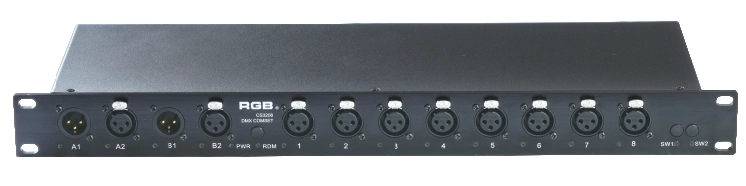
DMX&RDM Signal Mergers Amplifiers
The rack-mounted DMX signal amplifier complies with the DMX-512 standard protocol, improving the transmission quality of DMX-512 signals, ensuring the reliability of system control, and preventing faults such as reverse connection of AC high voltage in the lighting control system, high voltage intrusion due to lightning strikes, and line short circuits, which may affect the stability of the system.
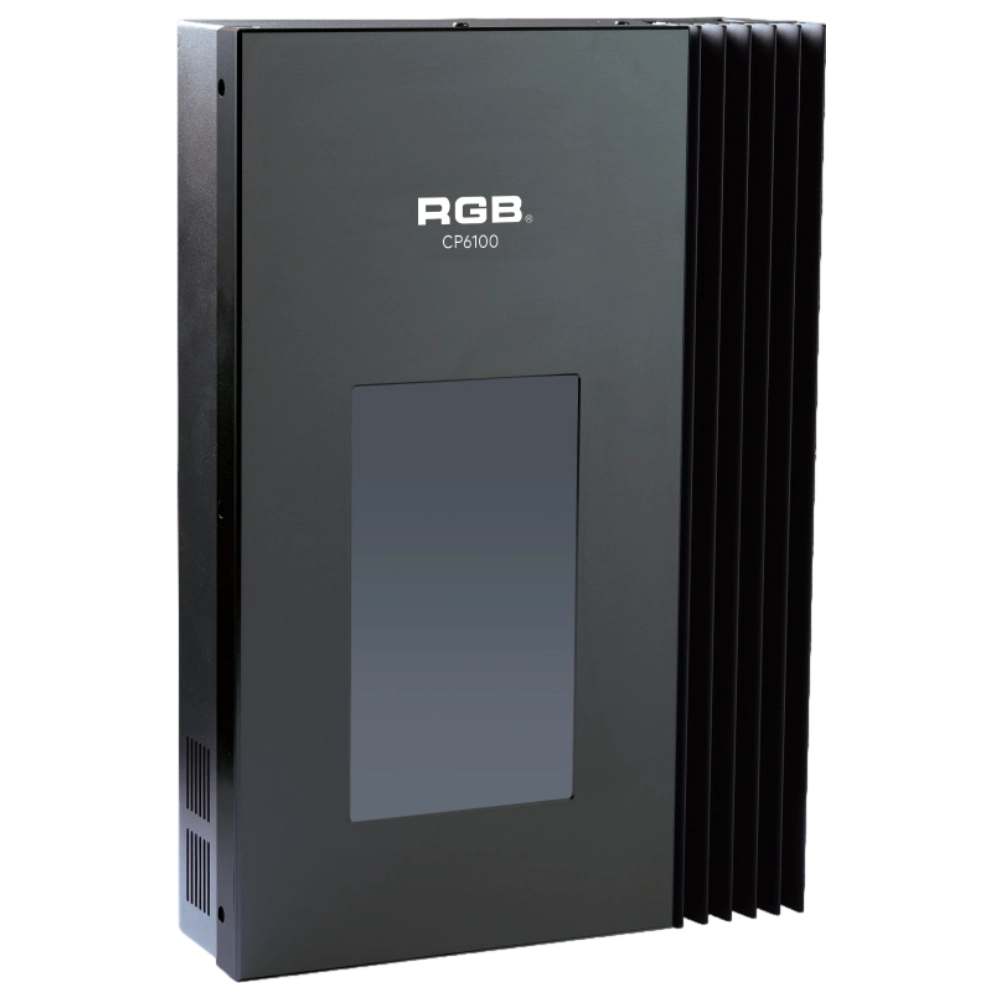
CP6100 Light Control System
The lighting control host is the main control device for theater stage lights, work lights, environmental lighting, commercial art lighting, sports venue lighting, and other places. By connecting the dedicated lighting control panels CP6104 and CP6108, it realizes the central control of the lighting system, supports a visual lighting control system, and intuitively displays the online and offline status of CP6100. Realize remote monitoring, editing, and setting of corresponding parameters.
It is widely applicable to theaters, cinemas, auditoriums, stadiums, museums, exhibition halls, cultural tourism performances, commercial art lighting, and other places.
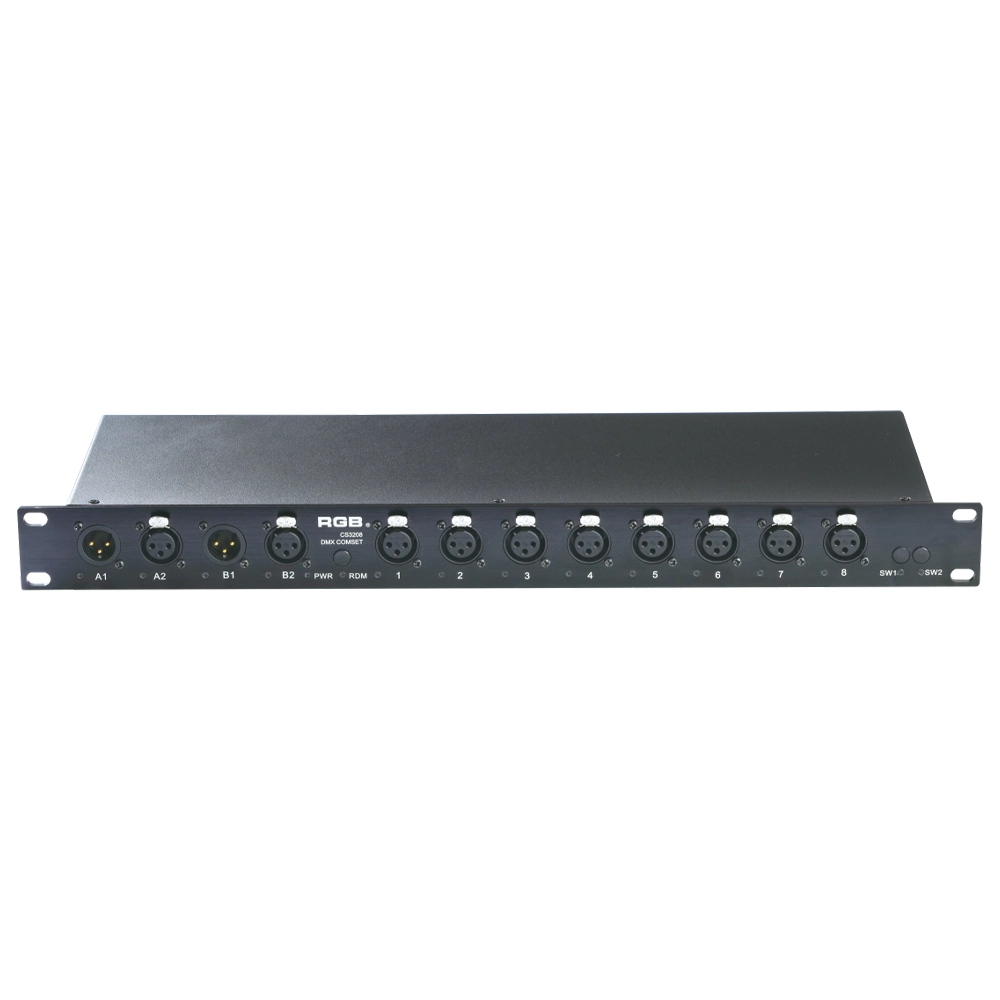
Multifunctional signal supercharger
The rack-mounted DMX signal amplifier complies with the DMX-512 standard protocol, improving DMX-512 signal transmission quality and ensuring reliable system control. It helps prevent issues such as AC high-voltage backflow into lighting control systems, lightning-induced surges, and signal interference caused by short circuits, thereby enhancing overall system stability.
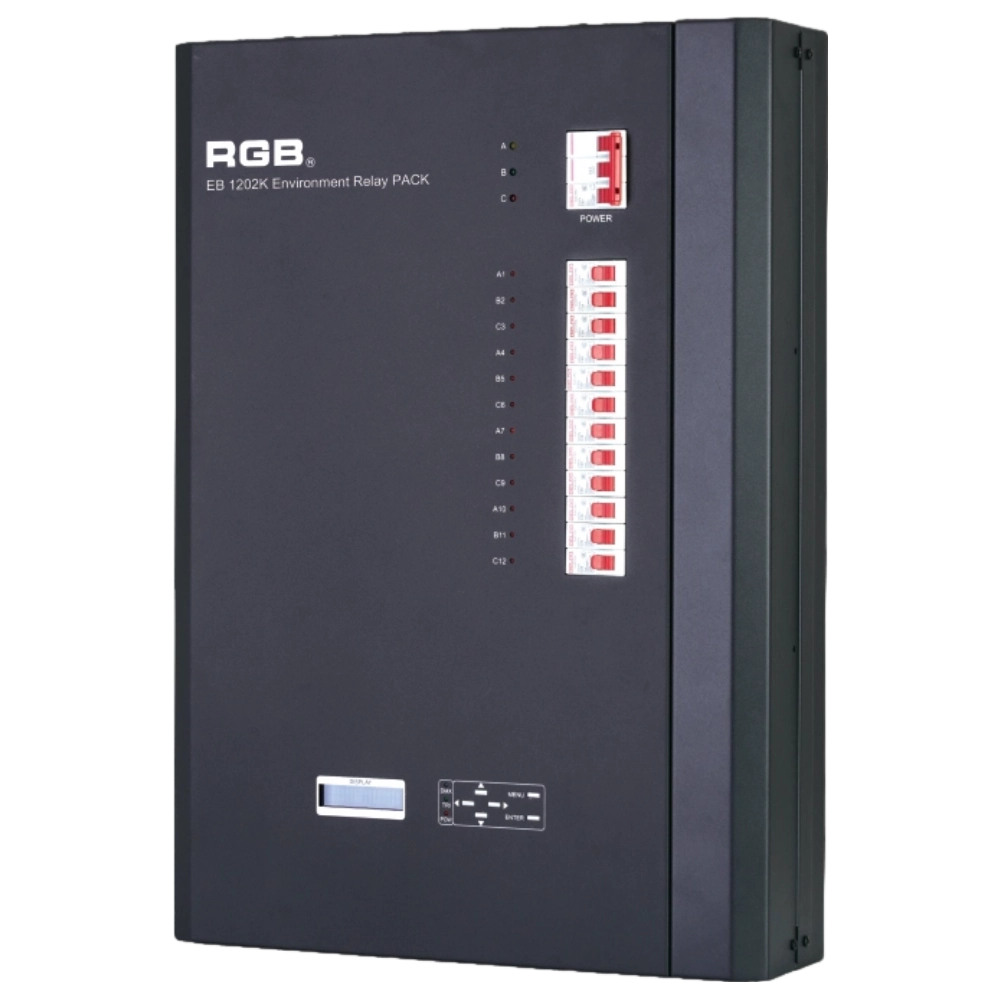
EB1202 Wall-Mounted Smart Site Light Control Series
Wall-mounted smart lighting controller with CE certification, DMX512 compatibility, flexible 12/24-channel output, scene backup, intelligent interface, and multiple dimming curves for precise professional lighting control.
Expert Support
Interested in learning more or need expert guidance related to this article? Fill in your details, and our team will provide tailored support.
Intelligent Control. Brilliant Performance.
RGB specializes in stage lighting control systems, delivering intelligent, reliable, and high-performance solutions for theaters and performance spaces worldwide.
Contact
Email:
Tel:
+86 20 3928 0245
+86 20 3928 0247
Address:
No.3, Huashan Road, Shilou Town, Panyu, Guangzhou, China.
Whatsapp: +8615975520131