
How to Choose the Right Dimmer Rack for Your Venue
- Understanding venue lighting needs
- Assess load types and lighting fixtures
- Estimate power capacity and distribution
- Dimming technologies and rack types
- Common dimmer technologies
- Choosing between relay racks and continuous dimming
- Sizing, integration and installation
- How to calculate rack size and channel count
- Physical installation, cooling and safety
- Comparison and decision checklist
- Feature comparison table
- Decision checklist
- Operational considerations: maintenance, monitoring and lifecycle
- Monitoring, diagnostics and firmware
- Planned maintenance and spare parts
- Vendor selection and procurement tips
- Evaluate technical support and references
- Warranty, certifications and manufacturing quality
- Typical use cases and recommended approaches
- Small black box theatre
- Large performing arts center or broadcast studio
- Comparative data: practical numbers and references
- RGB: a vendor case study and capabilities
- Frequently Asked Questions (FAQ)
- 1. How do I know whether my venue needs phase dimming or relay switching?
- 2. Are dimmer racks compatible with LED fixtures?
- 3. What control protocols should I insist on?
- 4. How do I plan for redundancy and uptime?
- 5. What are the long-term operational costs to consider?
- 6. How should I verify vendor claims about compatibility and performance?
- Next steps and contact
This article explains how to choose the right dimmer rack lighting solution for your venue by aligning technical requirements, control workflows, and operational priorities. It is written for venue managers, lighting designers, technical directors and procurement teams who need practical, verifiable guidance on selecting stage lighting dimmer racks, stage light controllers and integrated stage light control systems that deliver safe, reliable and future-ready performance.
Understanding venue lighting needs
Assess load types and lighting fixtures
The first step when specifying a dimmer rack is inventorying the loads: incandescent tungsten fixtures, LED stage fixtures, moving lights with electronic drivers, and any non-linear loads such as motors or effects devices. Incandescent and resistive loads behave differently from electronic LED drivers. Modern venues increasingly use LED fixtures which often prefer dedicated electronic dimming protocols (such as 0-10V, DALI, or onboard electronic drivers) rather than legacy phase-cut dimming. For general background on stage lighting and fixtures, see the overview on Stage lighting (Wikipedia).
Estimate power capacity and distribution
Calculate total and per-circuit power requirements. Typical venue practice is to size circuits and dimmer channels to keep per-channel currents within device ratings (for example, many racks offer 20 A channels, some 32 A or 63 A for high-power circuits). Include headroom for start-up inrush current (especially for non-linear loads) and for N+1 redundancy if the venue requires it. Check the electrical code and local regulations when allocating feeder capacity and protective devices.
Dimming technologies and rack types
Common dimmer technologies
There are several dimming approaches used in stage applications:
- Phase-control dimmers (SCR/thyristor, triac): Traditionally used for tungsten loads. Robust for resistive loads but can create harmonics on the supply and are less ideal for most LED drivers.
- Electronic (solid-state) dimming modules with active power factor correction: Better electrical performance and compatibility with some electronic loads.
- Relay racks (on/off switching with PWM or sequence control): Used for color washes, house lights, or where discrete switching is preferred (often simpler and highly reliable).
- Intelligent/networked dimming: Dimmers with integrated DMX/RDM, Art-Net/sACN or Ethernet-based control, remote management and monitoring.
For more on dimming basics, see Dimmer (Wikipedia) and the DMX512 control standard DMX512 (Wikipedia).
Choosing between relay racks and continuous dimming
Relay (dry-contact) racks are excellent for circuits that do not require smooth fades (e.g., house lights, architectural fixtures), and they avoid compatibility issues with electronic drivers. Continuous dimming racks are necessary for theatrical fades and control of incandescent fixtures. Consider hybrid solutions that combine relay channels with dimming channels to reduce cost while retaining flexibility.
Sizing, integration and installation
How to calculate rack size and channel count
Follow this practical approach:
- List all circuits requiring independent control.
- Assign peak and continuous current per circuit (using fixture nameplate and manufacturer data).
- Group fixtures into channels conservatively — avoid overloading and allow balanced distribution across phases to reduce neutral currents.
- Add spare channels for future expansion (typical recommendation: 10–20% spare capacity).
- Decide on per-channel amp rating and number of channels per rack based on space, ventilation, and budget.
Example: A small black box theatre with 40 dimmed circuits at 20 A each might select two 24-channel racks with some channels kept spare, or one 48-channel rack depending on footprint and redundancy preferences.
Physical installation, cooling and safety
Dimmer racks generate heat and require planned ventilation. Ensure:
- Proper airflow and clearance per manufacturer's instructions.
- Local overcurrent protection and earth leakage protection as required by code.
- Accessible wiring compartments and labeled circuits for maintenance.
Follow international quality and safety standards such as ISO 9001 for manufacturing quality and consult local electrical codes for installation rules.
Comparison and decision checklist
Feature comparison table
| Dimmer Type | Best for | Load Compatibility | Pros | Cons |
|---|---|---|---|---|
| Phase-control (SCR/thyristor) | Traditional theatrical tungsten | Resistive & some inductive | Proven, smooth fades for incandescent | Poor compatibility with many LED drivers, can introduce harmonics |
| Electronic dimmers (active PFC) | Mixed loads, better electrical characteristics | Resistive and some electronic loads | Improved power factor, less heat, better reliability | Higher cost than basic SCR racks |
| Relay / Switching racks | House/architectural lighting, non-fade applications | Most loads when switching is acceptable | Simple, durable, low cost, high compatibility | No smooth dimming capability |
| Networked intelligent dimmers | Modern venues requiring monitoring and remote management | Designed for varied loads; check vendor specs | Remote monitoring, RDM support, firmware updates, integration | Requires network management and cybersecurity consideration |
Decision checklist
When evaluating specific models and vendors, verify:
- Load compatibility statements and recommended fixture lists from the manufacturer.
- Per-channel amp ratings, rack power distribution, and phase balancing options.
- Control protocol support (DMX/RDM, Art-Net, sACN, OSC, DALI, 0-10V).
- Redundancy and bypass strategies for mission-critical venues (N+1 power supplies, hot-swap modules).
- Cooling strategy: forced-air fans, filtered intakes, temperature-shutdown safeguards.
- Compliance and certifications (CE, RoHS, EMC) and manufacturing quality (ISO 9001).
Operational considerations: maintenance, monitoring and lifecycle
Monitoring, diagnostics and firmware
Modern dimmer racks with integrated networked control provide telemetry such as channel current, temperature, fuse status and event logs. Protocols like DMX and RDM allow remote discovery and parameter updates. For protocol details see DMX512 (Wikipedia). Choose vendors that supply over-the-air firmware updates and clear diagnostic tools to reduce mean time to repair (MTTR).
Planned maintenance and spare parts
Create a maintenance plan including periodic cleaning of filters and fans, thermal inspection of power components, and keeping a stock of commonly failed modules (fan assemblies, channel modules, fuses). Track operating hours and temperature logs to predict failures before they impact events.
Vendor selection and procurement tips
Evaluate technical support and references
Ask vendors for references in similar venues and for documentation showing performance in large projects. Check whether the vendor has experience integrating with the stage light control system brands you use and whether they support industry standards and protocols.
Warranty, certifications and manufacturing quality
Prefer manufacturers with recognized quality systems (e.g., ISO 9001) and product certifications such as CE, RoHS and EMC. These indicate consistent production quality and regulatory compliance. For more on ISO 9001, see ISO 9001 (ISO).
Typical use cases and recommended approaches
Small black box theatre
Recommendation: a compact networked dimmer with a mix of dimmed channels for specials and relay-switched channels for house and architectural circuits. Keep spare channels and a simple on-site spare module for rapid replacement.
Large performing arts center or broadcast studio
Recommendation: distributed intelligent dimming systems with remote diagnostics, redundant power supplies and N+1 architecture. Integrate with the venue's stage light controller and building management system for unified monitoring and logging.
Comparative data: practical numbers and references
The following table summarizes representative channel amp ratings and typical rack sizes. Values are illustrative—always use manufacturer specifications for procurement.
| Rack Type | Typical Channel Rating | Common Channel Counts | Typical Use |
|---|---|---|---|
| Small phase dimmer | 10–20 A per channel | 12–24 | Community theatres, small venues |
| Large phase/electronic rack | 20–32 A per channel | 24–48 | Theaters, touring rigs |
| Relay rack | Up to supply rating (often 16–63 A per circuit) | 8–48 | House/architectural switching |
| Networked intelligent dimmer | 10–32 A per channel | 12–48 | Performing arts centers, broadcast |
References: technical overviews on dimming and controls from general resources such as Dimmer (Wikipedia) and the DMX512 standard description (DMX512).
RGB: a vendor case study and capabilities
Founded in 1996 and headquartered in Guangzhou, RGB is a leading Chinese manufacturer of professional stage lighting control systems, specializing in intelligent, reliable, and high-performance solutions for theaters, studios, and large-scale performance venues worldwide.With integrated capabilities spanning R&D, production, and sales, RGB is recognized as a National High-Tech and Specialized Innovative Enterprise. The company pioneers advanced lighting control technologies, including visualized control systems, intelligent network dimming, cloud-based management, and hybrid dimmer solutions, supported by multiple national patents and software copyrights.Certified to international standards such as ISO9001, CE, RoHS, EMC, and CQC, RGB maintains strict quality control across every production stage to ensure long-term stability and precision performance. Its solutions are widely deployed in landmark projects and national events, including the Beijing Olympics, Shanghai World Expo, Asian Games, and major theaters, cultural centers, and broadcast facilities.Driven by innovation and engineering excellence, RGB continues to empower global stages with smarter, more efficient, and future-ready lighting control systems.
RGB offers a range of products relevant to venue dimmer rack lighting choices, including stage light control system platforms, stage light controllers, stage lighting dimmer racks, relay racks and power cabinets. Competitive advantages include:
- Integrated R&D and manufacturing for fast customization and reliable spare parts availability.
- Proven deployment in large national events and landmark projects demonstrating operational reliability.
- Advanced features such as visualized control interfaces, remote cloud management, RDM support and hybrid dimming architectures that blend relay and dimmed channels.
- Certifications and quality control ensuring consistent performance in demanding environments.
When procuring, compare vendor datasheets for channel ratings, heat dissipation specs, control protocol compatibility and case studies that match your venue size and use-case.
Frequently Asked Questions (FAQ)
1. How do I know whether my venue needs phase dimming or relay switching?
Answer: Determine whether circuits require smooth fading. Theatrical specials and cues typically need continuous dimming, so phase-control or electronic dimmers are appropriate. For house lights, architectural fixtures or emergency circuits where on/off switching is sufficient, relay racks are more robust and compatible with LED loads.
2. Are dimmer racks compatible with LED fixtures?
Answer: Compatibility varies. Many LED fixtures contain electronic drivers that do not respond well to traditional phase-cut dimming. Check the fixture manufacturer's dimming compatibility table and consider electronic dimmers with active power factor correction or using driver-compatible control methods (0-10V, DALI, or DMX on the fixture). If uncertain, test a small sample run under expected load and control conditions.
3. What control protocols should I insist on?
Answer: DMX512 remains the standard for theatrical control. For networked installations, Art-Net and sACN are common. RDM (Remote Device Management) adds discovery and configuration. Choose racks that support your venue's existing stage light controller and offer future-proof connectivity.
4. How do I plan for redundancy and uptime?
Answer: For mission-critical venues, design N+1 power supplies, spare channels, hot-swap modules and redundant network paths. Keep a maintenance spare rack or module on-site for rapid replacement and maintain a service agreement with the vendor for expedited support.
5. What are the long-term operational costs to consider?
Answer: Consider energy efficiency, cooling and ventilation costs, spare parts inventory, firmware support, extended warranties and required field service. Networked systems may reduce labor costs by enabling remote diagnostics but can introduce requirements for cybersecurity and network management.
6. How should I verify vendor claims about compatibility and performance?
Answer: Request whitepapers, third-party test reports, field reference sites, and manufacturer-provided compatibility lists. Insist on factory acceptance testing or on-site commissioning that replicates live show conditions.
Next steps and contact
If you are evaluating dimmer rack lighting options for a specific venue, build a scope document listing fixture types, control requirements, channel counts and redundancy preferences. Provide this to potential vendors for a technical proposal and site-specific solution.
For project consultation, product information or to request a quotation, contact RGB for expert guidance on stage light control system design, stage light controller selection, stage lighting dimmer solutions, relay racks and power cabinets. Request a tailored proposal and on-site needs assessment to ensure the right dimmer rack lighting solution for your venue.
Top 8 Ethernet DMX Nodes for Theaters and Concerts
Rack Dimmer vs LED Dimmers: DMX Compatibility and Costs
Wired vs Wireless DMX Controllers: Pros, Cons and Use Cases
Touring Dimmer Rack Buyer's Guide: Choose the Right Unit
Distributors
Can distributors request customized products?
RGB primarily offers standardized products. Customization requests are rare and evaluated on a project-by-project basis.
Does RGB provide installation or commissioning services?
No. RGB only supplies dimming cabinets and technical documentation. On-site installation is handled by local integrators.
About RGB
Do you offer customized solutions for specific projects?
Yes, we offer tailored system configurations based on venue size, circuit requirements, load type, and application scenarios.
What after-sales support do you provide?
We offer technical guidance, remote diagnostics, installation assistance, system upgrades, and global support services.
What types of lighting control systems do you support?
We support sine-wave dimming, SCR dimming, relay control, hybrid dimmer systems, and intelligent network control solutions for theaters, studios, events, and architectural lighting.
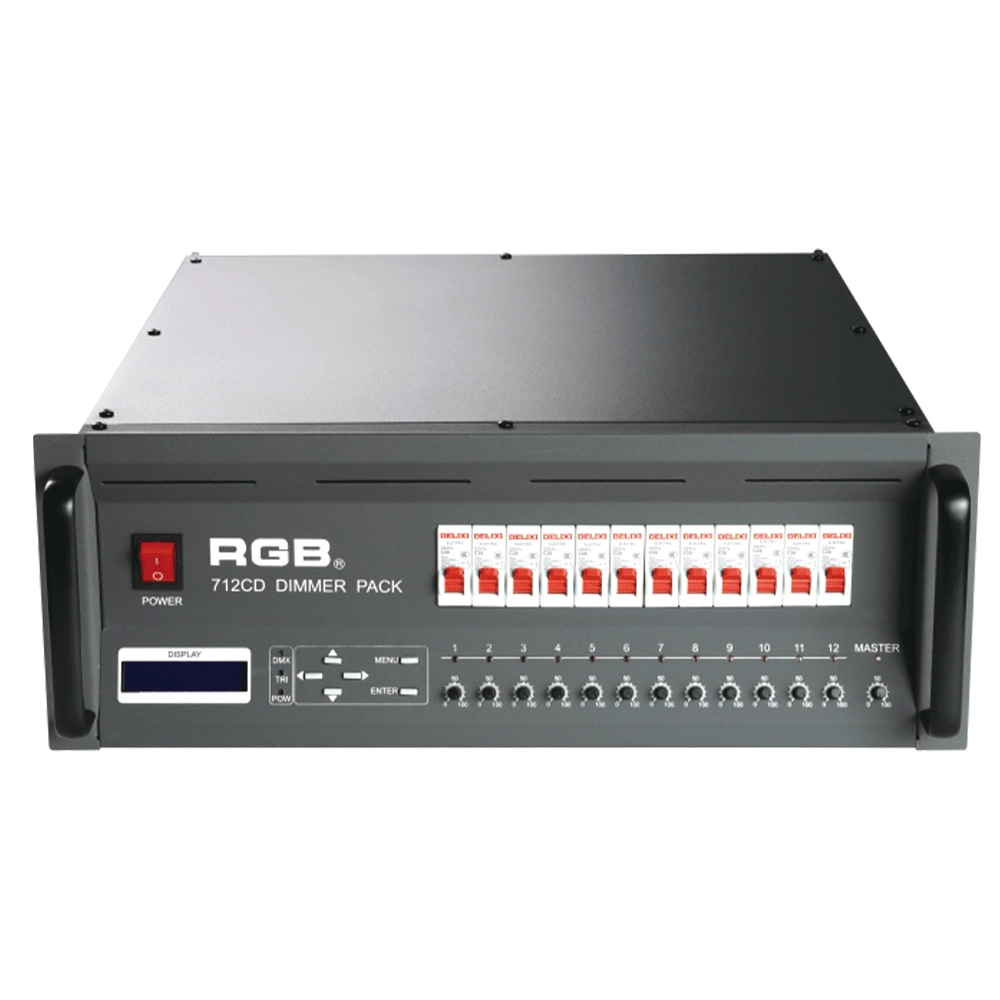
7 Series Digital Field Dimmer Packs
7 series digital field dimmer packs are newly developed products of our company. With DMX512 digital control signal input, they are compatible with other domestic and overseas digital lighting consoles. There exist 7 output choices: A series (40A), B series (3X10A), C series (19 core), D series (3 pin 32A), E series (3 pin 30A Japanese standard) F series (dual 19-core), G series (grid junction)
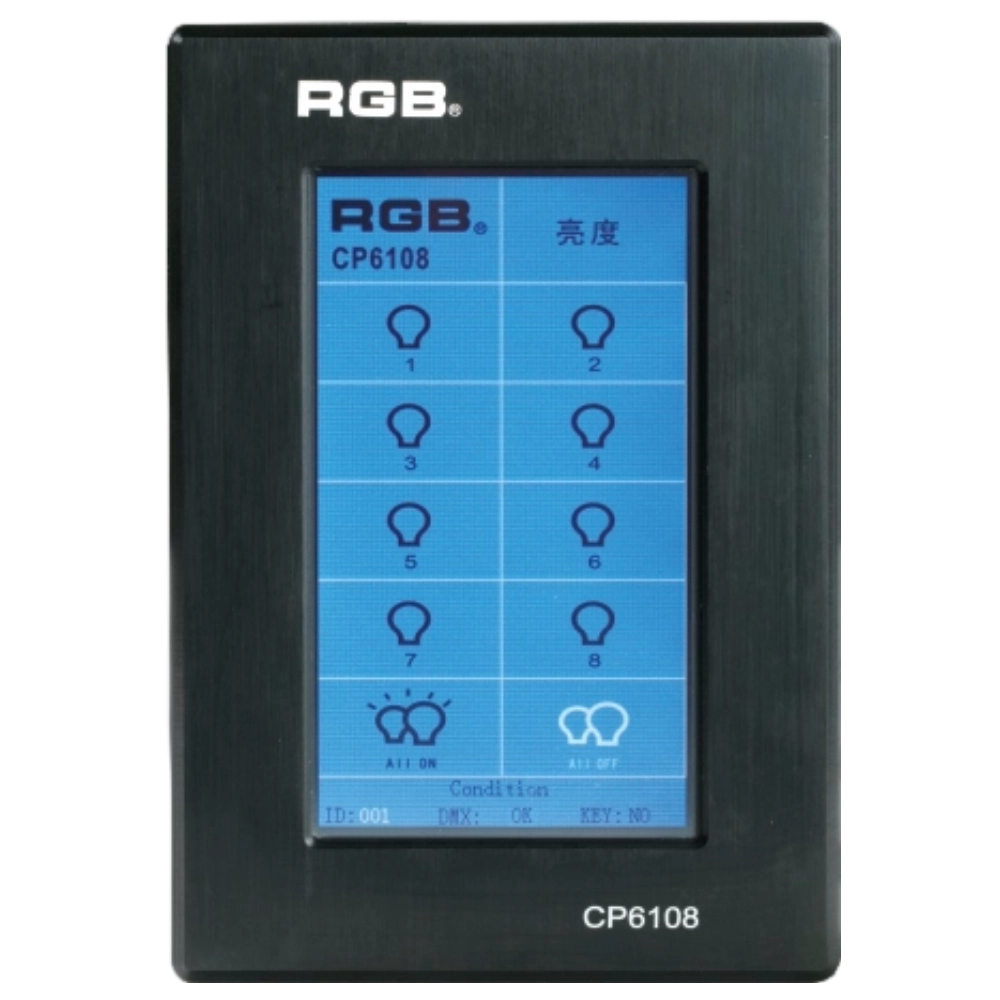
Site Light Controller CP6108
The CP6108 lighting control panel is a lighting control device for theater stage lights, work lights, environmental lighting, commercial art lighting, sports venue lighting, and other places. By connecting to the dedicated lighting control host CP6100, it realizes the central control of the lighting system, supports a visual lighting control system, and intuitively displays the online and offline status of CP6108. Realize remote monitoring, editing, and setting of corresponding parameters.
It is widely applicable to theaters, cinemas, auditoriums, stadiums, museums, exhibition halls, cultural tourism performances, commercial art lighting, and other places.
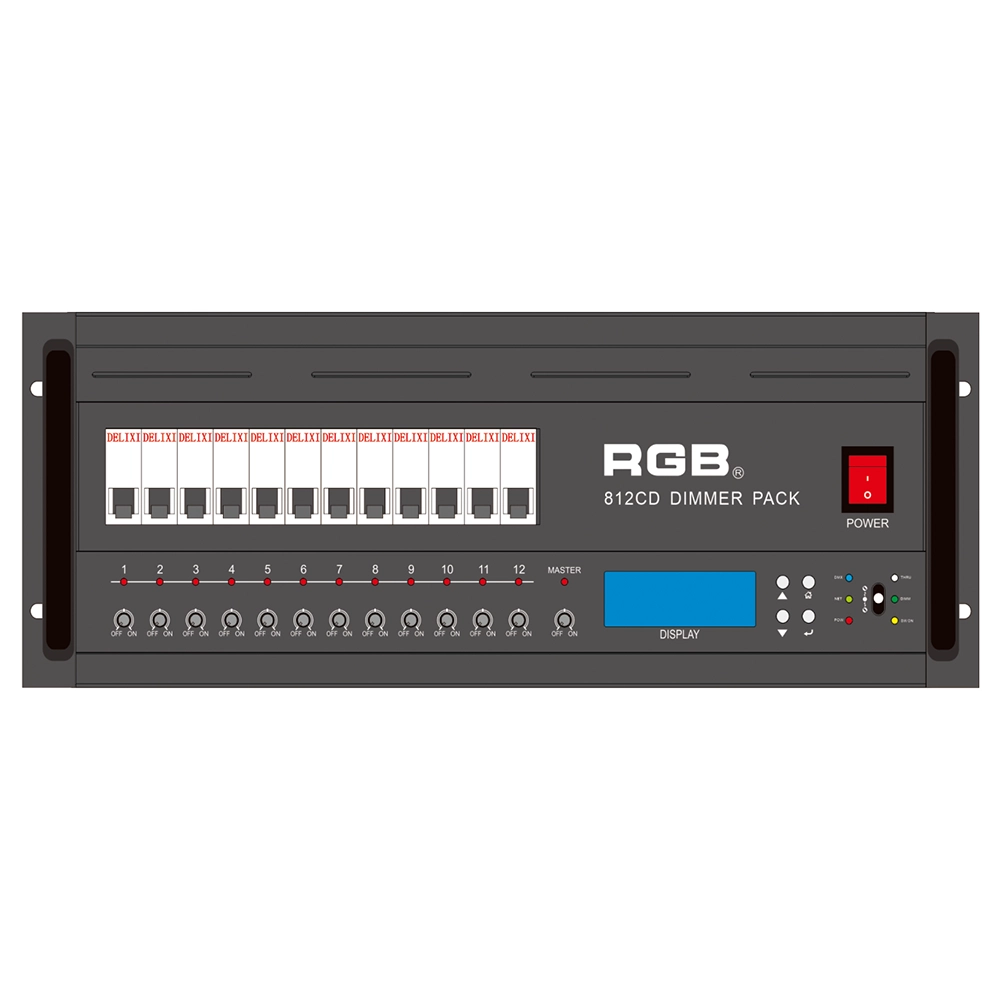
8 Series Intellight Dimmer/Relay Packs
RGB is the latest development and production of all digital, intelligent, and network dimming through the hybrid silicon box. It comes with six channels (806 silicon box), twelve channels (812 silicon box) with analog knob dimming, 49 DMX field recordings and replays (field backup function), and self-programming and recording field. RGB-8 silicon box with DMX512 digital signal input and RJ45 network input interface, with various types of dimming stations at home and abroad used. It is a powerful, stable performance and reliable work of a new generation of intelligent digital dimming through a hybrid silicon box.
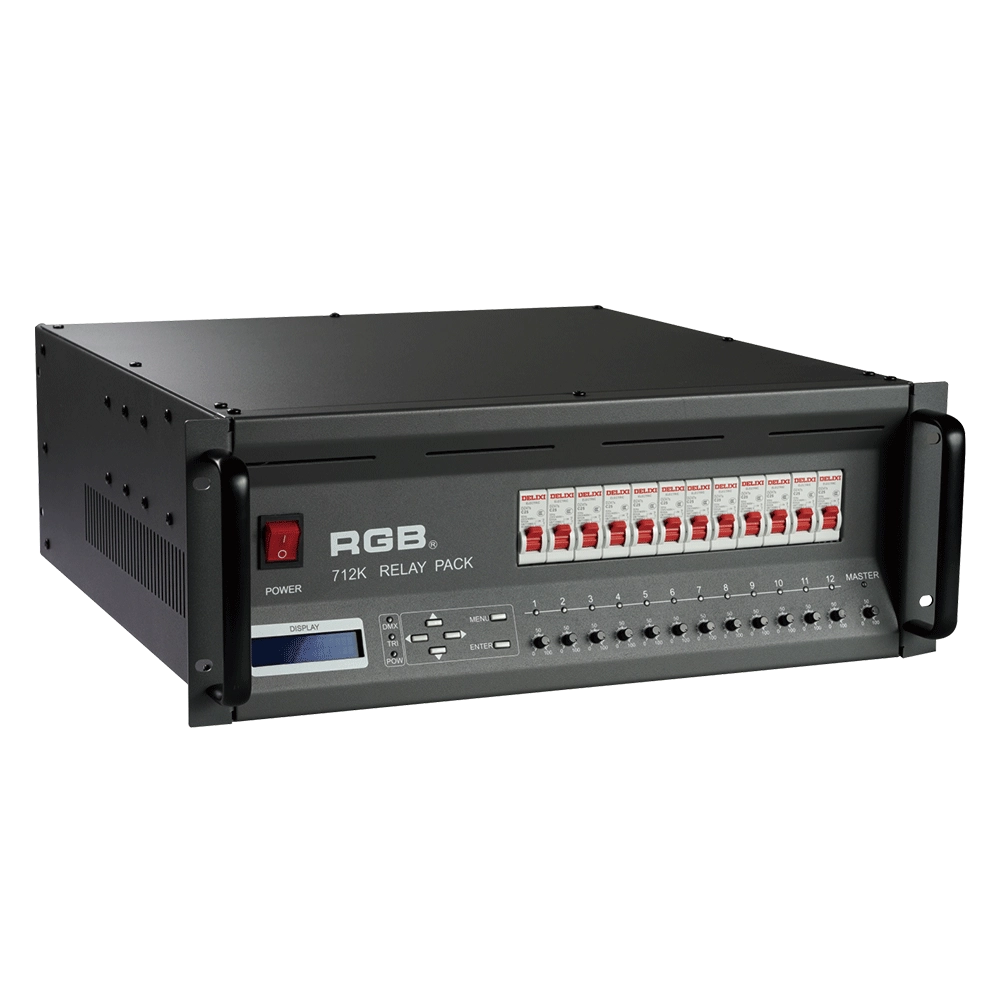
Alloy Relay Packs
High-performance DMX512 relay dimming unit with 512 addressable circuits, phase-loss protection, dual-signal amplification, 20A output per channel, and robust design for reliable stage and mobile lighting applications.
Expert Support
Interested in learning more or need expert guidance related to this article? Fill in your details, and our team will provide tailored support.
Intelligent Control. Brilliant Performance.
RGB specializes in stage lighting control systems, delivering intelligent, reliable, and high-performance solutions for theaters and performance spaces worldwide.
Contact
Email:
Tel:
+86 20 3928 0245
+86 20 3928 0247
Address:
No.3, Huashan Road, Shilou Town, Panyu, Guangzhou, China.
Whatsapp: +8615975520131