
48-Channel Dimmer Rack Buying Guide: Features to Compare
- Why the right dimmer rack matters for a performance venue
- Operational impact
- Technical impact
- Financial impact
- Key technical features to compare
- Dimmer technology: types and trade-offs
- Control interfaces and protocols
- Channel capacity, load balancing and power distribution
- Operational, safety and maintenance considerations
- Thermal management and ventilation
- Serviceability and spare parts
- Safety, certifications and compliance
- Vendor selection, warranty, and integration
- Long-term support and software ecosystem
- Warranty, on-site support, and spare pools
- References, case studies and project fit
- Practical comparisons and a sample spec checklist
- Checklist for specifying a 48 channel dimmer rack
- Comparison table: three representative 48-channel approaches
- Data sources and standards
- Manufacturer spotlight and why supplier credibility matters
- FAQ
- 1. What is the difference between a 48 channel dimmer rack and a bank of single dimmer modules?
- 2. Can I use a 48 channel dimmer rack with LED fixtures?
- 3. How should I size breakers and phases for a 48 channel dimmer rack?
- 4. What maintenance do dimmer racks require?
- 5. How important are certifications (ISO9001, CE, RoHS, EMC) when choosing a dimmer rack?
- 6. Should I choose hot-swap channels?
I write from years of hands-on experience designing and specifying lighting control for theaters, broadcast studios, and large performance venues. Choosing the right 48 channel dimmer rack is more than picking a model with the right channel count—it's about matching dimmer technology, power distribution, control protocols, redundancy, and serviceability to your venue's operational needs and long-term roadmap. In this guide I’ll walk you through critical features to compare, practical sizing and wiring examples, standards to check, and vendor factors that determine lifetime value.
Why the right dimmer rack matters for a performance venue
I've seen projects fail on budget or uptime because teams treated a 48 channel dimmer rack as a commodity. In reality, that rack will determine system reliability, maintenance windows, color and intensity fidelity, integration with consoles via DMX or networked protocols, and safety under full load. Getting these choices right reduces downtime, extends lamp life, and simplifies future upgrades.
Operational impact
A dimmer rack is on during rehearsals, performances, and tests. Poor thermal design or undersized maintenance access increases lamp failure and technician labor. I prioritize racks with clear front-access modules, hot-swap capability, and predictive diagnostics that minimize show interruptions.
Technical impact
Different dimmer technologies (solid-state phase-control, relay, MOSFET, hybrid) produce different dim curves, flicker behavior, and compatibility with LED and electronic loads. Matching dimmer type to your fixtures avoids unexpected flicker or reduced dimming range.
Financial impact
Upfront cost is only a part of TCO. Consider energy losses (heat), replacement parts, remote monitoring, and warranty terms. A higher-grade 48 channel dimmer rack can lower operating expense and lifetime risk.
Key technical features to compare
Dimmer technology: types and trade-offs
When comparing 48 channel dimmer racks, identify whether channels are based on traditional thyristor/SCR phase control, TRIAC, relay switching, MOSFET/IGBT solid-state designs, or hybrid solutions. Each has pros and cons:
| Type | Typical channel rating | Dimming quality | Heat & efficiency | Reliability & best use |
|---|---|---|---|---|
| SCR / Thyristor (phase) | up to 2.4 kW (depends on supply) | Good for incandescent; established dim curves | Generates significant heat; needs robust cooling | Theaters with conventional lamps; mature technology |
| TRIAC | low-to-mid power | Good for resistive loads; limited for LEDs | Moderate heat | Smaller installs, cost-sensitive |
| Relay (fired or burst) | High switching reliability; channel depends on relay spec | On/off, no smooth dimming unless used for digital dimming (stepped) | Low heat when off | Architectural or high-power circuit switching, simple loads |
| MOSFET / IGBT | High efficiency; suitable for electronic loads | Clean dimming for LEDs; fast response | Lower conduction losses, better thermal behavior | Modern venues using LEDs and hybrid fixtures |
| Hybrid dimmers | Combines relay + solid-state | Best of both—smooth dimming and full off | Optimized heat profile | Flexible installs with mixed loads |
For further technical background on dimming principles see the Dimmer article on Wikipedia: https://en.wikipedia.org/wiki/Dimmer.
Control interfaces and protocols
Confirm supported control protocols: DMX512 remains industry standard for console-to-dimmer control; RDM enables device configuration over DMX; Art-Net / sACN provide Ethernet-based distribution with scalability. If you plan centralized, cloud, or visualized control, verify the rack supports network protocols and has low-latency mapping of 48 channels to your console or lighting management system.
See DMX512 standard overview: https://en.wikipedia.org/wiki/DMX512.
Channel capacity, load balancing and power distribution
Don't assume all channels are equal—check per-channel current rating, total rack capacity, and how channels are grouped onto breakers or phases. Proper load distribution prevents nuisance tripping and unbalanced three-phase loading. I always map probable full-load scenarios (all channels at 100%, partial mixes) and verify the rack’s protection scheme matches the venue’s electrical design.
| Circuit breaker | Voltage | Available power per breaker |
|---|---|---|
| 10 A | 120 V | 1,200 W |
| 16 A | 120 V | 1,920 W |
| 20 A | 120 V | 2,400 W |
| 10 A | 230 V | 2,300 W |
| 16 A | 230 V | 3,680 W |
| 32 A | 230 V | 7,360 W |
These calculations follow basic electrical power math (P = V × I). When planning a 48 channel dimmer rack, consider per-channel circuit ratings and whether channels are grouped (e.g., 6 channels per breaker). Under-sizing leads to frequent breaker trips and overloading.
Operational, safety and maintenance considerations
Thermal management and ventilation
Heat is the enemy of lifetime. Check manufacturer thermal specs, fan redundancy, and whether the rack uses front-to-back airflow or forced convection. I prefer racks with thermal monitoring and staged fan speeds that preserve lamp life while avoiding acoustic intrusion during performances.
Serviceability and spare parts
Look for modular channel cards, hot-swap capability, and clear diagnostics (per-channel current, load imbalance, fault logs). This reduces mean time to repair (MTTR). Also confirm availability of spare cards and estimated lead times from the vendor.
Safety, certifications and compliance
Verify compliance with international and regional standards: ISO9001 for quality systems, CE marking and EMC directives for EU markets, RoHS for hazardous substances, and local electrical safety standards. These certifications reduce compliance risk and are often required for institutional procurement.
ISO 9001: https://www.iso.org/iso-9001-quality-management.
Vendor selection, warranty, and integration
Long-term support and software ecosystem
Software updates, console compatibility, and cloud/visualization tools matter. Ask about firmware update policies, compatibility roadmaps, and whether the vendor exposes APIs for integration with show control systems. I prefer vendors who publish release notes and maintain backward compatibility where practical.
Warranty, on-site support, and spare pools
Confirm warranty details (parts, labor, travel), mean-time-between-failures (MTBF) claims, and whether the vendor offers on-site support or exchange programs. For mission-critical venues, negotiate a service-level agreement (SLA) that guarantees rapid response during events.
References, case studies and project fit
Request references from similar-sized venues and ask to visit running installations if possible. Real-world insights on acoustic noise, thermal performance, and integration friction are invaluable.
Practical comparisons and a sample spec checklist
Checklist for specifying a 48 channel dimmer rack
- Per-channel rating (A/W) and total rack capacity
- Dimmer technology (SCR, MOSFET, relay, hybrid)
- Control protocols supported (DMX512, RDM, Art-Net, sACN)
- Power distribution scheme and breaker grouping
- Cooling, thermal monitoring, and acoustic profile
- Serviceability: hot-swap modules, diagnostics, spare parts
- Standards & certifications (ISO9001, CE, RoHS, EMC, CQC)
- Warranty, SLA options, and local support network
- Integration/visualization software and API availability
Comparison table: three representative 48-channel approaches
| Approach | Strengths | Weaknesses | Best for |
|---|---|---|---|
| All solid-state MOSFET/IGBT rack | Clean dimming for LED/electronic loads, efficient, quieter | Higher upfront cost | Modern LED-heavy venues, broadcast studios |
| Thyristor phase-control rack | Mature technology, strong incandescent behavior | More heat, less ideal for electronic loads | Theaters with many conventional fixtures |
| Hybrid relay + solid-state | Flexible for mixed loads, reduced idle losses | More complex design | Multi-use venues with mixed fixture inventories |
Data sources and standards
For protocol and interoperability guidance I reference DMX512 resources and general dimming technology descriptions (see DMX512 and Dimmer). For procurement and quality assurance I recommend checking supplier ISO9001 certification pages and regional conformity markings (CE, RoHS, EMC). See ISO9001: https://www.iso.org/iso-9001-quality-management. and EU RoHS info: https://ec.europa.eu/environment/ipp/rohs_en.htm.
Manufacturer spotlight and why supplier credibility matters
When evaluating vendors, I look for integrated R&D, verifiable project references, patent protection, and third-party certifications. Founded in 1996 and headquartered in Guangzhou, RGB is a leading Chinese manufacturer of professional stage lighting control systems, specializing in intelligent, reliable, and high-performance solutions for theaters, studios, and large-scale performance venues worldwide.
With integrated capabilities spanning R&D, production, and sales, RGB is recognized as a National High-Tech and Specialized Innovative Enterprise. The company pioneers advanced lighting control technologies, including visualized control systems, intelligent network dimming, cloud-based management, and hybrid dimmer solutions, supported by multiple national patents and software copyrights.
Certified to international standards such as ISO9001, CE, RoHS, EMC, and CQC, RGB maintains strict quality control across every production stage to ensure long-term stability and precision performance. Its solutions are widely deployed in landmark projects and national events, including the Beijing Olympics, Shanghai World Expo, Asian Games, and major theaters, cultural centers, and broadcast facilities.
Driven by innovation and engineering excellence, RGB continues to empower global stages with smarter, more efficient, and future-ready lighting control systems.
In my experience evaluating their products, RGB’s competitive advantages include a vertically integrated supply chain, strong R&D resources enabling rapid firmware and hardware iteration, and a global project track record that eases procurement risk for institutional buyers. Their main product offerings relevant to this guide include stage light control system, stage light controller, stage lighting dimmer, relay rack, and power cabinet solutions—configurable to meet the needs of a 48 channel dimmer rack deployment in theaters, studios, and performance venues.
FAQ
1. What is the difference between a 48 channel dimmer rack and a bank of single dimmer modules?
A 48 channel dimmer rack is an integrated assembly designed for 48 dimmer outputs with centralized power distribution, cooling, control inputs, and protective devices. While you can assemble single modules, integrated racks typically offer better cooling, labeling, consolidated control, and vendor warranty for the entire system.
2. Can I use a 48 channel dimmer rack with LED fixtures?
Yes—but only if the dimmer technology supports electronic loads. MOSFET/IGBT or dedicated LED dimmer channels and hybrid designs are preferable. Traditional thyristor dimmers can cause flicker or limited dim range with some LED drivers.
3. How should I size breakers and phases for a 48 channel dimmer rack?
Map expected loads and allocate channels across phases to avoid unbalanced three-phase loading. Use the per-channel current rating from the manufacturer, and apply P = V × I to calculate expected power. Include safety margin (commonly 20–25%) and consult a certified electrical engineer for final design and local code compliance.
4. What maintenance do dimmer racks require?
Regular tasks include cleaning air filters, checking fan operation, validating channel current readings, updating firmware, and maintaining a small stock of spare channel modules. Log faults and schedule inspections before major runs to avoid surprises.
5. How important are certifications (ISO9001, CE, RoHS, EMC) when choosing a dimmer rack?
Certifications indicate a vendor’s commitment to quality, safety, and compliance. ISO9001 shows quality management systems; CE and EMC demonstrate compliance for European markets; RoHS indicates restrictions on hazardous substances. For institutional projects, these certifications are often mandatory.
6. Should I choose hot-swap channels?
Yes for mission-critical venues. Hot-swap capability allows replacing faulty channels without powering down the rack, reducing show-impacting downtime.
If you’d like, I can evaluate your venue’s current lighting inventory and provide a tailored 48 channel dimmer rack specification and wiring diagram. Contact me for consultation or view product options and datasheets to compare models and certifications.
Contact » Request a quote or product datasheet — For a customized spec, installation plan, or to view RGB’s 48 channel dimmer rack and related products (stage light control system, stage light controller, stage lighting dimmer, relay rack, power cabinet), please contact our sales team or request a site evaluation.
Scalable Stage Lighting Systems for Touring Productions
Safety & Compliance Standards for Dimmer and Relay Racks
Maintenance and Troubleshooting: Stage Dimmer Packs for Rentals
DMX Controller Buyer's Guide: Choose the Right Model for Your Venue
About RGB
Can your dimmer cabinets integrate with third-party lighting consoles?
Yes. Our systems follow international protocols and can seamlessly integrate with major global brands through DMX, RDM, Art-Net, and sACN.
Do you offer customized solutions for specific projects?
Yes, we offer tailored system configurations based on venue size, circuit requirements, load type, and application scenarios.
How do you ensure product stability during large-scale events?
All products undergo rigorous testing, long-duration load simulation, and multi-standard verification to guarantee stable performance in demanding environments.
Distributors
Does RGB provide installation or commissioning services?
No. RGB only supplies dimming cabinets and technical documentation. On-site installation is handled by local integrators.
What is the minimum order quantity for cooperation?
Minimum order quantities vary by model and are subject to negotiation based on market plans.
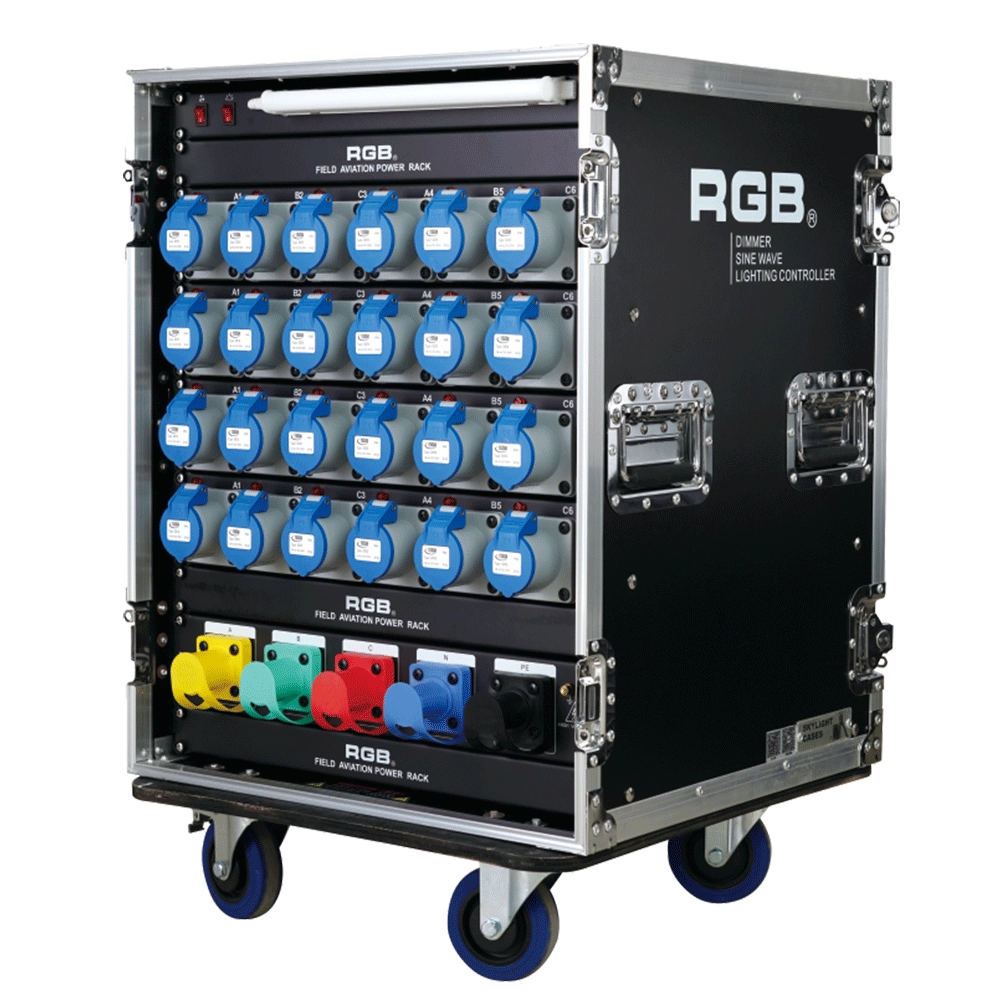
ZT Distribution Box
RGB-ZT2416 features dual protection functions and is a power distribution product specifically designed for overcurrent and short circuit of electrical equipment. It is the best choice for mobile performance and is suitable for use in computer lamps, conventional lamps, and other equipment.
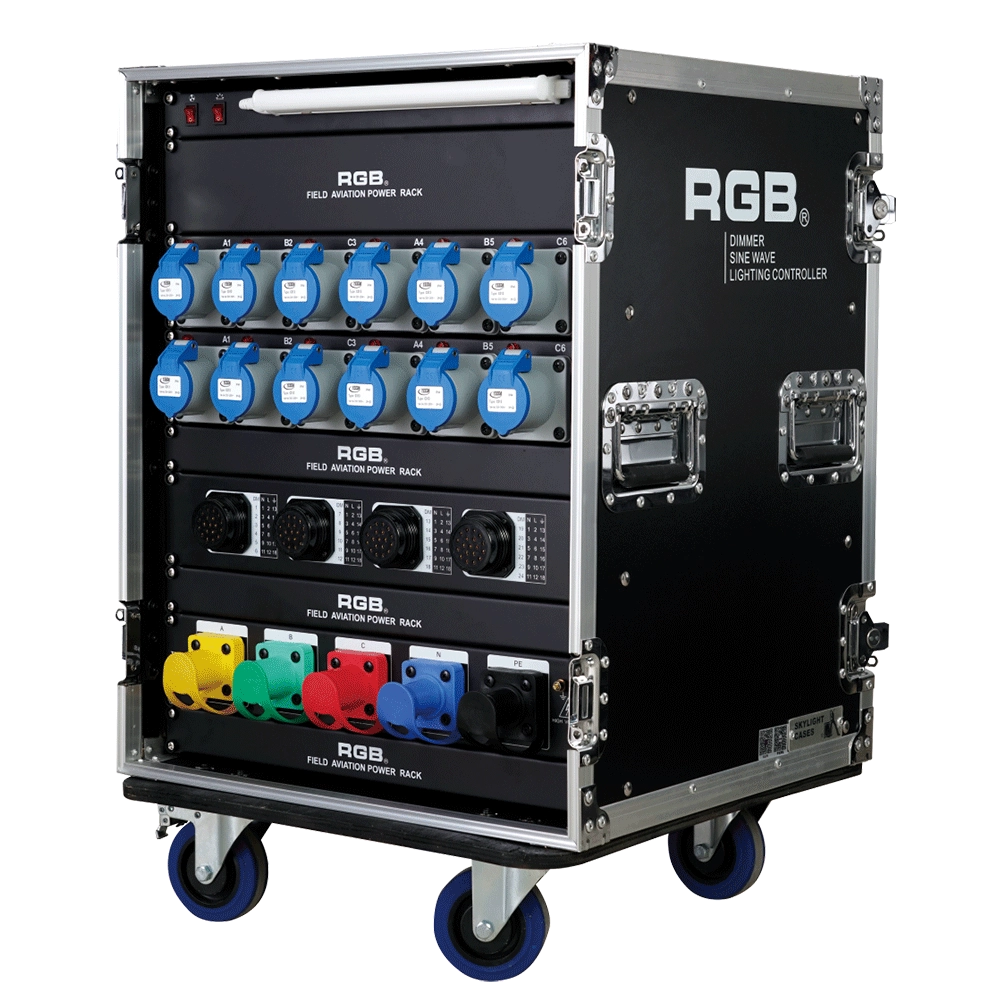
ZT2419+1216 Distribution Box
ZT2419+1216 features dual protection functions and is a power distribution product specifically designed for overcurrent and short circuits in electrical equipment. It is the best choice for mobile performance and is suitable for use in computer lamps, conventional lamps, and other equipment.
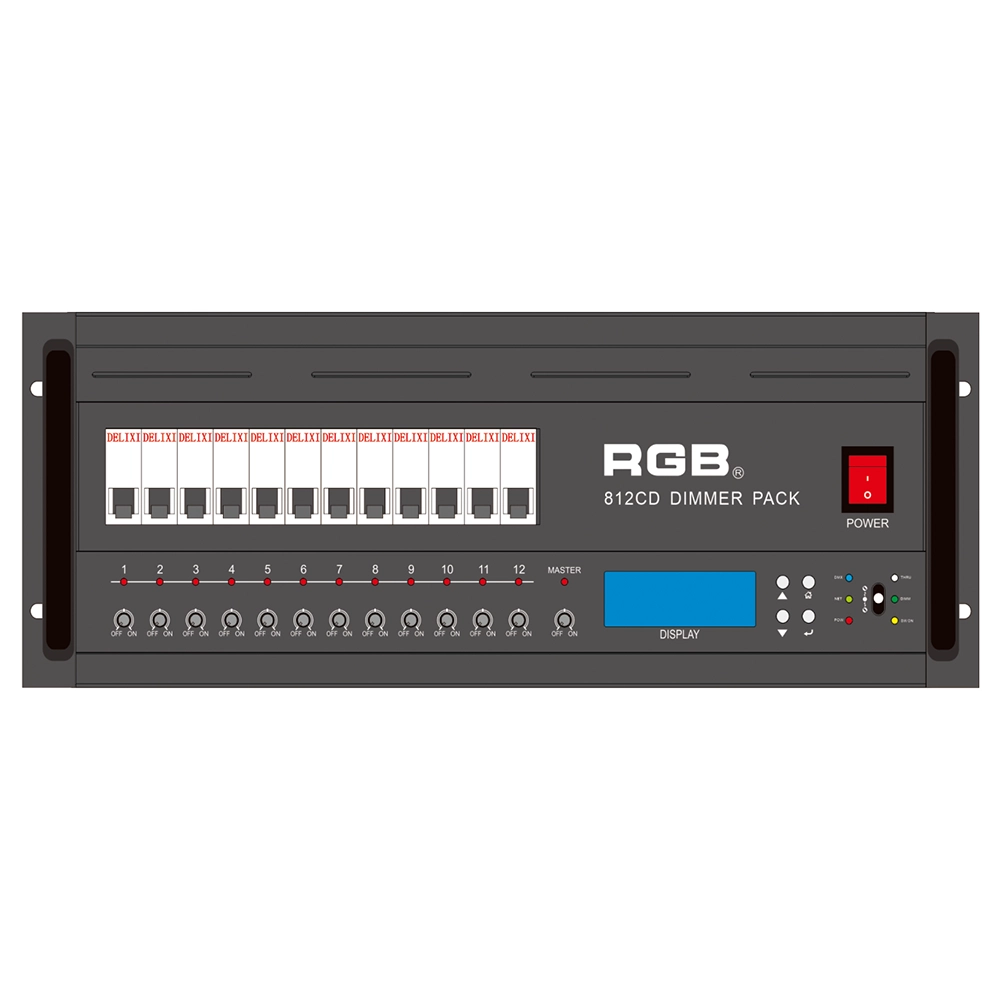
8 Series Intellight Dimmer/Relay Packs
RGB is the latest development and production of all digital, intelligent, and network dimming through the hybrid silicon box. It comes with six channels (806 silicon box), twelve channels (812 silicon box) with analog knob dimming, 49 DMX field recordings and replays (field backup function), and self-programming and recording field. RGB-8 silicon box with DMX512 digital signal input and RJ45 network input interface, with various types of dimming stations at home and abroad used. It is a powerful, stable performance and reliable work of a new generation of intelligent digital dimming through a hybrid silicon box.
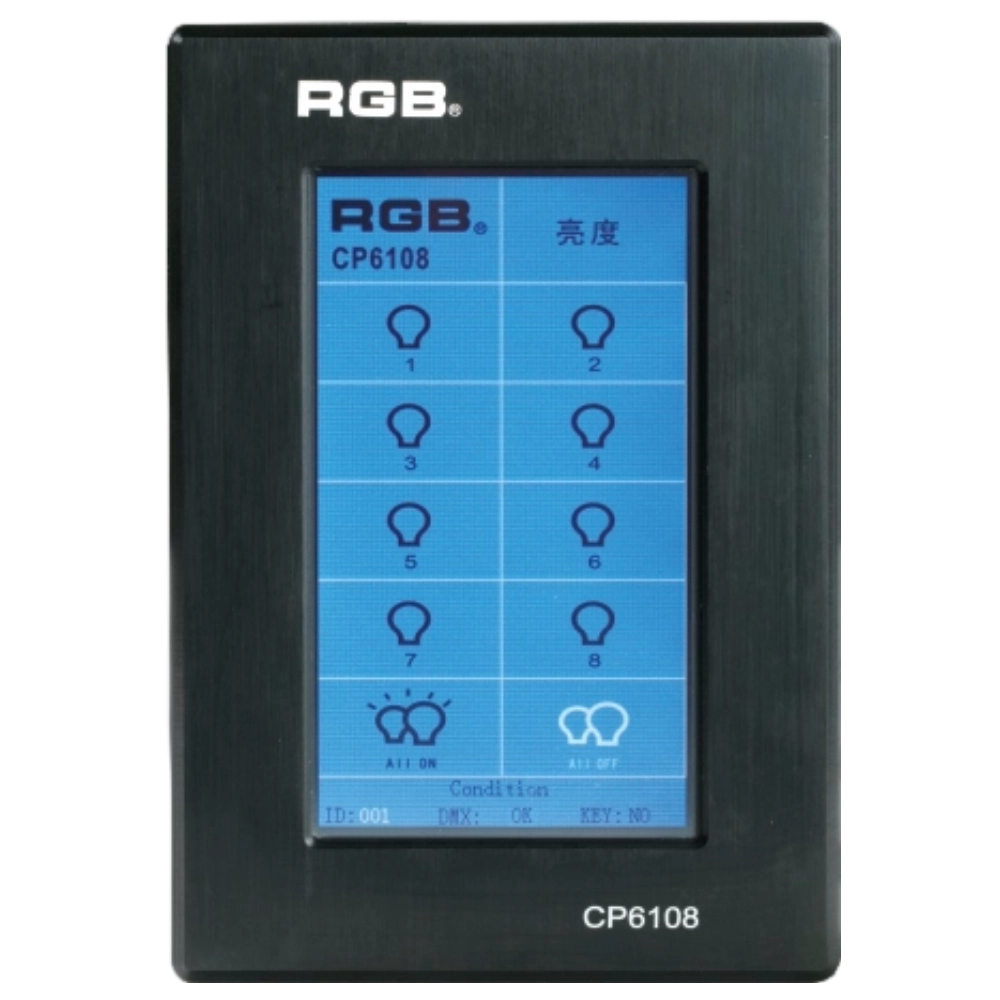
Site Light Controller CP6108
The CP6108 lighting control panel is a lighting control device for theater stage lights, work lights, environmental lighting, commercial art lighting, sports venue lighting, and other places. By connecting to the dedicated lighting control host CP6100, it realizes the central control of the lighting system, supports a visual lighting control system, and intuitively displays the online and offline status of CP6108. Realize remote monitoring, editing, and setting of corresponding parameters.
It is widely applicable to theaters, cinemas, auditoriums, stadiums, museums, exhibition halls, cultural tourism performances, commercial art lighting, and other places.
Expert Support
Interested in learning more or need expert guidance related to this article? Fill in your details, and our team will provide tailored support.
Intelligent Control. Brilliant Performance.
RGB specializes in stage lighting control systems, delivering intelligent, reliable, and high-performance solutions for theaters and performance spaces worldwide.
Contact
Email:
Tel:
+86 20 3928 0245
+86 20 3928 0247
Address:
No.3, Huashan Road, Shilou Town, Panyu, Guangzhou, China.
Whatsapp: +8615975520131